CNW e start conversion, sprag failures

This is what the tech at Cross+Morse said in email to Alan, our NOCNZ VP after he queried getting a different part number sprag which the NZ distribution rep said was an upgraded part, and his questions to them:

Alan: I have just purchased 3 of your Sprag clutches item SFB41-135 Part No 76SFB41-135 from RR Fisher, Auckland , NZ.

I had ordered clutch part No 1310145 and was told that the one I received was a model upgrade.

I am using them in the same way that RGM Norton us your Sprags to start a motorcycle.

Power from the starter motor is transferred to the outside of the sprag via a transfer gear.

This turns the crankshaft until the motor fires and then lifting off the crankshaft when the starter motor stops turning, with the outside of the sprag remaining stationary by way of sprung detents stopping the transfer gear..

Is this sprag correct for this application, I have read your notes on engaging and disengaging sprags and I’m not sure if I have the correct sprag.

Can you confirm?


Cross+Morse: For this application the sprag type is less of an issue. The sprags are designed to rotate with the outer race, and the differing sprag types (engaging/dis-engaging) only come into effect at relatively high speed with differing balance from centrifugal force.

For the application you describe, the sprag will be engaged for short periods at low to moderate speeds and will then be stationary whilst the engine is running.


Alan: I am about to fit the sprag to my electric start and have noticed that it has no lubrication. The primary case where it is located is a dry area and is driven by a belt not a chain. The sprag and transfer gear only rotate when I am starting the motorcycle.

Do I need to lubricate the sprag on assembly ? if so what type of lube and how much do you recommend?

Cross+Morse: In [this] case the sprag will require lubrication as the crankshaft will be rotating continuously.

Ideally the sprag will be lubricated by oil (Type A automatic transmission fluid), if not you can use grease, we recommend Kluber Polylub WH2. For either option it is imperative to ensure the lubricant is not an E.P. (extreme pressure) type, or contain any additives such as molybdenum disulphide, graphite and P.T.F.E.
 
See my answer in post #88
Both systems use the same size sprag
I have one of the ringspann sprags, lent to me as an example (came in a Cross and Morse box) and my impression is that it is too delicate for use in the Mk3 system, given that the engine vibrates i wouldn't install this type of sprag in a Mk3.


This is the one Alan installed, and it has been running the last 2.5 yrs.
 
This is what the tech at Cross+Morse said in email to Alan, our NOCNZ VP after he queried getting a different part number sprag which the NZ distribution rep said was an upgraded part, and his questions to them:

Alan: I have just purchased 3 of your Sprag clutches item SFB41-135 Part No 76SFB41-135 from RR Fisher, Auckland , NZ.

I had ordered clutch part No 1310145 and was told that the one I received was a model upgrade.

I am using them in the same way that RGM Norton us your Sprags to start a motorcycle.

Power from the starter motor is transferred to the outside of the sprag via a transfer gear.

This turns the crankshaft until the motor fires and then lifting off the crankshaft when the starter motor stops turning, with the outside of the sprag remaining stationary by way of sprung detents stopping the transfer gear..

Is this sprag correct for this application, I have read your notes on engaging and disengaging sprags and I’m not sure if I have the correct sprag.

Can you confirm?


Cross+Morse: For this application the sprag type is less of an issue. The sprags are designed to rotate with the outer race, and the differing sprag types (engaging/dis-engaging) only come into effect at relatively high speed with differing balance from centrifugal force.

For the application you describe, the sprag will be engaged for short periods at low to moderate speeds and will then be stationary whilst the engine is running.


Alan: I am about to fit the sprag to my electric start and have noticed that it has no lubrication. The primary case where it is located is a dry area and is driven by a belt not a chain. The sprag and transfer gear only rotate when I am starting the motorcycle.

Do I need to lubricate the sprag on assembly ? if so what type of lube and how much do you recommend?

Cross+Morse: In [this] case the sprag will require lubrication as the crankshaft will be rotating continuously.

Ideally the sprag will be lubricated by oil (Type A automatic transmission fluid), if not you can use grease, we recommend Kluber https://www.crossmorse.com/images/specifications/Sprag_Elements.pdf WH2. For either option it is imperative to ensure the lubricant is not an E.P. (extreme pressure) type, or contain any additives such as molybdenum disulphide, graphite and P.T.F.E.
I would not take anything this 'tech' has said, as being a Cross and Morse recommendation.
Take a look at this, copied from the Cross and morse website https://www.crossmorse.com/images/specifications/Sprag_Elements.pdf
The import stuff is on the twelfth line onwards:- 'The sprag element is designed to rotate with the outer housing, this being essential for correct operation of the unit'
 
I,m interested. Is Alans bike a Mk3 or is it an earlier one using the CNW conversion kit? How many starts has Alan clocked up since it was fitted?
Mk2.

I dont know. A fair few. He has been to the South Island at least once, and across the North Island a couple times just for our rallies.
 
I would not take anything this 'tech' has said, as being a Cross and Morse recommendation.
Take a look at this, copied from the Cross and morse website https://www.crossmorse.com/images/specifications/Sprag_Elements.pdf
The import stuff is on the twelfth line onwards:- 'The sprag element is designed to rotate with the outer housing, this being essential for correct operation of the unit'
While i understand the sprags may have been designed for use our way, the email came from a Cross Morse employee and email.

I am not trying to argue that they are the best option, I am just sharing what info I have at hand. Everyone makes their own bed.
 

I,m interested. Is Alans bike a Mk3 or is it an earlier one using the CNW conversion kit? How many starts has Alan clocked up since it was fitted?
Mk2.

I dont know. A fair few. He has been to the South Island at least once, and across the North Island a couple times just for our rallies.
Many thanks for that. It would be helpfull if all the Cnw estart kit owners kept a tally of how many starts their sprags clock up before failure and more importantly, how many miles the bike had done.
This photo was sent to me showing the wear (arrowed) on a ringspann sprag that had been fitted to a cnw kitted bike. Apparently this was the second ringspann to fail. Note the flat the arrow is pointing at.
With the 'heel dragging' problem in the CNW conversion kit it is the miles that the bike does that determines how the sprag wears. From one extreme to the other, you could do hundreds of starts and cover no miles, this would hardly wear the sprag at all.
At the other end of the scale, you could cover thousands of miles with very few starts (interstate tank, single carb!) and severly wear the sprag.

 
Last edited:
Many thanks for that. It would be helpfull if all the Cnw estart kit owners kept a tally of how many starts their sprags clock up before failure and more importantly, how many miles the bike had done.
This photo was sent to me showing the wear (arrowed) on a ringspann sprag that had been fitted to a cnw kitted bike. Apparently this was the second ringspann to fail. Note the flat the arrow is pointing at.
With the 'heel dragging' problem in the CNW conversion kit it is the miles that the bike does that determines how the sprag wears. From one extreme to the other, you could do hundreds of starts and cover no miles, this would hardly wear the sprag at all.
At the other end of the scale, you could cover thousands of miles with very few starts (interstate tank, single carb!) and severly wear the sprag.


My cNw is build #134, finished in September 2019. I received it in March 2020. Don't know what sprag is in it
I rarely use the e-start, maybe 4-6 times per month.
The bike has done nearly 18,000 miles, so probably has a total of around 600 operating hours. mostly beltween 3000 & 4000 rpm
I do clean the inside of the primary of clutch dust fairly frequently. Was bad early in its life but has very little nowadays.
No signs of failure (yet! ...touch wood, touch wood!)
Cheers
 
Last edited:
All aftermarket starter kits have their foibles that require inspection and maintenance etc for various reasons.

So for the cNw starter, it seems we need to treat a sprag as a service item. This really is not such a big deal.

Therefore, we need to try and identify the mileage at which they should be changed and which sprag type is the best to use.

Rob is on 18k miles without issue. I don’t know how many miles I’ve done but est around 7k.

@Café au Lait how many miles on yours when it showed the early symptoms?

Let’s work out a mileage service life, and the best replacement sprag, then we’re all good.

It ain’t rocket science. Or a cause for hysteria !
 
All aftermarket starter kits have their foibles that require inspection and maintenance etc for various reasons.

So for the cNw starter, it seems we need to treat a sprag as a service item. This really is not such a big deal.

Therefore, we need to try and identify the mileage at which they should be changed and which sprag type is the best to use.

Rob is on 18k miles without issue. I don’t know how many miles I’ve done but est around 7k.

@Café au Lait how many miles on yours when it showed the early symptoms?

Let’s work out a mileage service life, and the best replacement sprag, then we’re all good.

It ain’t rocket science. Or a cause for hysteria !
Yes Nigel, and as @dobba99 has already mentioned, if the heels of the elements (dogbones or whatever) are dragging all the time, due to the stationary cNw sprag, then it should be a "simple" function of how many cumulative revolutions the engine has done.
In my case it is say 600 times 3500 = 2.2 million revs 🤔 🤔 hmmm - may be simpler to just look at miles covered.

Come on - all you guys that have come out of the woodwork with failed cNw sprags (in this thread only it seems) - how many miles were completed before failure. Keep it to cNw for consistency.
 
Yes Nigel, and as @dobba99 has already mentioned, if the heels of the elements (dogbones or whatever) are dragging all the time, due to the stationary cNw sprag, then it should be a "simple" function of how many cumulative revolutions the engine has done.
In my case it is say 600 times 3500 = 2.2 million revs 🤔 🤔 hmmm - may be simpler to just look at miles covered.

Come on - all you guys that have come out of the woodwork with failed cNw sprags (in this thread only it seems) - how many miles were completed before failure. Keep it to cNw for consistency.
As I said mine failed about 6 or 7 years ago. I would not have done 500 km from first instal.

Replacement has been fine but I ride my DR mostly these days so probably less than 1500 km on the Commando since the Replacement went in..
 
Yes Nigel, and as @dobba99 has already mentioned, if the heels of the elements (dogbones or whatever) are dragging all the time, due to the stationary cNw sprag, then it should be a "simple" function of how many cumulative revolutions the engine has done.
In my case it is say 600 times 3500 = 2.2 million revs 🤔 🤔 hmmm - may be simpler to just look at miles covered.

Come on - all you guys that have come out of the woodwork with failed cNw sprags (in this thread only it seems) - how many miles were completed before failure. Keep it to cNw for consistency.
Rob
Your maths is a bit dodgy, its more in the region of 126 million revs.
Hours recorded or miles covered, the end result is similar. As Nigel says and as i said at the beginning, using a cnw kit you need to treat the sprag as a service item. Next problem is where to collate the results. Either send them to me or post on here.
So, miles covered (or hours run) since fitting. Sprag type i.e. Double cage dogbone, Ringspann etc (a photo would be good) and failure mode, If the sprag was fitted with or without lube, that info could be useful as well.
 
Last edited:
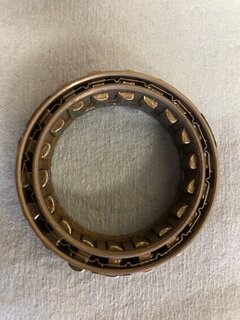
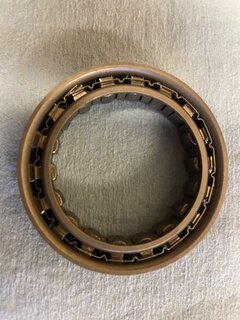
Does this sprag that Matt recently sent me to replace the one that was installed and failed in my 1972 Combat appear to be of a different design that might lift the dogbones off the nose of the drive gear after the bike starts? Is that some sort of spring in there? BTW, I only had about 500 miles on the bike with maybe 50 starts after installing the e-start kit before it failed.
 

Attachments

  • CNW e start conversion, sprag failures
    IMG_2502.jpeg
    361.5 KB · Views: 7
  • CNW e start conversion, sprag failures
    IMG_2503.jpeg
    345.7 KB · Views: 7
Does this sprag that Matt recently sent me to replace the one that was installed and failed in my 1972 Combat appear to be of a different design that might lift the dogbones off the nose of the drive gear after the bike starts? Is that some sort of spring in there? BTW, I only had about 500 miles on the bike with maybe 50 starts after installing the e-start kit before it failed.
No, that sprag won't lift the dogbones off the sprocket snout because when the engine is running, the sprag is stationary within the drive gear. This is the fundamental error in the cnw kit design, The sprag should revolve when the engine is running so centrifugal force throws the dogbones clear. It doesn't, so the sprag will still drag its heels and wear
 
Back
Top