gortnipper
MEMBER
- Joined
- Nov 2013
- Messages
- 5,567

This is what the tech at Cross+Morse said in email to Alan, our NOCNZ VP after he queried getting a different part number sprag which the NZ distribution rep said was an upgraded part, and his questions to them:
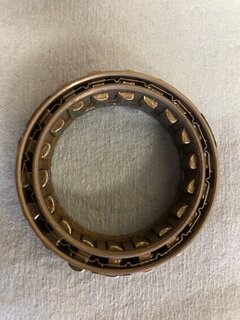
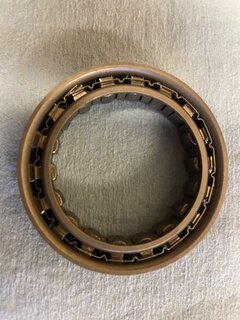
Alan: I have just purchased 3 of your Sprag clutches item SFB41-135 Part No 76SFB41-135 from RR Fisher, Auckland , NZ.
I had ordered clutch part No 1310145 and was told that the one I received was a model upgrade.
I am using them in the same way that RGM Norton us your Sprags to start a motorcycle.
Power from the starter motor is transferred to the outside of the sprag via a transfer gear.
This turns the crankshaft until the motor fires and then lifting off the crankshaft when the starter motor stops turning, with the outside of the sprag remaining stationary by way of sprung detents stopping the transfer gear..
Is this sprag correct for this application, I have read your notes on engaging and disengaging sprags and I’m not sure if I have the correct sprag.
Can you confirm?
Cross+Morse: For this application the sprag type is less of an issue. The sprags are designed to rotate with the outer race, and the differing sprag types (engaging/dis-engaging) only come into effect at relatively high speed with differing balance from centrifugal force.
For the application you describe, the sprag will be engaged for short periods at low to moderate speeds and will then be stationary whilst the engine is running.
Alan: I am about to fit the sprag to my electric start and have noticed that it has no lubrication. The primary case where it is located is a dry area and is driven by a belt not a chain. The sprag and transfer gear only rotate when I am starting the motorcycle.
Do I need to lubricate the sprag on assembly ? if so what type of lube and how much do you recommend?
Cross+Morse: In [this] case the sprag will require lubrication as the crankshaft will be rotating continuously.
Ideally the sprag will be lubricated by oil (Type A automatic transmission fluid), if not you can use grease, we recommend Kluber Polylub WH2. For either option it is imperative to ensure the lubricant is not an E.P. (extreme pressure) type, or contain any additives such as molybdenum disulphide, graphite and P.T.F.E.
Alan: I have just purchased 3 of your Sprag clutches item SFB41-135 Part No 76SFB41-135 from RR Fisher, Auckland , NZ.
I had ordered clutch part No 1310145 and was told that the one I received was a model upgrade.
I am using them in the same way that RGM Norton us your Sprags to start a motorcycle.
Power from the starter motor is transferred to the outside of the sprag via a transfer gear.
This turns the crankshaft until the motor fires and then lifting off the crankshaft when the starter motor stops turning, with the outside of the sprag remaining stationary by way of sprung detents stopping the transfer gear..
Is this sprag correct for this application, I have read your notes on engaging and disengaging sprags and I’m not sure if I have the correct sprag.
Can you confirm?
Cross+Morse: For this application the sprag type is less of an issue. The sprags are designed to rotate with the outer race, and the differing sprag types (engaging/dis-engaging) only come into effect at relatively high speed with differing balance from centrifugal force.
For the application you describe, the sprag will be engaged for short periods at low to moderate speeds and will then be stationary whilst the engine is running.
Alan: I am about to fit the sprag to my electric start and have noticed that it has no lubrication. The primary case where it is located is a dry area and is driven by a belt not a chain. The sprag and transfer gear only rotate when I am starting the motorcycle.
Do I need to lubricate the sprag on assembly ? if so what type of lube and how much do you recommend?
Cross+Morse: In [this] case the sprag will require lubrication as the crankshaft will be rotating continuously.
Ideally the sprag will be lubricated by oil (Type A automatic transmission fluid), if not you can use grease, we recommend Kluber Polylub WH2. For either option it is imperative to ensure the lubricant is not an E.P. (extreme pressure) type, or contain any additives such as molybdenum disulphide, graphite and P.T.F.E.