limitation

Status
Not open for further replies.
On the other hand the memories of running an obsolete clunker though lower gears to 9 grand is priceless. If an Axtell-Woods-Khun like engine > even if the power band fell off after 7500 that just meant ya finally could give it WOT and actually hook it up. The maxed out drag engines beyond TC's level did eventually reach case torque limits w/o over reving. Special fuels and boost were used to do so. I get sick listening to red lined Nortons now so geared up wide ratio Peel to load on the pressure not rpm. Yet Peel's targets are 200 hp bikes on tighter tracks so want to out accelerate em to 160 or so then pull some more till next corner filters them out again. A level-ish non extended no wheele bar motorcycle can only take so much acceleration before lifts over balance point. Higher pilot sits over the CoG than less it can leap forward than up. Peel will wear over the shoulder surrenders to help her in the elastic fastener zone. http://www.odgie.com/_mgxroot/page_10784.html

limitation


https://www.google.com/#q=Crygenic+friction+reduction
https://www.google.com/#q=Crygenic+fric ... r+increase
Cryogenic engine and parts treatment - Ian Williams Tuning
http://www.iwt.com.au/cryogenics.htm
Cryogenic treatment of engine parts. ... As can be seen, this gave a very dramatic increase in horsepower from 10,000 to 13,000 rpm,

https://www.google.com/#q=dry+friction+ ... m+increase
 
hobot said:
Our hot rod light valve train flutist @ JSM needs to study this piston skirt oiling holes in depth as directly bears on Norton rpm friction limitation and can DIY.
http://www.federalmogul.com/en-US/Media ... cript2.pdf

Thats interesting info but it impracticable to for me to make such shallow recesses in a piston skirt. But I have been drilling skirts for years. A lot of people thing this is outrageous but maybe there is something to it. The inside of the piston is exposed to oil and the skirt generally covers up the upper portion of the cylinder. Holes in the skirts allow oil to enter the upper cylinder area. I'll admit that I drill skirts to save weight. But there may be a benefit with the extra oil getting through the skirt. Its nice to think so and I have found no downside to drilling the skirts. But I have no proof that there is any benefit other than weight savings and vibration reduction.

limitation
 
acotrel said:
I worry about the 850 pistons pulling the tops off the aluminium conrods.

There has been considerable discussion about modifying Commando engines in hundreds of different ways, on this forum and several others, by hobbyists, professionals and racers. In all this time (over 10 years), I've never once heard of the top end being pulled off a con rod under any circumstance other than there being a chunk of the top of a rod still stuck to the piston when an engine exploded (but it was not stated to have been the CAUSE of the explosion).
 
Time Warp said:
That is not to say people shouldn't push the envelope, its only time and money.
For the street of course, building a unusable rev range ceiling defeats the purpose somewhat unless there is a sizable increase in mid range to go with it.
Perhaps offset pin crankshafts for better primary balance combined with light rotating parts might help but at the expense of anything Commando.
I would rather use 50 horsepower at 5000 rpm than 80 at 8000 on a road bike, I think once you have a taste for 'grunt you want more of the same, ride the torque curve.

If you want to go top end power, start with a weslake nourish engine. The commando engine is what it is, and from my own experience I believe it is a well-designed motor. I believe that the factory suggests something like 6,500 max. RPM. I take my 850 to 7,000 RPM and I still believe that is too much. The forces which derive from the accelerations of the internals are in a squared relationship as the revs rise. So the logical thing to do is improve the midrange power. You might get that by fitting a race cam, however the more likely result in a commando engine, is moving the power band upwards to where you cannot reliably use it. The problem can be the gearbox you are using. As you increase the torque the effects are not noticeable unless you increase the gearing and make the motor pull harder. I don't know whether I'd use a CR box on public roads, I don't think it is justified. For racing, the standard box is appalling. However, for speed I suggest it is important to know where the max. torque is and keep the revs close to that.
 
I was hoping JSM could make some sense of the skirt study for the rest of us but Its left me restless to try.

RPM gets my blood boiling better than cheating on taxes with cheating women on injected dope. I'm betting shoulder suspenders with extra stiff crank, JSM kit, over size 'CHO' early hogged out Combat head, narrow stems, Maney case Norris D+ and various proce$$es might allow blown Peel to increase torque rise up to 8000. Low boost engines are known for softening the jerk down rpm loads and sealing ring flutter to higher rpm, Tom Drouin ads showed torque rise to 8000 and comnoz to McGreor say boost ani't significant till 6000's. So implies 2000ish range in red zone to dice up chicanes in lower gears.

I've yet to hear of convincing evidence of any Norton rod failing before something else did first then of course they break close to the middle or lose the steel cap. A few said rods let go on their 9000 rpm Nortons just not mine.

Oh Yeah, I re-used Peel's over rev'd rods on first of Trixie Combat rebuilds but one failed just tooling along steady 50 on the level but I think it was piston fatique first that jammed the works as crank and rear patch momentum carried through another revolution.

Btw even though I saw all of Peel's engine seams turning into curled lips jetting out rippled sheets of white fog and fasteners popping up with gaps fanning cones of white smoke they didn't need re-torque or leak afterwards til full ice winter hit and buried Ms Peel's 2nd edition. Sensory over load hurts.

limitation
 
Jed said:
Would 4000 rpm or thereabouts be what you'd expect to see at 70 MPH with a 23 tooth front sprocket?
Not sure if my taco is telling the right story

Jed


4000 = 80 mph with my 22T
 
concours said:
Jed said:
Would 4000 rpm or thereabouts be what you'd expect to see at 70 MPH with a 23 tooth front sprocket?
Not sure if my taco is telling the right story

Jed

4000 = 80 mph with my 22T
Regarding bike speed, engine speed and countershaft sprocket.

limitation
 
With standard Commando primary, 42 T rear sprocket, 23T countershaft sprocket, and AVON AM23 130/650VB18 rear tire on a WM3 rim (793 revolutions per mile), you would be pulling 3704 rpm at 70 mph. If you are using a smaller diameter rear tire, you would be pulling a few more rpm. A 120/70ZR18 Bridgestone BT020 is 24.9” in diameter, giving 810 revolutions per mile, so with it you would be pulling 3783 rpm. If you are running an Avon Roadrider 100/90-19, your rpm at 70 should be really close to 3500 rpm. Unless you are running a really small rear tire, your tacho or speedo (or both) is/are off. Not exactly unusual for a Commando.

Ken
 
Jed said:
Would 4000 rpm or thereabouts be what you'd expect to see at 70 MPH with a 23 tooth front sprocket?
Not sure if my taco is telling the right story

Jed


should be 18.6 mph per 1000 rpm , odd .

130 @ 7000 , so 65 @ 3500 .

18.6 x 4 = 74.4 so 75 @ 4000 odd .

given 3.5 section tyre / 26 in high , as per 4.10 Dunlop which is 4.10 / 3.50 low profile . Try a 4.00 x 19 . :P :)
 
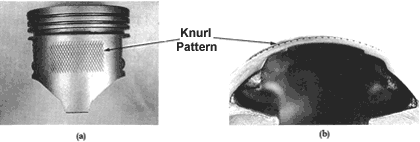
Interesting paper about piston oiling, Steve. We used to see forged aftermarket pistons with multiple grooves around the skirt, intended to hold a reserve of oil, similar to the recessed areas in the pistons discussed in the paper. I haven't seen those for a while, but it does make me wonder how well they worked. Seems to me that Jim's drilled holes might well serve the same function, but I doubt if any of us have test engines with glass windows in the cylinders to check it out with. I also noticed that the test results were all with really tight clearances, nothing like the .004" - .006" clearances that we use, so there might not be any gain from applying the technique to Commandos. The mechanism for reducing friction was ensuring that there was always oil on the skirt, and I suspect we already have a plentitude of oil on the cylinder walls and the skirts. Still, an entertaining read for the gearheads.

Ken
 
I've seen several sets of BSA pistons with those grooves cut around the circumference of the skirts; never seen them on any Norton or Triumph...
 
Factory cast iron flywheels reported to explode before Norton 750 cases so that and bearings got first racer attention then the ways to repair and re-enforce cases giving way, then valve and points float had to be dealt with then the drive train.
 
john robert bould said:
So No 1 is crank or case failure?

Your example engine was one that had high revolution potential.
I suggest the first hurdle to cross is still related to piston speed and that is pressure differential across the ring followed by ring flutter.
Your theoretical engine won't be using JCC pistons.
I thought of this thread today while I was assembling my 110 mm bore DR engine.
 
grandpaul said:
I've seen several sets of BSA pistons with those grooves cut around the circumference of the skirts; never seen them on any Norton or Triumph...

The cast Omega hemi pistons the works used had several grooves on the skirts, search on here and you will find images. I have one somewhere.....actually I have a pair but one has a big inlet valve embedded in it!
 
Them big lifters need controling . So you need A1 top notch No1 Valve Springs . And the keepers & collars'd better be good , or theyll fall off .
One usually checks the Collets are seating in the taper & on the valve , with Blue or Paste - so theres a full surface mate . Mate . :D :wink:

CASTOR Oil migh help things No end . Drilled Oilways ?? . Race Motors in COMPETITION would get regular tear downs and lifed components ,
if they were intending to clean up . SECURE fasteners - cradle to injun - often oversized reamed press fit - to secure accurately .
Even on Unit :x engines . :shock

Obviously the gearboxes fell to bits initially , particularrly in the I.o.M. , where max loading on irregular surface undulations had the shafts
swaying and the gears meshing uncoordinately tearing up teeth . The Later outrigger set up ( 73 F 750 ) stopped this . Usually D.N.F. in
P.R. was gearbox . Though thats not the Engine - its the POWERTRAIN . :)

They alledged the Oil Pump got down to Zero there , as the crank centrafuged it out as fast as the pump pumped it in , hot and bothered
by the third lap . The issue was Top End Oiling . A later issue had a humongous pump on a flat timing cover . as 10 psi per 1000 rpm is
considered esentian with plain bearing big ends , Blue Printing the pump & being particular with the Oiling System ( no pansey little tanks
or fitting bore restriction ) help stop it fadeing . Deburring , polishing drain down paths help it get out where its supposed to , too .

Dynamically balanced crank , and ten million dollar crank & rod bolts arnt a bad idea , removeing hard edges from fastening bores also .
And POLISHING .

Read Dunstalls Guide ? Kuhn was the other big mover , outside The Thruxton Norvil Race Shop . Though I dont think everone there got
up to their elbows in it . The wrenches wernt provided with company cars and expense accounts . Was all cost related . though Dunstall
inheriting Hele's developments had the fastest twins untill the JPN outfit got underway , and Kuhn equaled them with Commandos .

So the biggest limitation is TIME and Money . :(
 
So......the 9000 rpm motor will never be a commando...well just before the motor explodes.
Sort the crank, case fails, sort the case, the pistons fail, then the valves go AWL or the oil system gives up...sort all that and the trans self destructs.
OK i have heard enough....post close please. Many thanks for your imputs.
 
SteveA said:
The cast Omega hemi pistons the works used had several grooves on the skirts, search on here and you will find images. I have one somewhere.....actually I have a pair but one has a big inlet valve embedded in it!

Quite right. I'd forgotten about those.

limitation


Ken
 
Status
Not open for further replies.
Back
Top