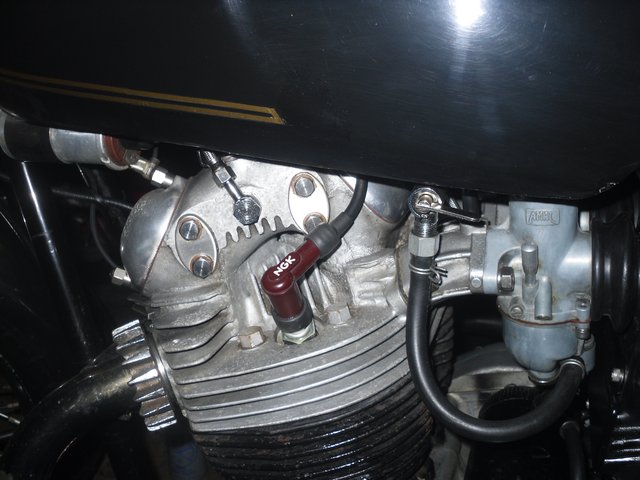
Where did you see a requirement for a special coil and leads for Tri-Spark?
They sell coils and leads but there is no requirement to use them on any bike I know. A single requires a 12v coil of 3-5 ohms (3.6-4.0 ideal), twin two 6v in series 1.8-2.2 ohms (Some original Lucas coils measure 1.6 ohms and they work fine but are outside the current Tri-Spark spec, older manuals had it as 1.5-3.0, I will ask about this. Tri-Spark coils 6v coils are 1.8 ohms) or a single dual lead 12v coil (3.0-5.0 ohms (3.6-4.0 ideal), and a triple three 12v coils, each 3-5 ohms (3.6 ideal-4.0) Original coils work and the standard Lucas-looking Tri-Spark coils are made the same way with a little difference in windings which allows a higher output. Coils only actually supply enough voltage for the current to jump the gap. Higher output is really only used in high compression engines, plug gap too large, carbs way to rich or lean, and higher RPMs than should not be used on a stock Norton. BTW, .028" is too large even though Norton specified it as max - Lucas never specified larger than .025" that I'm aware of and .025" should be considered the max unless you have higher output coils. From memory, Triumph specifies .025" and BSA singles .020" - .025" and I don't remember about BSA twins.
IMHO, a motorcycle should never use resistance wire - too much vibration for carbon core wires. Resistance caps or resistance plugs should be used for Tri-Spark. Tri-Spark sells these but there is no requirement to buy from Tri-Spark that I'm aware of.
The wires AN sells along with resistance plugs is fine.
Whenever possible I use original wires as long as both ends are solid, they can be cleaned up and at not cracked, and they have zero resistance. With standard coils they give the best clearance to the rocker nuts.
In general, not using resistance caps or plugs will work but any nearby devices may have interference and depending on how your wiring it routed it is possible for the electrical noise to bother the EI. For instance, I once ran the Tri-Spark wires and Don Pender oil pressure wire in the same sheath up the frame and then the oil pressure wire went to then red warning light with an LED. The LED flashed with the engine firing. Then I ran the wire away from the Tri-Spark wires, and it still flashed but just barely. Then I put in resistor plugs and the flashing stopped. The bike ran fine throughout. A customer complained that his hands free phone and and especially phone navigation did not work well on his bike. He had switched from a Boyer Digital to Tri-Spark to fix it. I installed resistor plugs and the problem was gone. Of course, following instructions to start with could have saved him time and money.
I'm am a Tri-Spark dealer and do Tri-Spark tech support and warranty work, generally in the US, so I'm interested in statements about Tri-Spark. If true I verify and don't deny, if false I try to set the record straight.


 www.bbc.co.uk


 )
)