Shindengen SH775 (2018)

Status
Not open for further replies.
If your battery is dipping below 13volts in a couple of minutes, you are about two minutes away from shutdown. All it takes is a bit of traffic delay, especially at night.
At 13.1 volts there is just 40% charge remaining.
At 12.8 +- these batteries shut off to prevent destruction. They don't always recover when charged. See Shorai 12.86volt warning below.
A 21pbeq Shorai has 7ah storage when fully topped up.
At anything below 13v there is very little juice left in the battery.


Do you have a motorcycle that has exhibited this condition? Have you had a meter on the motorcycle to see what the starter draw is?

And Shorai can go below 12.86 but you will need their charger to bring it back. We have had this occur on bikes when stored too long and the Shorai charger will work to bring it back to 14 volts.


We have never had this issue on any early bike with or without electric start that we have installed lithium batteries . Not to mention numerous customers who have installed their own. In fact out of all the Shorai and Anti Gravity batteries we have installed we have only had one warranty claim because a cell went dead. Shorai replaced no questions asked
 
Yes, I did a few years ago, early days of Lithium batteries. No starter draw, kickstart bike.
This was before learning about the information on the chart above.
Nowadays, if using a Lithium battery, I would follow that chart and the other recommendations by Shorai.
In the early days neither sellers nor users were tuned into this stuff.
Even now there are still some who are using these batteries and aren't aware of the low voltage cutout.
What happens is the bike shuts off and the light does too.
Not good on a night ride in traffic.

Glen
 
Last edited:
Then you have a problem somewhere. The podtronics should keep the battery charged. Maybe the AGM battery has been cycled so many times its going bad. Have you tested the battery?
That was going to be my next question
How to properly DIY test the battery
I've tested it with a multimeter
And that's about it
Cheers
 
That was going to be my next question
How to properly DIY test the battery
I've tested it with a multimeter
And that's about it
Cheers
you need a battery load tester that is AGM compatible for the battery you spec. It will tell you the state including the CCA of the battery. you can find a cheap one online or if you have a favorite shop ask if they will test it for you but make sure they have the right device not just an electrical meter.
 
  • Like
Reactions: baz
I will use big words .... IT WON'T :)

Meltdown is caused by thermal runaway...
There is a low voltage cutout in the Lithium batteries, as mentioned above.
This protects the battery from self destruction which would otherwise occur from low voltage. Note that Shorai and others give a clear warning on this.
The battery manufacturer claimed that the cause of the battery destruction was the low voltage condition.
Perhaps the cutout failed to do its job.

Glen
 
Yes, I did a few years ago, early days of Lithium batteries. No starter draw, kickstart bike.
This was before learning about the information on the chart above.
Nowadays, if using a Lithium battery, I would follow that chart and the other recommendations by Shorai.
In the early days neither sellers nor users were tuned into this stuff.
Even now there are still some who are using these batteries and aren't aware of the low voltage cutout.
What happens is the bike shuts off and the light does too.
Not good on a night ride in traffic.

Glen
Never heard of this occurring and that's not been our experience here. We have installed on motorcycles with less than an optimum systems and they fall below 12.5 all the time with no shut off and no charging issue.

You would have to amp stack to get even a lead acid to discharge that fast and not recover by normal riding.

The math doesn't add up when you look at amp hour etc of a battery. That would be a lot of idling without any charge assisting the system.

The fact that while idling the charging system is still providing power to offset a lot of the draw. it might not be perfect but again how long will you idle to have that draw happen?
 
Never heard of this occurring and that's not been our experience here. We have installed on motorcycles with less than an optimum systems and they fall below 12.5 all the time with no shut off and no charging issue.

You would have to amp stack to get even a lead acid to discharge that fast and not recover by normal riding.

The math doesn't add up when you look at amp hour etc of a battery. That would be a lot of idling without any charge assisting the system.

The fact that while idling the charging system is still providing power to offset a lot of the draw. it might not be perfect but again how long will you idle to have that draw happen?
The charging system on these old bikes does not provide any power at idle, it discharges.
When at idle all of the power for the headlight and ignition is flowing from the battery.
You can see it clearly on bikes equipped with an ammeter.
We often talk about "balancing the load".
That's the speed at which the charging system is equal to the load, but still not charging the battery.
For example, on my Vincent it is 45 mph in top gear.
On my BSA.... forget it, the needle bounces too much to read!!

Speaking of math , how many AH is an LFX18?


Glen
 
Last edited:
The charging system on these old bikes does not provide any power at idle, it discharges.
When at idle all of the power for the headlight and ignition is flowing from the battery.
You can see it clearly on bikes equipped with an ammeter.
We often talk about "balancing the load".
That's the speed at which the charging system is equal to the load, but still not charging the battery.
For example, on my Vincent it is 45 mph in top gear.
On my BSA.... forget it, the needle bounces too much to read!!

Speaking of math , how many AH is an LFX18?


Glen
On my A10 and before the tachometer packed up the load used to balance at around 2100rpm
And that's with the original 6v dynamo with a 12v regulator (JG unit) and an srm toothed belt conversion that gears the dynamo up a little
I did run this bike for a while with an alternator from an fj1200 yam
I used an offset drive from a shortened dynamo housing
But it was god awful ugly so I took it off and went back to the aforementioned setup
 
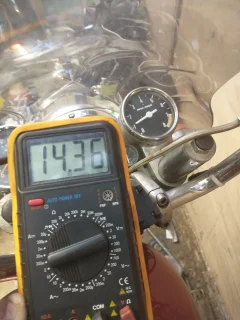
Just out of sheer interest I ran my bike with the alternator and reg/rectifier charging a slave brand new 12 v 6ah battery
And at at 1200rpm it was charging at 14.36v
This is without the drain of the ignition system or anything else for that matter
 

Attachments

  • Shindengen SH775 (2018)
    IMG_20210816_195306354.webp
    126.1 KB · Views: 178
Last edited:
Then you have a problem somewhere. The podtronics should keep the battery charged. Maybe the AGM battery has been cycled so many times its going bad. Have you tested the battery?
So would a series unit be better than a shunt ?
I'm asking because I want to know if it would give my Alton stator an easier life?
 
So would a series unit be better than a shunt ?
I'm asking because I want to know if it would give my Alton stator an easier life?
You have a malfunctioning system, the battery is not being charged. Series or shunt doesn't matter until the regulator is at its maximum output (control voltage).
 
So would a series unit be better than a shunt ?
I'm asking because I want to know if it would give my Alton stator an easier life?
An £8 shunt type hasn’t done anything bad to my Alton, charging a lead-acid battery.

It appears to be accepted that shunt regulation is a good principle for regulating permanent magnet automotive alternators, up to a certain level of alternator current output.

I’m not saying it’s accepted by everyone!

Series regulation brings its own issues, such as AC voltage spikes. No doubt the nice people at Shindengen take care of that in their designs.
 
Just out of sheer interest I ran my bike with the alternator and reg/rectifier charging a slave brand new 6v 6ah battery
And at at 1200rpm it was charging at 14.36v
This is without the drain of the ignition system or anything else for that matter
There's nothing wrong with that - though I'm sure you meant 12V battery, not 6.
Put a load on it and check again. A couple amps would be enough (the brake light bulb would do) to simulate ignition. If you still get 14 volts your charging system is working fine.
 
There's nothing wrong with that - though I'm sure you meant 12V battery, not 6.
Put a load on it and check again. A couple amps would be enough (the brake light bulb would do) to simulate ignition. If you still get 14 volts your charging system is working fine.
Oops typo
Should have been 12v 6ah sorry
 
Never heard of this occurring and that's not been our experience here. We have installed on motorcycles with less than an optimum systems and they fall below 12.5 all the time with no shut off and no charging issue.

You would have to amp stack to get even a lead acid to discharge that fast and not recover by normal riding.

The math doesn't add up when you look at amp hour etc of a battery. That would be a lot of idling without any charge assisting the system.

The fact that while idling the charging system is still providing power to offset a lot of the draw. it might not be perfect but again how long will you idle to have that draw happen?
I asked how many AH is an LFX 18 Shorai, and also what Lithium compatible charging system is available for Norton (twice) No answer so far on either question, perhaps the man is busy.
Regarding the statement above that the math doesn't add up for a draw down/ shut off, I'll give it a try.
This occurred on the Oregon Coast a few years ago, on our way to California. My wife and I used to do two annual 3000 mile trips with that bike, in pre Covid days.
We were riding in the early evening toward the end of a 400 mile day on Highway 101, the coastal highway. It's plugged with tourists so you are doing well to average 50 mph.
With headlight on the charging system was maintaining about 13.1 volts. I know that because the bike has a voltage monitor.
An LFX 18, which is a battery commonly used, holds about 6 amphours when fully charged to 14.4 volts.
At 13.1 volts you have just 40% capacity, or 2.4 ah. At 9 amp idle discharge ( headlight, taillight, ignition) you have about 20-25 minutes of idle time before zero capacity, not very long in traffic.
At some point in the evening we got into city traffic, lots of stoplights and traffic congestion.
With bumper to bumper traffic crawling along between the lights and more idle discharge we hit zero battery after a few traffic lights.
It was like somone shut the ignition off, no engine no lights, paddle thru a busy intersection in the dark,bike 2 up plus luggage.
After some testing of the battery with a Muti meter, we realized we needed a power transfusion. We jumped it from my friend's bike and made a lot of noise trying to stuff some electrons in the Lithium battery .
Ten minutes of that was sufficient to get it running and get to the nearest motel for the night.
In those days I had no knowledge of the charging differences between lead acid and Lithium batteries, nor did the seller. It was sold to me as a direct replacement for the lead acid battery and he claimed that any old British charging system would love the Lithium battery. This bike has a modern Alton, so even better.
There was no " minimum idle charge requirement " specified. That came later on.

After realizing I did not have adequate charging for Lithium, Rather than change everything on the bike to try to suit that, I just went back to Lead acid. That works fine and has done so for about 60,000 miles now. I don't worry about getting caught in traffic at night, that's happened a few times since, no issues.

Glen
 
Last edited:
  • Like
Reactions: baz
I asked how many AH is an LFX 18 Shorai, and also what Lithium compatible charging system is available for Norton (twice) No answer so far on either question, perhaps the man is busy.
Regarding the statement above that the math doesn't add up for a draw down/ shut off, I'll give it a try.
This occurred on the Oregon Coast a few years ago, on our way to California. My wife and I used to do two annual 3000 mile trips with that bike, in pre Covid days.
We were riding in the early evening toward the end of a 400 mile day on Highway 101, the coastal highway. It's plugged with tourists so you are doing well to average 50 mph.
With headlight on the charging system was maintaining about 13.1 volts. I know that because the bike has a voltage monitor.
An LFX 18, which is a battery commonly used, holds about 6 amphours when fully charged to 14.4 volts.
At 13.1 volts you have just 40% capacity, or 2.4 ah. At 9 amp idle discharge ( headlight, taillight, ignition) you have about 20-25 minutes of idle time before zero capacity, not very long in traffic.
At some point in the evening we got into city traffic, lots of stoplights and traffic congestion.
With bumper to bumper traffic crawling along between the lights and more idle discharge we hit zero battery after a few traffic lights.
It was like somone shut the ignition off, no engine no lights, paddle thru a busy intersection in the dark,bike 2 up plus luggage.
After some testing of the battery with a Muti meter, we realized we needed a power transfusion. We jumped it from my friend's bike and made a lot of noise trying to stuff some electrons in the Lithium battery .
Ten minutes of that was sufficient to get it running and get to the nearest motel for the night.
In those days I had no knowledge of the charging differences between lead acid and Lithium batteries, nor did the seller. It was sold to me as a direct replacement for the lead acid battery and he claimed that any old British charging system would love the Lithium battery. This bike has a modern Alton, so even better.
There was no " minimum idle charge requirement " specified. That came later on.

After realizing I did not have adequate charging for Lithium, Rather than change everything on the bike to try to suit that, I just went back to Lead acid. That works fine and has done so for about 60,000 miles now. I don't worry about getting caught in traffic at night, that's happened a few times since, no issues.

Glen
Perhaps the man is busy running his business. and perhaps the man stopped replying to someone who wants to argue every point instead of listening to what people who have experience posting what works and continues to work. and perhaps since you seem to already be on Shorai website as evidenced by the earlier postings perhaps the man thought you could easily find that information yourself since you are an expert in this area not the shop with over 80 lithium battery installs in the last 2 years with installing more than 30 upgraded systems on vintage motorcycles with zero complaints.

You keep referencing something from long ago with no current knowledge or skill. So no I will not be replying to any more of your posts since you don't want to believe that lithium will indeed work and have worked for years on early motorcycles. You seem to want to be negative about everything.

This is why we stay away from posting much of anything but we thought our expertise in this area might have helped a few people but you decided to take the fun out of that so we will not offer anymore advice and refer everyone to you because of your vast knowledge skills and abilities. Hope you you have a positive day!
 
Alrighty then.
I thought it was a good civil discussion, with good points raised, until now. You came on chastising in your first post, but we ignored that.
I was hoping to get more " current" but "2 wire or 3 wire" does not give much info on the best stator to use for Lithium.

I am sincerely interested in finding a charging system that meets Shorai requirements and fits these old bikes.

Glen
 
Last edited:
A kick start bike that isn't much more than a race bike with EI, a head light, brake light, and license plate is easy to install a LiFePO4 battery into, because the load requirements are close to zilch. That is just about what my P11 is except it has 1-inch wide 7-inch SLS drum brakes on it. Yikes!!

Here's the rinse repeat stuff:
I'm using a Lucas 2 wire stator that was available in the 1970's. It has no identifying marks on it, so can't tell what it really is. That Lucas 2 wire stator and rotor of the same vintage along with a Tri-Spark MOSFET reg/rect support a very small 4 cell Antigravity 401 LiFEPO4 battery the size of a wallet. I have LED lights, a Boyer MkIV ignition, dual e-coil, resistor plugs, and nothing else sucking on the electrical tit. Works for me. My P11 is not a touring bike, but it'll go farther than I can go without any issues.

Here's a little shot of Come on man!:
If I had a Commando with all the bells and whistles, I'd figure it what I needed for a LiFEPO4 battery, if I really wanted to use one. More than likely I'd just stuff an AGM battery in it, and use the Tri-Spark MOSFET reg/rect. Then get on with my life.
 
My Candidates for Lithium are the lightweight Norton 920 project bike and the Vincent Special, also a very light machine.
A few pounds doesn't much matter on the others, AGM has been the choice there.

Glen
 
Status
Not open for further replies.
Back
Top