Never heard of this occurring and that's not been our experience here. We have installed on motorcycles with less than an optimum systems and they fall below 12.5 all the time with no shut off and no charging issue.
You would have to amp stack to get even a lead acid to discharge that fast and not recover by normal riding.
The math doesn't add up when you look at amp hour etc of a battery. That would be a lot of idling without any charge assisting the system.
The fact that while idling the charging system is still providing power to offset a lot of the draw. it might not be perfect but again how long will you idle to have that draw happen?
I asked how many AH is an LFX 18 Shorai, and also what Lithium compatible charging system is available for Norton (twice) No answer so far on either question, perhaps the man is busy.
Regarding the statement above that the math doesn't add up for a draw down/ shut off, I'll give it a try.
This occurred on the Oregon Coast a few years ago, on our way to California. My wife and I used to do two annual 3000 mile trips with that bike, in pre Covid days.
We were riding in the early evening toward the end of a 400 mile day on Highway 101, the coastal highway. It's plugged with tourists so you are doing well to average 50 mph.
With headlight on the charging system was maintaining about 13.1 volts. I know that because the bike has a voltage monitor.
An LFX 18, which is a battery commonly used, holds about 6 amphours when fully charged to 14.4 volts.
At 13.1 volts you have just 40% capacity, or 2.4 ah. At 9 amp idle discharge ( headlight, taillight, ignition) you have about 20-25 minutes of idle time before zero capacity, not very long in traffic.
At some point in the evening we got into city traffic, lots of stoplights and traffic congestion.
With bumper to bumper traffic crawling along between the lights and more idle discharge we hit zero battery after a few traffic lights.
It was like somone shut the ignition off, no engine no lights, paddle thru a busy intersection in the dark,bike 2 up plus luggage.
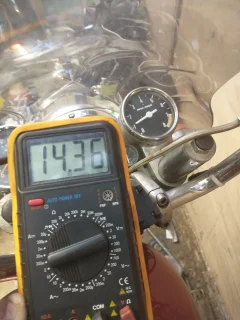
After some testing of the battery with a Muti meter, we realized we needed a power transfusion. We jumped it from my friend's bike and made a lot of noise trying to stuff some electrons in the Lithium battery .
Ten minutes of that was sufficient to get it running and get to the nearest motel for the night.
In those days I had no knowledge of the charging differences between lead acid and Lithium batteries, nor did the seller. It was sold to me as a direct replacement for the lead acid battery and he claimed that any old British charging system would love the Lithium battery. This bike has a modern Alton, so even better.
There was no " minimum idle charge requirement " specified. That came later on.
After realizing I did not have adequate charging for Lithium, Rather than change everything on the bike to try to suit that, I just went back to Lead acid. That works fine and has done so for about 60,000 miles now. I don't worry about getting caught in traffic at night, that's happened a few times since, no issues.
Glen