

There has been considerable discussion on this forum over the years about breaking in a new top end—torquing frequency, how long it takes for rings to break in, etc. Although I certainly don’t have any absolute answers on these subjects, I can relay some recent observations from a new CDO top end. I’m not suggesting that anything I’m reporting here is right or wrong, or that anyone else should attempt to emulate what I’ve done. I’m simply reporting my observations.
The bike under discussion is a ’74 CDO with ~11K miles on it. The head gasket had been leaking oil, so the bike was torn down to replace the composite gasket with a new one. As you can likely guess, this undertaking turned out to be a bit more than a quick gasket replacement.
The standard-bore pistons were worn out, and the bore was too large for new standard pistons, so a rebore was in order. The EX threads had been repaired previously, and both threaded inserts were now loose and compromised. Fortunately, I had another very nice, unmolested RH10 core on the shelf. The head gasket surface was flat to about 0.002". Although it didn’t strictly need to be cut, since the machinist had already invested the time fixturing it on the mill to make that determination, I asked that it be fly-cut to level it.
The IN guides were fine, and new G2 EX guides were installed. New Kibblewhite Black Diamond valves were used, and the seats were cut on a Newen seat machine.
A new ARP cylinder head mounting kit was obtained from CNW and installed. Although the three large head studs were not waisted as received, they were waisted before installation.
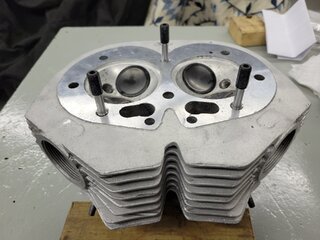
The cylinder was bored for new 0.020" OS billet MAP 4032 standard-compression pistons, fitted at 0.004". The cylinder top gasket surface was deemed flat, so no additional machining was required there.
Before assembly, all cylinder head fasteners, washers, and contact surfaces were cleaned and generously lubricated with ARP Ultra-Torque. All fastener components could be easily hand-tightened into their respective locations or onto their mating fasteners before assembly. The upper end, with composite gasket and new EX washers, was assembled and all fasteners were tightened to the factory torque specifications.
The engine was started and allowed to warm modestly for about three minutes, then shut off and allowed to cool to ambient temperature. The next day, the engine was started again and the bike was immediately ridden easily for three miles before being shut down and allowed to cool completely. Thereafter, the bike was ridden easily under modest load and RPM in 50-mile increments and allowed to fully cool after each outing. After each 50-mile ride, the EX nuts were tightened immediately after stopping, and at each interval both nuts could be tightened appreciably.
After accruing 250 miles total (~5+ full thermal cycles), the valve adjustment was checked and the head was re-torqued. The valve adjustment showed the IN valves were unchanged, while the EX valves had tightened by 0.001". Torque was checked by loosening each fastener one revolution and then torquing it back to specification in a continuous pull. The four head bolts near the spark plugs were marked with a magic marker to denote their position relative to the head surface before loosening. After re-torquing, any change in fastener position could be easily observed. The images below show the additional rotation of each fastener after re-torque relative to the original datum line.

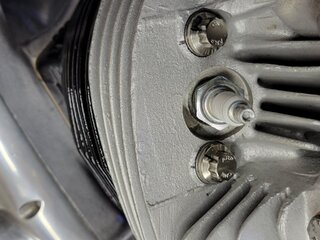
As the images show, the fastener heads rotated on the order of 30–45 degrees beyond their original position.
A compression check was also performed at this 250-mile interval with the engine hot to see how the two cylinders compared. A compression gauge reading was recorded with each kick. The results showed a somewhat lazy right cylinder relative to the left cylinder. I was a bit surprised by the compression result, as I thought the rings would have been well broken in by now, but obviously that was not yet the case.

The engine break-in continued in the same fashion, with ride durations of ~50 miles per outing. As time progressed and miles accrued, considerably higher ring loads were applied in short bursts, and runs to 4500 RPM under light loads were also introduced. As observed previously, after each outing the EX nuts were tightened, and on every occasion they continued to require further tightening. I began to wonder if they would ever stop moving.
With five additional heat cycles and a total of 500 miles on the engine, valve lash, compression, EX nut tightening, and torque were again checked. I am pleased to report that at the 500-mile mark the EX nuts finally stopped moving and could no longer be tightened further. Valve lash was unchanged from the 250-mile checkup, indicating the valves had settled in nicely.
A re-torque using the same procedure and fastener marking system described previously was again performed. The photos show the result of this re-torque, where additional fastener rotation was minimal to non-existent on three of the fasteners, while the fourth moved slightly more.
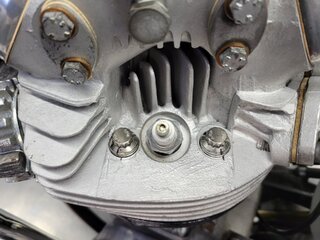
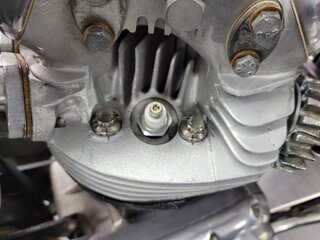
I have no explanation as to why one fastener moved more than the other three, aside from the many variables in play—thread fit, thread quality, lubrication, etc. I would predict that at the 1000-mile check-up the fasteners will show minimal, if any, additional rotational movement.
The 500-mile compression check data below show that the two cylinders are now essentially broken in and behaving identically.

The bike under discussion is a ’74 CDO with ~11K miles on it. The head gasket had been leaking oil, so the bike was torn down to replace the composite gasket with a new one. As you can likely guess, this undertaking turned out to be a bit more than a quick gasket replacement.
The standard-bore pistons were worn out, and the bore was too large for new standard pistons, so a rebore was in order. The EX threads had been repaired previously, and both threaded inserts were now loose and compromised. Fortunately, I had another very nice, unmolested RH10 core on the shelf. The head gasket surface was flat to about 0.002". Although it didn’t strictly need to be cut, since the machinist had already invested the time fixturing it on the mill to make that determination, I asked that it be fly-cut to level it.
The IN guides were fine, and new G2 EX guides were installed. New Kibblewhite Black Diamond valves were used, and the seats were cut on a Newen seat machine.
A new ARP cylinder head mounting kit was obtained from CNW and installed. Although the three large head studs were not waisted as received, they were waisted before installation.
The cylinder was bored for new 0.020" OS billet MAP 4032 standard-compression pistons, fitted at 0.004". The cylinder top gasket surface was deemed flat, so no additional machining was required there.
Before assembly, all cylinder head fasteners, washers, and contact surfaces were cleaned and generously lubricated with ARP Ultra-Torque. All fastener components could be easily hand-tightened into their respective locations or onto their mating fasteners before assembly. The upper end, with composite gasket and new EX washers, was assembled and all fasteners were tightened to the factory torque specifications.
The engine was started and allowed to warm modestly for about three minutes, then shut off and allowed to cool to ambient temperature. The next day, the engine was started again and the bike was immediately ridden easily for three miles before being shut down and allowed to cool completely. Thereafter, the bike was ridden easily under modest load and RPM in 50-mile increments and allowed to fully cool after each outing. After each 50-mile ride, the EX nuts were tightened immediately after stopping, and at each interval both nuts could be tightened appreciably.
After accruing 250 miles total (~5+ full thermal cycles), the valve adjustment was checked and the head was re-torqued. The valve adjustment showed the IN valves were unchanged, while the EX valves had tightened by 0.001". Torque was checked by loosening each fastener one revolution and then torquing it back to specification in a continuous pull. The four head bolts near the spark plugs were marked with a magic marker to denote their position relative to the head surface before loosening. After re-torquing, any change in fastener position could be easily observed. The images below show the additional rotation of each fastener after re-torque relative to the original datum line.
As the images show, the fastener heads rotated on the order of 30–45 degrees beyond their original position.
A compression check was also performed at this 250-mile interval with the engine hot to see how the two cylinders compared. A compression gauge reading was recorded with each kick. The results showed a somewhat lazy right cylinder relative to the left cylinder. I was a bit surprised by the compression result, as I thought the rings would have been well broken in by now, but obviously that was not yet the case.
The engine break-in continued in the same fashion, with ride durations of ~50 miles per outing. As time progressed and miles accrued, considerably higher ring loads were applied in short bursts, and runs to 4500 RPM under light loads were also introduced. As observed previously, after each outing the EX nuts were tightened, and on every occasion they continued to require further tightening. I began to wonder if they would ever stop moving.
With five additional heat cycles and a total of 500 miles on the engine, valve lash, compression, EX nut tightening, and torque were again checked. I am pleased to report that at the 500-mile mark the EX nuts finally stopped moving and could no longer be tightened further. Valve lash was unchanged from the 250-mile checkup, indicating the valves had settled in nicely.
A re-torque using the same procedure and fastener marking system described previously was again performed. The photos show the result of this re-torque, where additional fastener rotation was minimal to non-existent on three of the fasteners, while the fourth moved slightly more.
I have no explanation as to why one fastener moved more than the other three, aside from the many variables in play—thread fit, thread quality, lubrication, etc. I would predict that at the 1000-mile check-up the fasteners will show minimal, if any, additional rotational movement.
The 500-mile compression check data below show that the two cylinders are now essentially broken in and behaving identically.
Last edited:


