JS Motorsport Pistons/Rods First Impressions

My first ride on the Commando, I broke down after 3 miles, because I forgot to turn the choke off. After cleaning the plugs, it didn't run right until I put fresh plugs in.

I find it interesting that each bike has its own starting needs.

On the Commando, with a single mk2 Amal (no tickler), my bike will not start first thing without the choke. Now, choke on, start, immediately choke off using the throttle to keep it running, start riding, 2,500 revs for 500 yds and it ticks over without throttle at my first road junction. True for all weather temperatures. Don't need the choke for the rest of the day, just a little throttle to start.

Can't do that on my 4 x Keihin Honda, which needs full choke to start and half choke for 500yds to keep running on all cylinders. It soots the plugs if i let it idle on the choke. My 4 x Mikuni Bandit is similar, but less fussy on when I turn the choke off. It will warm up happily on the drive on a reducing choke.
 
My first ride on the Commando, I broke down after 3 miles, because I forgot to turn the choke off. After cleaning the plugs, it didn't run right until I put fresh plugs in.

I find it interesting that each bike has its own starting needs.

On the Commando, with a single mk2 Amal (no tickler), my bike will not start first thing without the choke. Now, choke on, start, immediately choke off using the throttle to keep it running, start riding, 2,500 revs for 500 yds and it ticks over without throttle at my first road junction. True for all weather temperatures. Don't need the choke for the rest of the day, just a little throttle to start.

Can't do that on my 4 x Keihin Honda, which needs full choke to start and half choke for 500yds to keep running on all cylinders. It soots the plugs if i let it idle on the choke. My 4 x Mikuni Bandit is similar, but less fussy on when I turn the choke off. It will warm up happily on the drive on a reducing choke.
Japanese use metric remember… try riding it 500 metres instead of 500 yards…
 
I guess you idle so low because you don't have chokes.

With chokes my Commando will idle happily at 1800 or so settling to 1100 to 1200 when warm and no choke.

The only reason to idle at 700 is if your aim is to destoy your cam and followers.

A very very bad idea in my opinion. 😢

I know I'm probably going to get flamed with this comment but Amal did include a choke for a reason.
You didn't read what I wrote! 700 immediately after starting cold which increases to 1000-1100 when warmed up.

Cam and followers are getting plenty of oil. The oil to the head is about the same and therefore the oil down the exhaust pushrod tunnel is about the same but the cam and followers are doing less work.

If chokes make your cold engine idle at 1800, you need to adjust your carbs correctly.
 
You didn't read what I wrote! 700 immediately after starting cold which increases to 1000-1100 when warmed up.

Cam and followers are getting plenty of oil. The oil to the head is about the same and therefore the oil down the exhaust pushrod tunnel is about the same but the cam and followers are doing less work.

If chokes make your cold engine idle at 1800, you need to adjust your carbs correctly.
I'm pretty sure I read it right. 700 rpm immediately after start up when cold. That's how I read it.

How long will you run the bike at 700 rpm when cold before it comes up to 1100 rpm?
 
I'm pretty sure I read it right. 700 rpm immediately after start up when cold. That's how I read it.

How long will you run the bike at 700 rpm when cold before it comes up to 1100 rpm?
Since I hate idling Norton engines, I start and ride so I've never timed that. At my first stop, it's at about 1100. I suspect that it would be less than 3 minutes if just sitting idling but I never do that with a Norton and rarely with any bike.

BTW, I DO NOT set it to 700. When setting up the pilot circuit, I get the engine up to temp by riding and then set it up between 1000-1100. With Premier carbs and Tri-Spark ignition they will idle at 700 when started cold and they will not die. If they do die, I fix whatever is wrong. This works for all standard Nortons (750, 750 Combat, 850).

I discarded the choke on my first Triumph in 1968 and every tickler equipped bike I've had since then. I had no transportation other than my Triumph 500 while in college and often rode in sub-freezing weather. I never engage the choke on Amal-equipped customer bikes and it's fun to show the owner that it is simply not needed when properly setup. So many people put the choke on and then crack the throttle - think about it!
 
Since I hate idling Norton engines, I start and ride so I've never timed that. At my first stop, it's at about 1100. I suspect that it would be less than 3 minutes if just sitting idling but I never do that with a Norton and rarely with any bike.

BTW, I DO NOT set it to 700. When setting up the pilot circuit, I get the engine up to temp by riding and then set it up between 1000-1100. With Premier carbs and Tri-Spark ignition they will idle at 700 when started cold and they will not die. If they do die, I fix whatever is wrong. This works for all standard Nortons (750, 750 Combat, 850).

I discarded the choke on my first Triumph in 1968 and every tickler equipped bike I've had since then. I had no transportation other than my Triumph 500 while in college and often rode in sub-freezing weather. I never engage the choke on Amal-equipped customer bikes and it's fun to show the owner that it is simply not needed when properly setup. So many people put the choke on and then crack the throttle - think about it!
OK. So I think we are going to the same place.

Indeed I hate idling cold engines and only idle at traffic lights etc when warm.

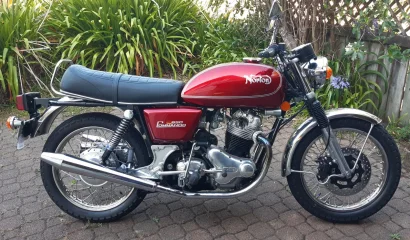
I tickle both carbs, start my 1974 850 Commando on the choke and idle it on the choke at the end of the drive while I shut the gate. Ride maybe 500 metres take choke off and it idles perfectly at 1100 or so thereafter . Also on Premiers that had the jets changed from 17 to 19. Apart from that standard Mk11 settings with the needle on the left hand carb raised one notch to get the plugs looking the same. Carbs balanced with guages. Pazon ignition set at 28 on calibrated primary case scale. Strobed at around 31 above 3000 rpm. Bike runs fine.

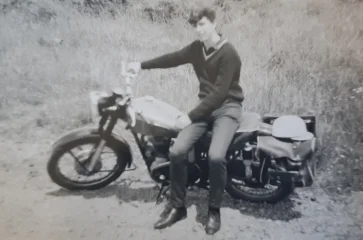
It's my old bike. Bought it in 1978. My days of riding in snow are long gone 🤣🤣🤣 The bike I rode back then in 1968, 15 years old and snow was a Matchless G3LS. Pretty sure it had a choke but that carb was pretty worn anyway. Would have been a Monobloc.
 

Attachments

  • JS Motorsport Pistons/Rods First Impressions
    20200526_092753.webp
    414.1 KB · Views: 207
  • JS Motorsport Pistons/Rods First Impressions
    20220130_152008.webp
    90.4 KB · Views: 204
I am a fair weather rider in California no need for a choke, I run Keihin CR carbs on the Norton, Amal concentrics on my 70 Triumph, when the concentrics wear out I have a pair of Mikunis waiting. The carb is not the issue when it comes to my idle issues, my ignition is.

In general I think that the advance curves on these electronic ignitions are set for the Triumph which is timed around 39 to 41 degrees with vintage specs and lot of guys running 37 with modern fuels, even then 4000 rpm is way too late to hit full advance, and mid range power is lost. From the seat of my pants testing I like full advance around 2500 rpm on the Norton, the Tri Spark comes closest to this in the available EI options.
 
I have FCRs and had all the JS parts, rods, pistons, cam, lifters, blah blah in my 750 Norton engine. I still have the JS2 cam and lifter setup, but different rods and pistons currently. No problems with idle warm with either set of rods and pistons. Won't idle at all right off dead cold start. Throttle has to be blipped for about 2 minutes then held open for 2 more minutes before it will start slow idling pre-warmup. I use the TriSpark ignition at static 29 degrees. No strobing a P11. It runs better mid summer.

I warm up my engine, but not idling. I do make sure it will idle before I head up my driveway to the surface street. To me it all seems completely typical of my Norton. If it had fuel injection and a computer controlling the fuel delivery, it would probably idle dead cold.

I did not ditch the JS long rods and pistons. I wanted to try another long rod set when I plopped on a new set of barrels. If I am repeating myself I'd be the last one to know it. :)
 
When I tune my 850 motor, I get carburation as lean as possible in the midrange, but rich on the main jets. I set the idle so that it idles perfectly when the motor is hot. My carbs are MK2 Amals so they have the enricher similar to a Mikuni. To start the motor, I usually have rollers which are powered by an angle grinder. When the motor is cold, I open both enrichers, then start the motor on idle without opening the throttle, and allow the motor to idle until it starts to slow. Then I close the enrichers and open the throttle.
I do not rev a cold motor. Even when the motor is hot, I start it with the throttle closed and let it idle. I use methanol fuel, however I would do the same with petrol.
Two-strokes are not much different to four-strokes, but if you crack the throttle while starting one, they usually refuse to start completely.
My 850 motor is tuned very similarly to a two stroke. Many guys probably do not realise the significance of that. The difference in jetting, between extremely fast and slow is bugger-all.
With a two-stroke, it is stop or go. If you get the midrange wrong, they will not even start.
 
Last edited:
Riding a race bike is different from riding a road bike. When you race you use lean jetting around all the slow parts, and full throttle when you are fairly well down the straights. With a road bike, you might use lean jetting for much longer, if you set it up like a race bike. With a race bike the main time when valves and pistons get burned are when full throttle is being used. A road bike might be different.
 
Unfortunately, after rebuilding the transmission and taking a closer look at everything, I ended up having to tear down the engine (main bearing spun on crank). Definitely not what I was hoping to do after two years and over 25,000 miles, but it was necessary. That said, once I got into it, I was pleasantly surprised by what I found inside.

The pistons are still in great shape. There’s some carbon buildup on the crowns and a bit of burnishing through in some small patches on the coated skirts, but dimensionally they still measure like new. The cylinder bores haven’t changed at all since my original rebuild notes. Not bad for a stock bore size and well over 50k total miles. The wrist pins fared the best there’s no visible wear or even signs of use, and the DLC coating is mind blowing. The pin-to-bore fit is unchanged, and the small ends of the rods look perfect, so I’ll be reusing those without hesitation.

The rod bearings also came out in surprisingly good condition. I didn’t grind the crank during the initial rebuild, and while the coating on the bearings shows some wear, the actual bearing surfaces underneath are intact and show no damage. In photos, they might look grooved, but I can’t catch a fingernail on them and the texture is barely noticeable by touch. I’d honestly feel comfortable running these again as-is, though I might send them out to be re-coated just to be thorough. The fit is still excellent, especially considering it’s the stock crank grind.

For the refresh, I’m planning to install a new set of rod bearings with the same dry film lubricant, and coating these as a spare. I’ve polished the crank,to remove any high spots, it is still in the standard spec so hopefully that helps reduce wear on the new coating. The pistons will get the same skirt coating they had before, along with a new high-temperature thermal barrier coating on the tops. Since the wrist pins are in such great shape, I’ll be reusing them as well. I’m also exploring the idea of making some new parts and having them DLC coated. I had initially hoped to coat my current rocker spindles and intermediate spindle, but was strongly advised against coating used or nitrided parts—so I’ll be sourcing new ones instead. Lastly I am going to experiment with the dry film coating on the rod bearings on all the bronze bushings and rocker bores.

While this was not ideal, I’m really encouraged by what I found inside. The wear is minimal, the components have held up far better than expected, and this refresh should give everything a solid new run. Hopefully I get more than another 2 years before I need to open things up again.

JS Motorsport Pistons/Rods First Impressions


JS Motorsport Pistons/Rods First Impressions


JS Motorsport Pistons/Rods First Impressions
 
Unfortunately, after rebuilding the transmission and taking a closer look at everything, I ended up having to tear down the engine (main bearing spun on crank). Definitely not what I was hoping to do after two years and over 25,000 miles, but it was necessary. That said, once I got into it, I was pleasantly surprised by what I found inside.

The pistons are still in great shape. There’s some carbon buildup on the crowns and a bit of burnishing through in some small patches on the coated skirts, but dimensionally they still measure like new. The cylinder bores haven’t changed at all since my original rebuild notes. Not bad for a stock bore size and well over 50k total miles. The wrist pins fared the best there’s no visible wear or even signs of use, and the DLC coating is mind blowing. The pin-to-bore fit is unchanged, and the small ends of the rods look perfect, so I’ll be reusing those without hesitation.

The rod bearings also came out in surprisingly good condition. I didn’t grind the crank during the initial rebuild, and while the coating on the bearings shows some wear, the actual bearing surfaces underneath are intact and show no damage. In photos, they might look grooved, but I can’t catch a fingernail on them and the texture is barely noticeable by touch. I’d honestly feel comfortable running these again as-is, though I might send them out to be re-coated just to be thorough. The fit is still excellent, especially considering it’s the stock crank grind.

For the refresh, I’m planning to install a new set of rod bearings with the same dry film lubricant, and coating these as a spare. I’ve polished the crank,to remove any high spots, it is still in the standard spec so hopefully that helps reduce wear on the new coating. The pistons will get the same skirt coating they had before, along with a new high-temperature thermal barrier coating on the tops. Since the wrist pins are in such great shape, I’ll be reusing them as well. I’m also exploring the idea of making some new parts and having them DLC coated. I had initially hoped to coat my current rocker spindles and intermediate spindle, but was strongly advised against coating used or nitrided parts—so I’ll be sourcing new ones instead. Lastly I am going to experiment with the dry film coating on the rod bearings on all the bronze bushings and rocker bores.

While this was not ideal, I’m really encouraged by what I found inside. The wear is minimal, the components have held up far better than expected, and this refresh should give everything a solid new run. Hopefully I get more than another 2 years before I need to open things up again.

JS Motorsport Pistons/Rods First Impressions


JS Motorsport Pistons/Rods First Impressions


JS Motorsport Pistons/Rods First Impressions
Nice update after some decent miles.

What do the cam, lifters and lifter blocks look like?
 
Unfortunately, after rebuilding the transmission and taking a closer look at everything, I ended up having to tear down the engine (main bearing spun on crank). Definitely not what I was hoping to do after two years and over 25,000 miles, but it was necessary. That said, once I got into it, I was pleasantly surprised by what I found inside.

The pistons are still in great shape. There’s some carbon buildup on the crowns and a bit of burnishing through in some small patches on the coated skirts, but dimensionally they still measure like new. The cylinder bores haven’t changed at all since my original rebuild notes.

My JSM Wiseco +.040 Norton 750 long rod piston skirts are not that pretty with only 2500 miles on them. I'm not pooh poohing Jim's parts. I'm just saying yours look incredibly clean for 25,000 miles. My cylinder bores have no scratches at all in them. The scratch near the oil ring are from me doing something during handling after taking them out. The piston material itself is perfect. The coating is warn in oval patches. I have a feeling your coating is thicker.

JS Motorsport Pistons/Rods First Impressions
 
Nice update after some decent miles.

What do the cam, lifters and lifter blocks look like?

Cam is fine, I am doing something new with it I polished it. Minor marks on the primary side journal, which is why I want to coat the bushings.

I spoke too soon on the rocker shafts mine are galled. After seeing how the DLC held up on the piston pin I am going to make some rocker spindles and intermediate spindles out of tool steel and have them DLC coated.

In the short term i took a 320 grit ball hone to the bore on the rockers themselves which looks rough drilled from the factory, I was debating running a dry film coating in there as well, but not sure it is needed with the DLC.

My JSM Wiseco +.040 Norton 750 long rod piston skirts are not that pretty with only 2500 miles on them. I'm not pooh poohing Jim's parts. I'm just saying yours look incredibly clean for 25,000 miles. My cylinder bores have no scratches at all in them. The scratch near the oil ring are from me doing something during handling after taking them out. The piston material itself is perfect. The coating is warn in oval patches. I have a feeling your coating is thicker.

The coating I had was much thicker, around 0.0015" to fit my bore. I am doing the same this round, but I am going to switch vendors as I want to use a higher heat rated top of piston coating.

Curious about the main bearing. What went wrong?

No clue, the race spun on the crank, all I can assume is that maybe there was not a great press fit to begin with, but I did not see or feel any issues with assembly. I did measure the crank from my notes, but I did not measure the bearing race. Hard to say as the crank shrunk more with this.

JS Motorsport Pistons/Rods First Impressions


JS Motorsport Pistons/Rods First Impressions


JS Motorsport Pistons/Rods First Impressions


JS Motorsport Pistons/Rods First Impressions
 
With the low balance factor of the Commando crank, it will always be difficult to get it to spin up quickly. When lighter pistons are fitted, the balance factor improves. Changing the balance factor the way I did it, is not good. If the steel plug came out of its hole, I would lose the motor. I did not know it, but at the time I built the Seeley 850 - where I worked I could have had a billet crank made for almost nothing.
Isolastics protect the frame - they do not change what the crank is doing. With a high balance factor, a Commando road bike would be like a BSA Gold Star - useless under 40 MPH - but better at high speeds.
 
A Triumph Saint 650 has a low crank balance factor. It was probably designed to be used by local council parking attendants. Every other Triumph 650 I have ridden had some get-up and go.
 
A Triumph Saint 650 has a low crank balance factor. It was probably designed to be used by local council parking attendants. Every other Triumph 650 I have ridden had some get-up and go.
Hmm, I suspect that your local constabulary would rather take offence at being described as "local council parking attendants" :cool:
 
Schwany
Your Wiseco piston molly coating is only .0005" thick (1/2 thou) on each skirt. Its considered a sacrifical coating to make sure there is no scuffing during break in. So the Wiseco coating has served its purpose especially if the underlying alum looks good.

Eric's pistons are coated with graphite. Its a thick .0015" coating on each skirt and the advantage is that its thick and conforms to the bore by wearing at the tight spots. But its an extra charge for my JE bare pistons as shown below.

JS Motorsport Pistons/Rods First Impressions
 
Schwany
Your Wiseco piston molly coating is only .0005" thick (1/2 thou) on each skirt. Its considered a sacrifical coating to make sure there is no scuffing during break in. So the Wiseco coating has served its purpose especially if the underlying alum looks good.

Eric's pistons are coated with graphite. Its a thick .0015" coating on each skirt and the advantage is that its thick and conforms to the bore by wearing at the tight spots. But its an extra charge for my JE bare pistons as shown below.
The last two engines I built (920 and 1007) had JS pistons with the thick coating as described an above.

I liked the notion that it beds in to suit the bore as you describe Jim. They were both built for track use so we’re gonna have a hard life.

Neither engines have been stripped since, so I don’t know what the pistons look like now, but all external indicators are still good. I’d definitely use the same in future
 
Back
Top