- Joined
- Dec 10, 2008
- Messages
- 7,253

L.A.B. said:
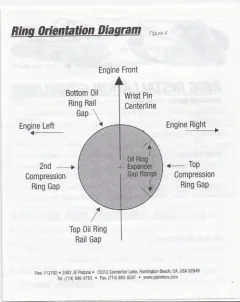
I have never heard that one. Obviously Hastings hasn't either as their picture shows the ends pointing toward the top of the piston. Jim

L.A.B. said:
The wear patterns shown in your first image are certainly due to variations in pressure the expander or expander rails are exerting on the cylinder. It is clear from the image that the wear pattern ends just at the witness mark from the top expander rail, and appears to occur uniformly between the top and bottom expander rails.MS850 said:Any ideas why both cylinders look like this, the vertical marks. Has Emgo pistons and Hastings rings, about 2000 miles on motor. Head was removed because of stud pulled on re-torque, (has inserts now).


comnoz said:I have never heard that one. Obviously Hastings hasn't either as their picture shows the ends pointing toward the top of the piston. Jim

WZ507 said:[
Was the engine using any oil? I ask because the limited view provided by the pictures suggest a damp look on the cylinder deck and piston sides, so just wondering.
I’d be tempted to pop a piston out, fit it with rings, and on the bench assemble into the bore and move it to see what it feels like and qualitatively or quantitatively (with a scale) assess the amount of drag that is occurring. Something seems out of whack there.
Regarding the ring gap spacing, there are myriad suggestions/opinions on the topic. Here is JE’s $0.02 on the subject.

concours said:Do the oil ring rails have "shiny spots" (magnifying glass)? Or evenly polished? A final grinding step COULD have been accidentally skipped....
It does happen. Recently I was in a precision bearing manufacturing shop, three pallets of bearings sitting there, rejected from a well know turbine engine manufacturer. Seems they somehow got a final grind step missed, they only showed up when assembled and engine test run. Both (engine) competitors HEARD of it, sent there bearings back just because. :shock:


MS850 said:concours said:Do the oil ring rails have "shiny spots" (magnifying glass)? Or evenly polished? A final grinding step COULD have been accidentally skipped....
It does happen. Recently I was in a precision bearing manufacturing shop, three pallets of bearings sitting there, rejected from a well know turbine engine manufacturer. Seems they somehow got a final grind step missed, they only showed up when assembled and engine test run. Both (engine) competitors HEARD of it, sent there bearings back just because. :shock:
I looked at the oil ring expander under a magnifying glass, I didnt see wear, no shinny spots.

Dances with Shrapnel said:Did you clip and shorten the oil ring expander upon initial install of the Pistons and rings? The butting of the expander ends does not look right and could be binding the rails, thus causing scuffing.
kerinorton said:Here is a good question. Apart from the pulled head stud, why did you pull the barrel off etc. If it want using oil, compressions were good??????
Why. Why Why.
maybe because there are tooooo many theorists on this site.
Have you too much time and too much money burning a hole in your pocket.
Sorry to be blunt.
Dereck
Danno said:I think you can see from the illustrations that the spacer's function is to hold the oil scrapers in place vertically and to contribute nothing to the axial tension of the scrapers. A better design has a turned-up rear face that keeps the spacer inside the outer perimeter of the scrapers where the type you have would allow it to float outward and contact the cylinder wall, resulting in the marks shown in the first photo. Could it possibly require a trimming of the ends? The total circumference of the spacer determines the diameter in situ and contact tension with the cylinder wall.
bill said:geeze I think we have had this conversation before. IT IS NOT A SPACER it is called an EXPANDER for a reason. nobody makes a 3 piece oil ring like you describe where it is JUST a spacer.
Danno said:I think you can see from the illustrations that the spacer's function is to hold the oil scrapers in place vertically and to contribute nothing to the axial tension of the scrapers. A better design has a turned-up rear face that keeps the spacer inside the outer perimeter of the scrapers where the type you have would allow it to float outward and contact the cylinder wall, resulting in the marks shown in the first photo. Could it possibly require a trimming of the ends? The total circumference of the spacer determines the diameter in situ and contact tension with the cylinder wall.

Danno said:Dances with Shrapnel said:Did you clip and shorten the oil ring expander upon initial install of the Pistons and rings? The butting of the expander ends does not look right and could be binding the rails, thus causing scuffing.
Exactly.