
You are using an out of date browser. It may not display this or other websites correctly.
You should upgrade or use an alternative browser.
You should upgrade or use an alternative browser.
Here's a question no one's asked
- Thread starter seattle##gs
- Start date

marshg246
VIP MEMBER
- Joined
- Jul 12, 2015
- Messages
- 6,077

Easier to understand here: https://gregmarsh.com/MC/Norton/Info/NortonTorque.aspxThank you all for this thread. My 850 head is off and I have new studs for the top of cylinders and for the head.
They will be installed with blue loctite.
The manual says to tighten the cylinders to crankcase "in sequence." Would that mean the 20 foot pounders first, then the 30, then the 25?
I would do them in stages but don't quite know what the manual means
Thanks again
Dennis
View attachment 123785
Number sequence not torque value sequence ie 1 - 10 .... see manual image
Well that is the issue , depending on the copy of the manual I guess.
In a scanned pdf of the workshop manual that I am looking at there is no image that I can find of a tightening sequence for the cylinder to crankcase studs.
There is only the image dennismo posted in post #20 which appears at or about page 62 of the 172 pages scanned.
marshg246
VIP MEMBER
- Joined
- Jul 12, 2015
- Messages
- 6,077
The workshop manual you are looking at is for 750/850 (065146) (generally considered to cover 1970-1973, copyright 1973) which adds confusion.Well that is the issue , depending on the copy of the manual I guess.
In a scanned pdf of the workshop manual that I am looking at there is no image that I can find of a tightening sequence for the cylinder to crankcase studs.
There is only the image dennismo posted in post #20 which appears at or about page 62 of the 172 pages scanned.
The same page says:
Which of course, simply adds confusion.
1) The words are referring to 750 except the last sentence.
2) Generally, in such things, you do a crisscross pattern which I'm guessing you're expected to know. But the wording even confuses that.
The MK3 workshop is a little more clear.
It's for reasons like this that I took the time to make the torque page on my site - hopefully no confusion and if there is, all someone needs to do is tell me what and I fix it.
2) Generally, in such things, you do a crisscross pattern which I'm guessing you're expected to know. But the wording even confuses that.
I think this was the gist of what dennismo was asking. Most of us know about criscrossing and such. But when a manual states "in sequence" we would expect they would give said sequence as the do in the case of the head bolts/studs where they give a numbered sequence.
Stephen Hill
Basic
- Joined
- Oct 28, 2009
- Messages
- 1,514

Greg, a very nice piece of work on Norton torques and head fasteners!
How diid Comstock repaired the pulled stud on the head referred to in the link? Did he use an oversize threaded bronze insert?
Can this thread be retitled? It is a useful thread but the content will be lost with such an ambiguous subject line.
How diid Comstock repaired the pulled stud on the head referred to in the link? Did he use an oversize threaded bronze insert?
Can this thread be retitled? It is a useful thread but the content will be lost with such an ambiguous subject line.

jseng1
Basic
- Joined
- Nov 26, 2009
- Messages
- 3,457
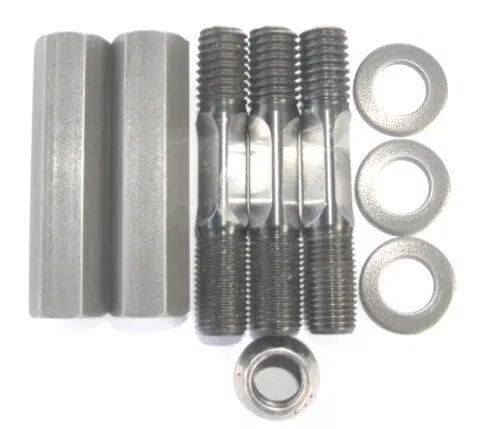
Like con rod bolts the 3 Norton head studs should have reduced shanks so they can stretch evenly and not pull out the alum threads thoughout heat expansion. But its better to triangulate the studs so the outside of the triangle has the same OD as the original stud because the stud shanks help locate and center the head on the cylinders. You can use heli coils or better yet inserts that don't spin out. Spring washers are also a good idea.

Shelby-Right
VIP MEMBER
- Joined
- Jan 28, 2022
- Messages
- 960

Don't torque studs, just make sure their fully screwed in, if you torque them, your just distorting the area around it.When installing the 3 head studs do you bother torqueing them or just guess at it? I've never known the answer. I usually use red locktite, a moderate amount of pressure, and hope the red loctite does not burn out.

robs ss
VIP MEMBER
- Joined
- Aug 16, 2016
- Messages
- 4,533

I don't agree JimLike con rod bolts the 3 Norton head studs should have reduced shanks so they can stretch evenly and not pull out the alum threads thoughout heat expansion. But its better to triangulate the studs so the outside of the triangle has the same OD as the original stud because the stud shanks help locate and center the head on the cylinders. You can use heli coils or better yet inserts that don't spin out. Spring washers are also a good idea.
I fully support reduced shanks where the item being clamped is aluminium (the head), which wants to expand with heat more than the steel bolts. The waisted bolts will stretch elastically a little bit more, reducing crushing damage to the head.
It's a different story for these three studs. They are clamping steel (the barrel) which expands at the same rate as the bolts - so, no waisting needed. They won't even reduce the "pull-out" force of these studs.
Same for 850 outside bolts holding the barrel to the crankcases - no waisting needed for the same reason.
They won't do any harm - just not needed.
Cheers
Last edited:

robs ss :I don't agree Jim
I fully support reduced shanks where the item being clamped is aluminium (the head), which wants to expand with heat more than the steel bolts. The waisted bolts will stretch elastically a little bit more, reducing crushing damage to the head.
It's a different story for these three studs. They are clamping steel (the barrel) which expands at the same rate as the bolts - so, no waisting needed. They won't even reduce the "pull-out" force of these studs.
Same for 850 outside bolts holding the barrel to the crankcases - no waisting needed for the same reason.
Studs depicted are replacements for 06.7885 CYLINDER HEAD STUD 3/8" (NM24389) , fitted into the head.
- Knut
jseng1
Basic
- Joined
- Nov 26, 2009
- Messages
- 3,457
rob ss - The stud or bolt tension still needs to be evened out with cast iron and that's why you see waisted through bolts for cast iron cylinder heads. And there are plenty of Norton Alum cylinder motors out there as well. A waisted stud is more forgiving tension wise and that's something to think about if you can't get a torque wrench in there to tighten up the three studs. Its best to have some elasticity because things change over time and repeated heat cycles - you still have to deal with head warpage. My stock studs stripped out when I had to retighten them (they loosened up).
Here's a quote off the web:
"Waisted (or necked-down) head bolts are used on cast iron engines to provide more consistent, uniform clamping force across the cylinder head, preventing head gasket failures, bolt breakage at the threads, and thread pulling from the block. By reducing the shank diameter, these bolts stretch more evenly under thermal expansion and torque."
In practice I think you'll find less tendency for oil leaks with the reduced shank studs/bolts and its one of the things I use to keep my Norton oil tight, This also applies to the two 5/16" studs near the pushrod tunnels that can be a probematic oil leakage area. See the reduced shank 5/16" studs below.
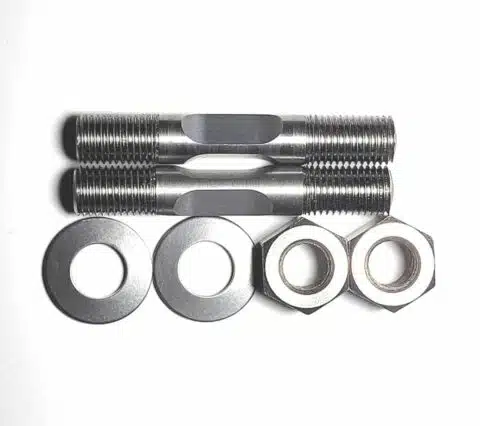
I also had to use .005" copper wire around the pushrod tunnels and use high temp pliobond contact cement.
3/8" reduced triangular shank studs for alum cylinders such as Maney or Molnar
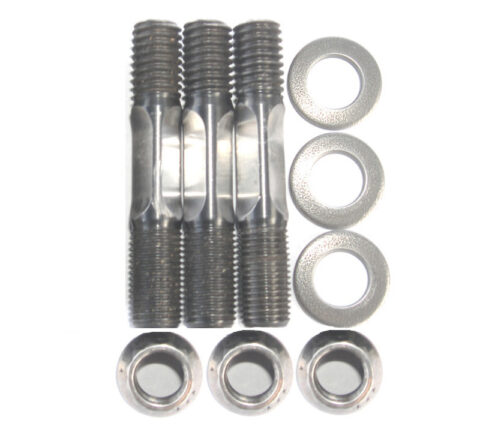
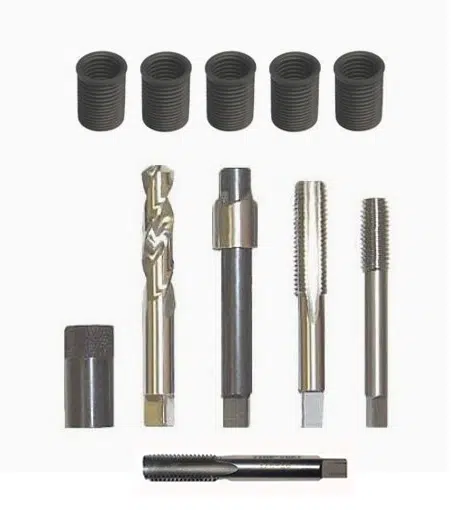
Time serts are my favorite (the extra tap is a bottoming tap for the 3 studs)
Here's a quote off the web:
"Waisted (or necked-down) head bolts are used on cast iron engines to provide more consistent, uniform clamping force across the cylinder head, preventing head gasket failures, bolt breakage at the threads, and thread pulling from the block. By reducing the shank diameter, these bolts stretch more evenly under thermal expansion and torque."
In practice I think you'll find less tendency for oil leaks with the reduced shank studs/bolts and its one of the things I use to keep my Norton oil tight, This also applies to the two 5/16" studs near the pushrod tunnels that can be a probematic oil leakage area. See the reduced shank 5/16" studs below.
I also had to use .005" copper wire around the pushrod tunnels and use high temp pliobond contact cement.
3/8" reduced triangular shank studs for alum cylinders such as Maney or Molnar
Time serts are my favorite (the extra tap is a bottoming tap for the 3 studs)
Last edited:
marshg246
VIP MEMBER
- Joined
- Jul 12, 2015
- Messages
- 6,077
Pity the fool that tries in install thread inserts in a Norton head with a hand drill or even a decent drill press. I paid a machine shop to do it, carefully explained the accuracy required, and got the head back with all three holes crooked and $90 missing from my wallet for their effort plus the cost of the inserts. Then with the appropriate amount of begging, time, and $$$, Jim Comstock saved the head for me.rob ss - The stud or bolt tension still needs to be evened out cast iron and that's why you see waisted through bolts for cast iron cylinders. And there are plenty of Alum cylinder motors out there as well. A waisted stud is more forgiving tension wise and that's something to think about if you can't get a torque wrench in there to tighten up the three studs.
Here's a quote off the web:
"Waisted (or necked-down) head bolts are used on cast iron engines to provide more consistent, uniform clamping force across the cylinder head, preventing head gasket failures, bolt breakage at the threads, and thread pulling from the block. By reducing the shank diameter, these bolts stretch more evenly under thermal expansion and torque."
In practice I think you'll find less tendency for oil leaks with the reduced shank studs/bolts and its one of the things I use to keep my Norton oil tight, This also applies to the two 5/16" studs near the pushrod tunnels that can be a probematic oil leakage area. See the reduced shank 5/16" studs below.
3/8" reduced triangular shank studs for alum cylinders such as Maney or Molnar
Time serts are my favorite (the extra tap is a bottoming tap for the 3 studs)
No chance in hell that I will replace those studs for the fun of it!
IMHO, regardless of what "the web" says, making bolts weaker is simply making bolts weaker! Do weaker bolts stretch more - I guess so. I've seen no study of the stretch of waisted bolts and the same bolts not wasted at 30 ft. lb. So, after studying using ARP and non-wasted bolts, the general consensus is that ARP bolts used in the three locations in a Norton head at 30 ft. lb. will stretch .001" - .0015" and an equivalent non-wasted bolt the same or slightly less. Keep in mind that the area of these three that could stretch is about 1" I am not any sort of expert, but then I've not heard/found any expert information either that comes close to matching this use case.
Last edited:
Jim,rob ss - The stud or bolt tension still needs to be evened out with cast iron and that's why you see waisted through bolts for cast iron cylinder heads. And there are plenty of Norton Alum cylinder motors out there as well. A waisted stud is more forgiving tension wise and that's something to think about if you can't get a torque wrench in there to tighten up the three studs. Its best to have some elasticity because things change over time and repeated heat cycles - you still have to deal with head warpage. My stock studs stripped out when I had to retighten them (they loosened up).
Here's a quote off the web:
"Waisted (or necked-down) head bolts are used on cast iron engines to provide more consistent, uniform clamping force across the cylinder head, preventing head gasket failures, bolt breakage at the threads, and thread pulling from the block. By reducing the shank diameter, these bolts stretch more evenly under thermal expansion and torque."
I agree with you that waisted bolts are a good idea to ease variations in bolt pre-stressing, thus helping to maintain a uniform gasket pressure. Furthermore, they will reduce cyclic load stresses in the bolt (caused by combustion pressure), thus protecting the threads.
Thermal expansion does not create the same clamp‑load variation in a Norton engine that waisted bolts are designed to mitigate in a car engine, where head bolts span the height of the head. Hence, any reference to thermal expansion needs to be dismissed.
Net effect of waisted cylinder head bolts in a Norton engine still needs to proven mathematically, and the question that must be asked is, does the short length of the waisted section yield a noticeable improvement over non-waisted studs? In car engines and modern m/c engines, the studs or bolts are much longer, and the waisted sections equally longer, creating a more favorable load vs. elongation behavior.
We agree that thermal expansion variations is irrelevant for the through-studs. However, the cyclic loading is not, and for the through-studs, waisted bolts would be a meaningful improvement, helping to prevent thread pull-out in the crankcase. Waisted through-bolts would be particularly useful in 750 engines converted to using 850-style cylinder barrels, including most alloy barrels.Same for 850 outside bolts holding the barrel to the crankcases - no waisting needed for the same reason.
- Knut
Last edited:
robs ss
VIP MEMBER
- Joined
- Aug 16, 2016
- Messages
- 4,533
@jseng1 and @mdt-son
I guess we'll have to agree to disagree.
If the bolt/stud is thermally expanding the same amount as the steel/iron (barrel in this case) then there will be no stretch needed, other than that during installation torquing.
...and don't get me started on "quotes off the web" or I'll ride clean off the edge of the flat earth
Cheers
I guess we'll have to agree to disagree.
If the bolt/stud is thermally expanding the same amount as the steel/iron (barrel in this case) then there will be no stretch needed, other than that during installation torquing.
...and don't get me started on "quotes off the web" or I'll ride clean off the edge of the flat earth
Cheers
SteveBorland
VIP MEMBER
- Joined
- Nov 15, 2010
- Messages
- 1,042

My experience was that prior to using the Comstock (CnW) bolt kit, I had problems with the fasteners loosing tension and oil leaks around the pushrod tunnels.. After converting, both problems solved. YMMV of course,@jseng1 and @mdt-son
I guess we'll have to agree to disagree.
If the bolt/stud is thermally expanding the same amount as the steel/iron (barrel in this case) then there will be no stretch needed, other than that during installation torquing.
...and don't get me started on "quotes off the web" or I'll ride clean off the edge of the flat earth
Cheers

concours
VIP MEMBER
- Joined
- Dec 29, 2011
- Messages
- 10,617
Likewise, I installed them 8 years ago.My experience was that prior to using the Comstock (CnW) bolt kit, I had problems with the fasteners loosing tension and oil leaks around the pushrod tunnels.. After converting, both problems solved. YMMV of course,
Purchased directly from Jim Comstock.
No leaks anywhere.
Last edited:
This is the best chart ever- I’m printing it to hang in the shop.There is a lot to know on this subject. Please read to the end: https://gregmarsh.com/MC/Norton/Info/HeadStudStudy.aspx
I always put studs in aluminum with blue threadlocker (243). My primary goal being so the next guy doesn't have the stud come loose when removing the nut. If the stud is stainless, that also works as an anti-seize. I "feel like" it also tightens the stud to aluminum threads but that's probably not true.
I don't/won't use red threadlockers - too many times taking apart bikes where someone used it. Takes way too much heat to release to get things apart without damage and not using the heat will bring the threads out of aluminum if you don't know it's in there and try too hard. Also, IMHO, it's not good to heat things like cases to the red release temp.
So, I use blue threadlocker (243), double-nut, and snug them, no torquing.
BTW, just saying the color is not enough:
View attachment 123781

Fast Eddie
VIP MEMBER
- Joined
- Oct 4, 2013
- Messages
- 23,096

Same here and I’m running them on two engines fitted with Maney alloy barrels, which are well known for leaking around the pushrod tunnels.My experience was that prior to using the Comstock (CnW) bolt kit, I had problems with the fasteners loosing tension and oil leaks around the pushrod tunnels.. After converting, both problems solved. YMMV of course,
Both are big bores, so reduced head material, also renowned for leakages.

Schwany
VIP MEMBER
- Joined
- Apr 22, 2020
- Messages
- 3,839
The cNw parts are pretty, but I removed all of the cNw head fasteners because I'm using Molnar barrels. With Molnar barrels the cNw head fasteners don't work because Molnar uses a 3/8" x 20tpi thread instead of 3/8"-24, or whatever it is. None of the stainless fasteners for the head on my 750 are of the wasted variety now. No leaks. Making sure the head and deck surfaces are flat and some copper kote on a copper head gasket = zero leaks with my high compression 750. I do use the JS wasted barrel through bolts with no leaks at the base without a gasket and some sealant not recommended by the prolific posters. Those 4 bolts do need to stretch with alloy barrels. However, I really have no idea if they make a big difference over the standard bolts commonly used. Never used the standard through bolts.
My guess is I will eventually have some weeping between the head and barrels, but it won't have anything to do with the bolts. It'll be too much throttle for too long. Sometimes I forget I'm riding a Norton.
My guess is I will eventually have some weeping between the head and barrels, but it won't have anything to do with the bolts. It'll be too much throttle for too long. Sometimes I forget I'm riding a Norton.
Similar threads

- Replies
- 43
- Views
- 9,104

- Replies
- 10
- Views
- 1,288

- Replies
- 2
- Views
- 809