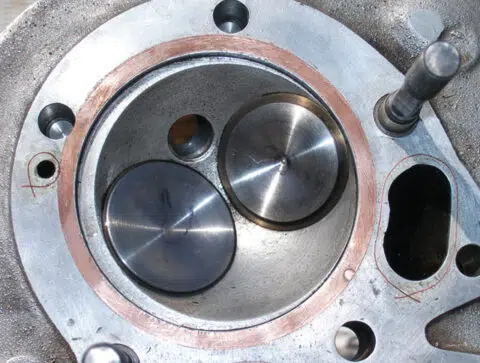
Norton Desaxe cylinder offset

What’s the formula for optimum results ?
I don't think there is a formula behind this due to the large number of variables. To keep development costs low, most large manufacturers build one-cylinder test engines for trying out various configurations. Once a maximum gain is found, the design parameter is frozen.

In the world of cars, we can find desaxe values up to 14 mm (Honda K and R series engines).

- Knut
 
Jim
Have to tested to ensure the thick end of the gasket does not overly compress, negating the effect you're looking for?
What "effective desaxe" value are you chasing? Zero or further?
Cheers
 
Jim
Have to tested to ensure the thick end of the gasket does not overly compress, negating the effect you're looking for?
What "effective desaxe" value are you chasing? Zero or further?
Cheers
It will be made of steel and will not compress. You'll want to use Yamabond sealer. I'm going for .097" offset towards the front from the stock location. That should give it a millimeter or so Desaxe in the right direction. Ideally I would want about 2mm but I'm not ready to push it that far yet. They should be ready in about a month. It will raise the head about 1/32" but I have a .003" headgasket ring that will restore compression with .005" copper wire and plyobond around the pushrod tunnels and oil return (I've been using one 10 years without leaks).

Norton Desaxe cylinder offset
 
If Norton designed their engines with considerations of desaxe, there are probably relevant research papers. There is a matter of angularity and the timing at which maximum thrust occurs, which must affect the torque characteristics of the motor. In that area, the Commando motor is very different from many others. It can give the impression that it is pulling as strongly as it can - when it actually is not. If you lose revs on an up-change, the acceleration rate is much slower due to the heavy crank. It affects throttle position, and means richer mixture. Everything affects everything else. Close ratio gears have a big effect on performance. In the end, whatever we end up with, we need to work with by changing gearing timings, exhausts and jetting etc.
 
When I want a motorcycle to accelerate faster, I usually lower the gearing. I also used to believe that bigger inlet ports give more power - so better acceleration. It takes practice to know when you are faster or slower. When the gearing is lowered behind a Commando motor, the motor does not usually spin-up much quicker. I prefer it to a light crank motor, but it must be kept spinning high.
 
Last edited:
It will be made of steel and will not compress. You'll want to use Yamabond sealer. I'm going for .097" offset towards the front from the stock location. That should give it a millimeter or so Desaxe in the right direction. Ideally I would want about 2mm but I'm not ready to push it that far yet. They should be ready in about a month. It will raise the head about 1/32" but I have a .003" headgasket ring that will restore compression with .005" copper wire and plyobond around the pushrod tunnels and oil return (I've been using one 10 years without leaks).

Norton Desaxe cylinder offset
You have mentioned moving the desaxe 'in the right direction', however I suggest that what is 'correct' depends on what is achieved when all the variables are adjusted to suit the change. The Commando 850 engine has surprised me - what is right seems so wrong - my Seeley 850 is beautiful in a race - that is strange. When I first began racing it, it was really weird - it took a bit to become used to the crank inertia. But it actually works very well.
 
Last edited:
You have mentioned moving the desaxe 'in the right direction', however I suggest that what is 'correct' depends on what is achieved when all the variables are adjusted to suit the change. The Commando 850 engine has surprised me - what is right seems so wrong - my Seeley 850 is beautiful in a race - that is strange. When I first began racing it, it was really weird - it took a bit to become used to the crank inertia. But it actually works very well.
If you ignore your racing irrelevance - to minimise the force on the heaviest thrust side of the piston the desaxe movement should be towards the front.
For bean counting reasons, Norton moved it to the rear.
Jim's innovation is to not treat "horizontal" as sacrosanct, instead, creating a new "horizontal", thus eliminating Norton's wrong desaxe ( and going a bit further - post #83)
 
'For bean counting reasons, Norton moved it to the rear.' Is that a statement of fact, or supposition ? Is there documentation of Joe Craig's and Bert Hopwood's work on engine development ? Regardless of whether the bike is for road or race use - a good engine setup is important.
 
I would not presume that the desaxe in the Norton motor is either right or wrong. It probably depends on a lot of other things as to what is the most suitable desaxe. I am surprised that the Commando 850 motor responds so well to tuning. It is very different.
 
I would not presume that the desaxe in the Norton motor is either right or wrong. It probably depends on a lot of other things as to what is the most suitable desaxe. I am surprised that the Commando 850 motor responds so well to tuning. It is very different.
I would presume. There is not a single modern engine with a "negative" desaxe.
 
It is not possible to predict what changing desaxe might do without evidence. It is almost certain that somebody has tried variations of it. Institutes of Automotive Engineers used to keep research papers.
 
It is not possible to predict what changing desaxe might do without evidence. It is almost certain that somebody has tried variations of it. Institutes of Automotive Engineers used to keep research papers.
There's plenty of evidence and it makes sense in theory and it works in practice. Nobody questions it.
 
There's plenty of evidence and it makes sense in theory and it works in practice. Nobody questions it.
I am not questioning it. If somebody was going to remanufacture crankcases, they would need more than anecdotal evidence about the effects of changing desaxe. What Jim is doing with the base gasket, is a good thing. In reality, there is probably documented in formation on the effects. However with any motor, we never know the effects of a change until we work with it. The motorcycle is changed to suit its purpose, and the rider adapts to the bike. A rider who has ridden an excellent motorcycle, is often capable of improving a less perfect one. However Mike Hailwood began racing on a world championship winning Mondial 250, and was not good at conveying what needed changing to improve performance. Marc Marquez improves by crashing. Japanese motorcycles are good because the Japanese do their research. I suggest Joe Craig probably never told anybody anything. Norton were always about racing.
 
I am not questioning it. If somebody was going to remanufacture crankcases, they would need more than anecdotal evidence about the effects of changing desaxe. What Jim is doing with the base gasket, is a good thing. In reality, there is probably documented in formation on the effects. However with any motor, we never know the effects of a change until we work with it. The motorcycle is changed to suit its purpose, and the rider adapts to the bike. A rider who has ridden an excellent motorcycle, is often capable of improving a less perfect one. However Mike Hailwood began racing on a world championship winning Mondial 250, and was not good at conveying what needed changing to improve performance. Marc Marquez improves by crashing. Japanese motorcycles are good because the Japanese do their research. I suggest Joe Craig probably never told anybody anything. Norton were always about racing.
In this video, there is a photo of John Surtees working in the Norton factory in the 1960s -
 
Back
Top