1972 750 Interstate Resurrection

So, you owned the bike in 1976? Was it running? If both are true, how is there a clearance issue now? Feel free to call me!


OK, will give a ring soon.

Just for the record, yes, I have owned the bike since 1975 and put around 28 thousand miles on it before 1979. Mostly long distance touring around USA and Canada. Was taken apart sometime early 80s and hasn't been back together since.
 
OK, will give a ring soon.

Just for the record, yes, I have owned the bike since 1975 and put around 28 thousand miles on it before 1979. Mostly long distance touring around USA and Canada. Was taken apart sometime early 80s and hasn't been back together since.
This is not definitive in any way but might help understand if the crankcases have been decked. The gap between the intake lobe and the crankcase is .010" on both sides in the Combat engine I'm building with a new 2S cam and new MK3-style timing side bushings. The exhaust clearance is more but I didn't measure.


1972 750 Interstate Resurrection
 
$20 eBay Yamaha Vino 125 scooter MC, can chirp or lock the front up with very good control at any road-legal speed (but I must admit my tires are K70 repros, which have pencil-eraser rubber compound). I believe it's a 12mm.

Ferodo organic pads, drilled rotor, braided steel line with the stock Lockheed Norton caliper. Stops as well as any bike I've owned, but I had ABS on my Ducati Multistradas and Honda VFRs, so that's nice too.

1972 750 Interstate Resurrection


1972 750 Interstate Resurrection
 
Well I continue to putter with this and that and the past few days been looking at gearbox lay and mainshafts. No fancy (or even cheap) lathes have I so I put this together to have a go at checking for straightness.


IMG_20251001_172407.jpg
20251001_183549.jpg


My bikes' mainshaft clocked in at 0.08 mm max runout at the center with lesser amounts moving towards each end. That's a little over 3 thousandths, right?


I bought a scrap gearbox off ebay about a month ago to play with. That mainshaft ran about 0.23 mm max runout at center. About 9 thousandths inch?? Again with lesser deviation towards the ends.

I had seen a post here stating that .002 is maybe OK.

I recently read another post here, maybe an old thread where someone used a hydraulic press to straighten their mainshaft. I have no such fancy device here but I do have a porta-power type device.

Some time ago I used that porta-power to straighten out some 1" OD tube so I used the same setup to have a go at this ebay mainshaft. The material at all the contact points is pieces of soft copper.

20251002_134941.jpg


Got it down to about 1.5 thousandths (.0015") max at center. I haven't decided whether I would use a shaft tweaked in this fashion but it's fun to experiment with this stuff.


A related/unrelated comment: The makers of dial indicators like the one seen above would be wise to implement a short time delay on their zero function. The moment you touch the gauge to press the zero button the device shifts ever so little. Have to press the button several times to actually get it set right. When taking macro images with my cellphone I generally set the phone in a device and use the timer for shutter release so everything can recover from my touch before the shutter trips.
 
Well I continue to putter with this and that and the past few days been looking at gearbox lay and mainshafts. No fancy (or even cheap) lathes have I so I put this together to have a go at checking for straightness.


View attachment 121942View attachment 121943

My bikes' mainshaft clocked in at 0.08 mm max runout at the center with lesser amounts moving towards each end. That's a little over 3 thousandths, right?


I bought a scrap gearbox off ebay about a month ago to play with. That mainshaft ran about 0.23 mm max runout at center. About 9 thousandths inch?? Again with lesser deviation towards the ends.

I had seen a post here stating that .002 is maybe OK.

I recently read another post here, maybe an old thread where someone used a hydraulic press to straighten their mainshaft. I have no such fancy device here but I do have a porta-power type device.

Some time ago I used that porta-power to straighten out some 1" OD tube so I used the same setup to have a go at this ebay mainshaft. The material at all the contact points is pieces of soft copper.

View attachment 121944

Got it down to about 1.5 thousandths (.0015") max at center. I haven't decided whether I would use a shaft tweaked in this fashion but it's fun to experiment with this stuff.


A related/unrelated comment: The makers of dial indicators like the one seen above would be wise to implement a short time delay on their zero function. The moment you touch the gauge to press the zero button the device shifts ever so little. Have to press the button several times to actually get it set right. When taking macro images with my cellphone I generally set the phone in a device and use the timer for shutter release so everything can recover from my touch before the shutter trips.
I like your "between centers" contraption but check the two ends before the center. If the centers in the shaft or your pointed screws are not true then the center of the shaft cannot be expected to be true. Also, the shafts generally don't bend in the center, but at one point or another away from center. The last two I checked on a surface plate (not using centers) were true a few tenths everywhere.

After you straighten one, then you probably need to temper it - someone here with much more knowledge of metallurgy than me should speak up on that.

BTW, life is simpler with analog dial indicators and micrometers IMHO. They certainly don't have the issue you mention with zeroing.
 
like your "between centers" contraption but check the two ends before the center. If the centers in the shaft or your pointed screws are not true then the center of the shaft cannot be expected to be true. Also, the shafts generally don't bend in the center, but at one point or another away from center. The last two I checked on a surface plate (not using centers) were true a few tenths everywhere.


I tried a little bit on the surface plate but haven't got the hang of that yet.

Since the end points of my contraption do not rotate while I am checking I don't think I am actually checking against the shafts centers. Not sure about that. I guess it would depend on the accuracy of the small taper at the ends of the bore through the shaft??

I did check the endpoints as well as many points along the shafts.


shafts generally don't bend in the center, but at one point or another away from center.

I figured that maybe looking at the deviations along the shaft would point to where the bend was.


One odd thing between the two shafts..... the Rbay shaft mics slightly larger diameter than the original unworn diameter of my bikes shaft, seen at the center of my sleeve gear. Can't remember the value right now but it struck me odd.
 
One odd thing between the two shafts..... the Rbay shaft mics slightly larger diameter than the original unworn diameter of my bikes shaft, seen at the center of my sleeve gear. Can't remember the value right now but it struck me odd.
The timing side of the mainshaft must be fairly accurate as it must be a snug slip fit in the bearing. In a perfect world, the drive side would be perfect where it passes though the sleeve gear but there are tolerances for the bushes so I'm guessing for the mainshaft too:

1972 750 Interstate Resurrection
 
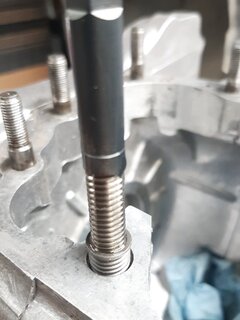
So is there a go-to fix for this?? It's for the front center stud for the cylinder barrel.

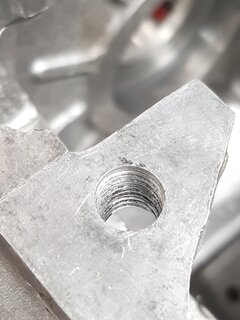
What a mess! Best I can tell there was a perhaps M10x1.5 stud in there. I may be responsible for this, it would have been like 45 years ago!

Helicoil/Time-Sert or the like, but what stud may be available? The original 06-2641 looks awfully short on the case end?


View attachment 121441


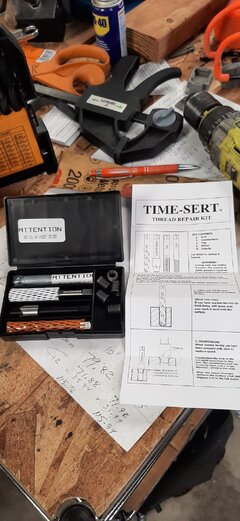
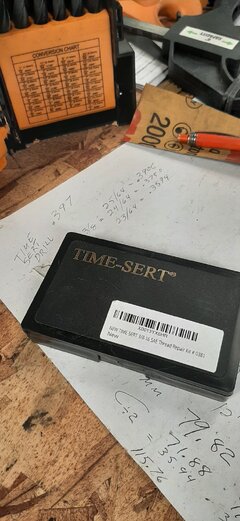
Quoted above is post #96. Don't think I got any comments on this. I finally worked up the nerve to install a Time-Sert here. Never done such a repair before.

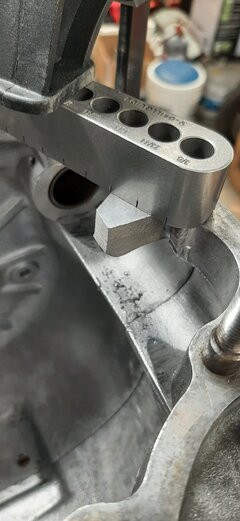
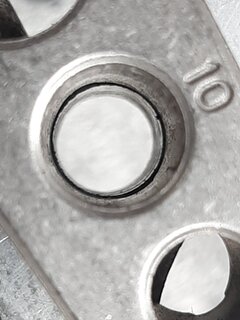
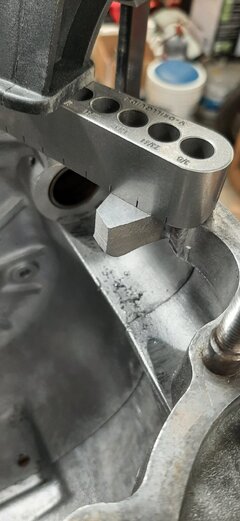
Once I had the TimeSert kit in hand I mic'd the included drill bit then gauged my existing hole using the butt ends from a drill bit index that increments by 64ths of an inch. Did this so I knew how much I had to play with.

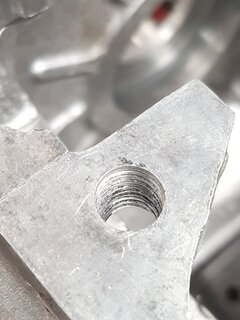
The existing hole was not perpendicular to the crankcase deck, was leaning a little forward and to the drive side. I remember this causing some troubles when mating the cylinders to the crankcases in the long ago past.

With the existing hole a little crooked I expected to have some issues with getting the new hole straight so I decided I would drill only the minimum increase I could and check each result. So between the existing hole and the Time-Sert bit I had several 64ths to work with.

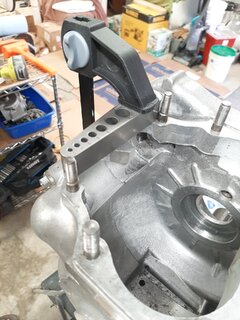
After using a battery powered hand drill for the first pass I decided to NOT use the power drill. Even with drill guides I didn't like the measure of control I got so everything else would be done by hand, slowly.

The first pass was mainly just starting to clear the uneven existing threads. The hole was larger at the top than the bottom. Decades ago a metric stud was run into the case, I guess the original threads pulled? Cannot remember.

The first couple of passes did not help to straighten the hole up. The uneven exit into the camshaft bore didn't help, tending to tilt the drill bits as they exited. At some point I decided I would use a rat tail file in through the hole to try to help steer the bottom of the hole towards the front of the crankcase. I had several 64ths still to go so I felt this was my best option with the tools at hand.

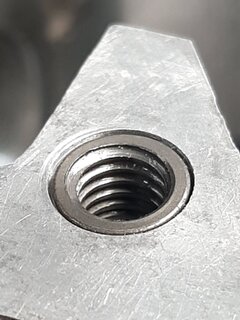
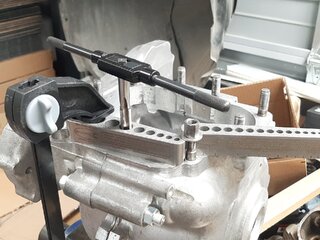
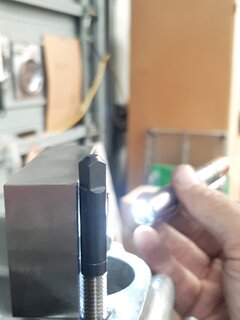
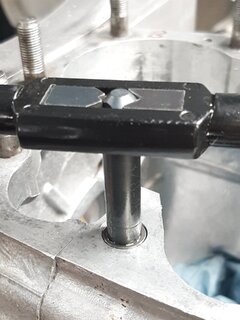
This worked and I got a decent hole with the Time-Sert bit, that bit being 0.3970". Next came the counterbore bit which was easy enough. Then came the Time-Sert tap. Time-Sert recomends the use of WD-40 for the drilling and tapping.

30W Oil is called for when using the insert driving tool. This operation also went well and I got what looks to be a good end result. The driver tool is quite snug after setting the insert and I used that as a check for straightness. No absolutely perfect but far better than it was before.
 

Attachments

  • 1972 750 Interstate Resurrection
    IMG_20251008_170024.jpg
    215.3 KB · Views: 98
  • 1972 750 Interstate Resurrection
    IMG_20251008_150320.jpg
    227.1 KB · Views: 87
  • 1972 750 Interstate Resurrection
    IMG_20251008_171815.jpg
    228.2 KB · Views: 90
  • 1972 750 Interstate Resurrection
    20251008_150232.jpg
    171.8 KB · Views: 87
  • 1972 750 Interstate Resurrection
    IMG_20251008_155555.jpg
    174.8 KB · Views: 86
  • 1972 750 Interstate Resurrection
    IMG_20251008_155639.jpg
    365 KB · Views: 97
  • 1972 750 Interstate Resurrection
    IMG_20251008_164329.jpg
    322.9 KB · Views: 96
  • 1972 750 Interstate Resurrection
    IMG_20251008_171018.jpg
    164.5 KB · Views: 90
  • 1972 750 Interstate Resurrection
    IMG_20251008_170522.jpg
    242.4 KB · Views: 89
  • 1972 750 Interstate Resurrection
    20251008_154131.jpg
    228.7 KB · Views: 98
Quoted above is post #96. Don't think I got any comments on this. I finally worked up the nerve to install a Time-Sert here. Never done such a repair before.

Once I had the TimeSert kit in hand I mic'd the included drill bit then gauged my existing hole using the butt ends from a drill bit index that increments by 64ths of an inch. Did this so I knew how much I had to play with.

The existing hole was not perpendicular to the crankcase deck, was leaning a little forward and to the drive side. I remember this causing some troubles when mating the cylinders to the crankcases in the long ago past.

With the existing hole a little crooked I expected to have some issues with getting the new hole straight so I decided I would drill only the minimum increase I could and check each result. So between the existing hole and the Time-Sert bit I had several 64ths to work with.

After using a battery powered hand drill for the first pass I decided to NOT use the power drill. Even with drill guides I didn't like the measure of control I got so everything else would be done by hand, slowly.

The first pass was mainly just starting to clear the uneven existing threads. The hole was larger at the top than the bottom. Decades ago a metric stud was run into the case, I guess the original threads pulled? Cannot remember.

The first couple of passes did not help to straighten the hole up. The uneven exit into the camshaft bore didn't help, tending to tilt the drill bits as they exited. At some point I decided I would use a rat tail file in through the hole to try to help steer the bottom of the hole towards the front of the crankcase. I had several 64ths still to go so I felt this was my best option with the tools at hand.

This worked and I got a decent hole with the Time-Sert bit, that bit being 0.3970". Next came the counterbore bit which was easy enough. Then came the Time-Sert tap. Time-Sert recomends the use of WD-40 for the drilling and tapping.

30W Oil is called for when using the insert driving tool. This operation also went well and I got what looks to be a good end result. The driver tool is quite snug after setting the insert and I used that as a check for straightness. No absolutely perfect but far better than it was before.
 

Attachments

  • 1972 750 Interstate Resurrection
    IMG_20251008_150320.jpg
    227.1 KB · Views: 91
  • 1972 750 Interstate Resurrection
    20251008_150232.jpg
    171.8 KB · Views: 90
  • 1972 750 Interstate Resurrection
    20251008_154107.jpg
    227.2 KB · Views: 103
The existing hole was not perpendicular to the crankcase deck, was leaning a little forward and to the drive side. I remember this causing some troubles when mating the cylinders to the crankcases in the long ago past.
...
30W Oil is called for when using the insert driving tool. This operation also went well and I got what looks to be a good end result. The driver tool is quite snug after setting the insert and I used that as a check for straightness. No absolutely perfect but far better than it was before.
Good job and great write-up. Great move switching to hand drilling - much less chance of disaster!

Studs that are not perpendicular are more likely to pull, but then a timesert is less likely to pull. At any rate, don't overtighten that nut if you're off on perpendicular. 1-2 degrees may be OK, but more is not good. You've had a good experience - don't think fixing a stud in the head is the same - you cannot be off from perpendicular on those because the head studs won't go in the cylinder.
 
Last edited:
Is it common to find some studs that are listed as being the same part not appearing the same?

These are the studs I removed from my cases, minus the 9mm one that was in the center front. Starting from the top, 2 of the 6 standard studs don't look the same as the next 4. The coarse thread is a bit shorter and the center unthreaded portion is a bit longer.

I think I noticed a hole or two that look to be countersunk a bit.

1972 750 Interstate Resurrection
 
Is it common to find some studs that are listed as being the same part not appearing the same?

These are the studs I removed from my cases, minus the 9mm one that was in the center front. Starting from the top, 2 of the 6 standard studs don't look the same as the next 4. The coarse thread is a bit shorter and the center unthreaded portion is a bit longer.

I think I noticed a hole or two that look to be countersunk a bit.
Unfortunately, yes. Fortunately, in the case you showed, it won't physically matter. These are not precision machines and parts did not always come from the same suppliers.

When overtightened, the edge of the hole can rise a little and making a potential sealing a problem. I cut that off, but some countersink. Countersinking is OK as long as it's a little. It's also important to use the correct thick washers under the base studs nuts.

Also, if buying from other than AN, some may be way too long. I bought a stainless set from RGM where the stud you fixed was WAY too long on the crankcase threaded end. Also, AN goes by the Norton drawings that weren't always matching reality and RGM (poorly) made a fix for one of those problems - see this horror story: https://gregmarsh.com/MC/Norton/Info/HeadStudStudy.aspx
 
You've had a good experience - don't think fixing a stud in the head is the same - you cannot be off from perpendicular on those because the head studs won't go in the cylinder.


So I decided to have a look at the studs in my "doorstop" head. Just to see what I might learn. It's too heavy for a paperweight and it's not good for anything else as far as I'm concerned. It is not the original head from the bike. That's a story for another day.

I will be replacing this head for the bike.

I had previously noticed that the head gasket did not easily slide over the 3 studs. The drive side stud close to the exhaust had to lead the other 2 studs by maybe a half inch or so. If I tried to place the gasket on parallel to the head surface there is not enough distance between the drive side stud and the rear center stud. Only when the gasket is seated at the head surface is there proper hole alignment.

IMG_20251014_144313.jpg


It can be mated to the cylinder barrel but it takes a good deal of fiddling to get the 3 studs in.

I used a reference block (1-2-3) on the head surface and rotated it around the stud(s) until the stud surface lines up with the reference block. The error would then be perpendicular to that orientation.

I moved the reference block 90 degrees around in the direction of the stud lean to have a look at the amount of error. The picture here somewhat exaggerates the error due to the light.

IMG_20251014_134240.jpg


Now if the error were in the stud and I rotate the stud 180 degrees I should see it go the other way.

It doesn't. In fact no amount of rotation alters the lean angle or direction. This tells me the error is in the head itself and the stud(s) are apparently fairly straight. I guess not really surprising given the era these heads were produced in.

The holes in the head do not appear to me to have been altered in any way.

IMG_20251014_141818.jpg


I have done this test 3 times now with the same results. Most recently today I tried all 3 studs in each of the 3 holes of the head and not one of the holes is perfectly true. I saw the same results with each of the studs in each of the holes. One is very close but still exhibits a very slight lean. The sharpie marks here indicate the lean direction.

IMG_20251014_141015.jpg


EDIT: A question: Can a threaded hole in a head begin straight and get pulled out of alignment during use??? Like a precursor to the threads pulling??
 
Last edited:
I have done this test 3 times now with the same results. Most recently today I tried all 3 studs in each of the 3 holes of the head and not one of the holes is perfectly true. I saw the same results with each of the studs in each of the holes. One is very close but still exhibits a very slight lean. The sharpie marks here indicate the lean direction.
Bores were machined in semi-automatics aided by jigs at the factory, thus I find it had to believe the bores were drilled skew. Could the observed skewness be a result of thermal deformation? I noticed your head has been decked, but this does not rectify bore orientation. It appears your head has lifted in the middle, causing a rotation of the threaded bore axes towards the center. more or less.

- Knut
 
Bores were machined in semi-automatics aided by jigs at the factory, thus I find it had to believe the bores were drilled skew. Could the observed skewness be a result of thermal deformation? I noticed your head has been decked, but this does not rectify bore orientation. It appears your head has lifted in the middle, causing a rotation of the threaded bore axes towards the center. more or less.

- Knut

I sort of figured they had some sort of jig at least.


Thermal deformation.... I will confess that when I used this head in 1978 I was like 21 years old and did not own a torque wrench. So lord only knows what the bolts and nuts were tightened to. ;)
 
I noticed your head has been decked

So the story of this head:

It's the summer of 1978. I have ridden from south eastern New York State westward through the midwest to South Dakota then angled northwest to Montana, up into Alberta, west through Banff, south through the Okanagan Valley and Washington State, westward along the Columbia River to Portland OR at the Pacific coast then south on the coast highway to southern California.

There some forgotten reason had me remove the head and barrel. I took the head to Jack Hateley I think in Burbank for refresh. Their shop was very backed up and they offered to swap heads with me instead of having me wait for mine. I should have waited.

My head was the original Combat head with the C stamped on top. The head they offered was not a Combat head but they said they had somewhat made it into one. Perhaps they decked it, I don't know. They did show me that when they were porting out the intakes they once broke through to the outside. They showed me the spot and how they had welded it up. They had a good reputation, I think I have read Jack had ridden for Norton ?? So I figured they knew what they were doing. I swapped my head for theirs. Bad move.

On my return trip to New York somewhere eastbound on an interstate in Iowa while decelerating into a rest area the weld let go.

The small weld material went into the chamber and bounced around in there taking out the spark plug. I remember pulling that plug and seeing the ground electrode bent and porcelain mosty gone and wondering wtf happened here?!? In due course I found the open hole where the weld had been. Well crap, what do I do now. I had some blue silicone sealer with me so I squirt that into the finned area of the opening and let that sit overnight while I get some sleep on a picnic bench or wherever. That's how I travelled then, sleeping under bridges and such.

Come morning the silicone has set up enough and I set off for New York. The bike took a beating on that trip and the following spring I bought a used Honda CB750 and used that for several years before retiring from motorcycling.

The Norton was dismantled at some point after that ill fated trip and only now is being slowly addressed and ready for reassembly.

This shot of the piston tops reveals some of the carnage that happened in one chamber.

20250808_165937.jpg


So I don't really have much history of the head beyond that. It makes sense what you say about perhaps the head is thermally distorted, the center having risen thus tilting the studs inward. Though I cannot remember specifics I am fairly certain I had no torque wrench and very likely had uneven clamping across the head that perhaps added to the distortion??

@marshg246 is going to put a replacement Combat head together for me so all this is not an issue but an opportunity for me to experiment and learn and play with new toys (1,2,3 blocks, machinist squares, micrometers etc.)
 
Last edited:
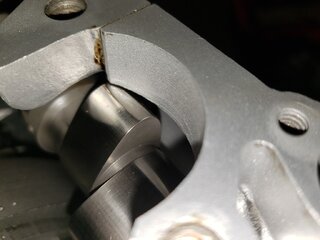
Well this doesn't look good at all. I was cleaning up my cases a bit before taking them to cNw for cam bushings and a cleaning service. Then I discovered this.... timing side by the tach drive.

1972 750 Interstate Resurrection


Saw this post that sounds like it was the same place??


Given that I doubt I will put more than a couple thousand miles on this in my remaining lifetime after I get it back together I am hopeful there is someone who can weld this.
 
Well this doesn't look good at all. I was cleaning up my cases a bit before taking them to cNw for cam bushings and a cleaning service. Then I discovered this.... timing side by the tach drive.

View attachment 122146View attachment 122147


Saw this post that sounds like it was the same place??


Given that I doubt I will put more than a couple thousand miles on this in my remaining lifetime after I get it back together I am hopeful there is someone who can weld this.
Someone good at welding cast aluminum can easily fix that. I had a Kawasaki H2 case with a MUCH worse crack welded and it held fine. It must be V'ed out, cleaned out, and welded. You'll probably need the mating surface milled slightly. This is not a "Joe Bob" job! You might email the picture to Jim Comstock and see what he says - I would think bronze insert for the threaded hole after the welding. http://nortonmachineshop.com/ or ask Matt - he might have someone that can do it while the cases are there.
 
Someone good at welding cast aluminum can easily fix that. I had a Kawasaki H2 case with a MUCH worse crack welded and it held fine. It must be V'ed out, cleaned out, and welded. You'll probably need the mating surface milled slightly. This is not a "Joe Bob" job! You might email the picture to Jim Comstock and see what he says - I would think bronze insert for the threaded hole after the welding. http://nortonmachineshop.com/ or ask Matt - he might have someone that can do it while the cases are there.

Thanks @marshg246 for the quick comments. They align with what I was thinking.

Doesn't look like a high stress area with the cylinder barrel base there for added support. I suspect the crack may be the result of my poor workmanship of uneven tightening without a proper torque wrench back in the late '70s. Which was also the likely cause of the pulled threads of the front center stud.

Back in the day I did some welding myself but never aluminum or cast. I did stick welding of schedule 40 steel pipe for HVAC hot and chilled water to fan coil units, some natural gas lines in commercial buildings and such. So I have some familiarity with the welding process but do not have the skill set for anything like this. Nor would I consider any 'run of the mill' shop for this task.

I was planning to ask Matt first if he had someone for the job before considering others.

When I think back about my days riding cross country in all weather conditions etc. I suspect I will have more fun with the wrenching for this resurrection than with the riding later ;)
 
The following post has been edited, I had swapped the drive vs timing sides in the original post.

50 years after I first encountered the following issue, but I finally figured out the cause!

Every time I had to install the cylinder barrel it was a struggle. The thing wouldn't align right so that it would simply lower into place. Always had to rock it this way and that and even after getting it down it never seated fully. The timing side rear always sat high.

So this afternoon I took a real close look at this. Set it in place with no studs present and measured the gaps with feeler gauge. Only the forward drive side made good contact. The timing side rear stud location had 11 thousandths gap!

20251018_180439.jpg


The question was what the hell was holding it up? No portion of the flange other than the forward drive side made contact at all. I could push down on the high side and it would sort of rock, the timing side went down and the drive side lifted.

Took the cases apart (there's nothing in them right now) and had a look setting them separately on the inverted barrel one at a time.

The drive side was first and by itself it sat down nicely. Little to no gaps.

The timing side however, even by itself resisted. Had to rock it around a bit to get it down. I noticed there was no play at all between a point over the cam location and the rear right of the cylinder bore skirt. The case half still rocked a little around these points, apparently it was enough of a bind to prevent the case half from dropping flat to the barrel.

There's scratch marks inside the case half where the skirt has been draging during installation.

Similarly the forward point also had scratch marks from contact with the cam follower bore skirt.

20251018_190543.jpg
20251018_190529.jpg
20251018_190600.jpg
20251018_190657.jpg


I dressed up that front location some and now the barrel lowers on nicely onto the assembled cases and sits down flat without a struggle. Will need to recheck this with studs in place of course.
 
Last edited:
Back
Top