Norton Desaxe cylinder offset

Joined
Nov 26, 2009
Messages
3,374
Country flag
From what I've read the cylinders are supposed to be offset in the direction of crank rotation to reduce friction against the cylinder wall on the power stroke (increase HP & efficiency). It looks like Norton went the wrong direction when they offset the 650 cylinders to fit the larger 750 bore (they moved the cylinders away from the pushrod tunnels. Does anyone know exactly how much offset there is? (I'm rough measuring about 2mm). This is with early Commando/Atlas cases. Are Commando 750/850 cases the same? This may be correctable by milling the cases at an angle at the cyl base or using a tapered base gasket. The through bolts should still thread in OK as long as you don't go too far. See offset below.
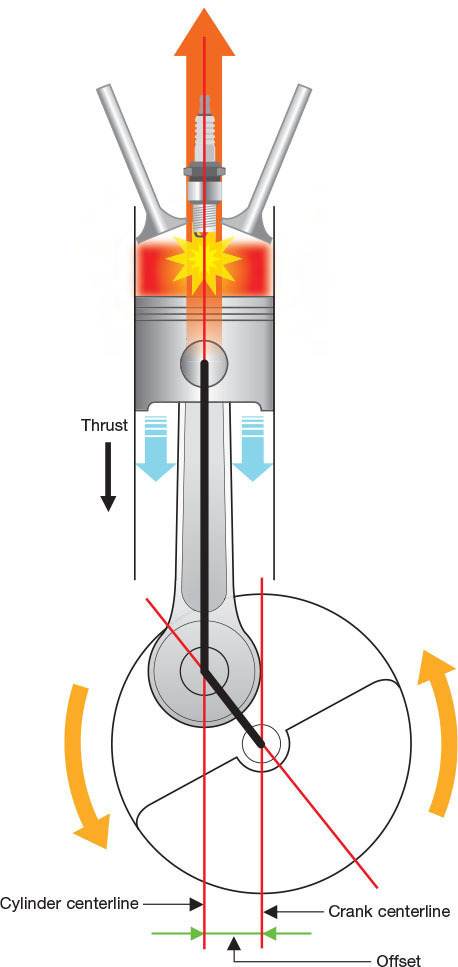


Norton Desaxe cylinder offset
 
Last edited:
When I think of crankshaft rotation, I am usually standing on the right hand side of the bike. If somebody was making aftermarket crankcases, desaxe might be a good way to go. The timing side might be difficult.
 
I don't think the 650 was desaxe. Everything from the 750 (Atlas) on was desaxe
The direction of the offset was obviously driven by finance - the desire to fit a bigger bore to existing tooling at the lowest cost meant the barrel centrelines had to go backwards - the opposite of your diagram Jim.
I don't know what you're talking about with aftermarket crankcases @acotrel , the OEM were already desaxe! There's no way to reverse the direction of the desaxe without moving the camshaft.
 
Whatever they are the Commando engines seem to be excellent. I do not know anything about Isolastic frames, and I do not want to know. Any Commando seems to be a nice road bike. The 650SS probably only suited one type of rider. I think it was better than a Bonneville - all of that is ancient history.
 
I am surprised that my 850 engine performs so well with so little modification. Because I began racing with a very nasty bike, I learned what needed to be changed to create sanity. The Seeley 850 was actually very easy to develop. It was much more responsive. Judging from it can do with 4 speeds close ratio - with the 6 speed TTI box, it should be beautiful. I don't think I will get the opportunity to prove it.
 
One cure is to mill the case or cyl base 1/16" at an angle (lower in the back) to move the cyl centerline 1mm forward. The easier fix would be to move the piston pin 1mm forward. This would reduce piston slap, noise, wear, and increase efficiency. Currently the cylinders are staggered backwards (the wrong way) somewhere between 1/2 and 1 mm according to others measurments (I'm measuring about 1.5mm on the cases I have).
 
One cure is to mill the case or cyl base 1/16" at an angle (lower in the back) to move the cyl centerline 1mm forward. The easier fix would be to move the piston pin 1mm forward. Currently the cylinders are staggered backwards (the wrong way) somewhere between 1/2 and 1 mm according to others measurments (I'm measuring about 1.5mm on the cases I have). There's talk about which way makes more friction and which way makes more noise - depending if you offset the cylinders or the piston pin and it needs to be verified. So far I'm finding that offsetting the cylinders offers both less friction and less noise. But offsetting the piston pin to the front reduces friction but increases noise. So moving the pin is out. Tilting the cylinders is in and should be fine if lowering the back side 1/16". That shouldn't be enough to bother the cam and lifters.
 
Last edited:
Thinking outside the box, fit an idler gear to the primary drive and reverse the engine direction of rotation.
It seems to have worked for Ducati (without the idler gear, of course).
I daresay the power gains would likely be absorbed by the additional gear losses, but perhaps not?
 
But... this is all just trying to optimise the power of an engine that is soooo far from optimum, the point is moot.
It is lovely to ride as it is thank you very much!
Cheer
Quite right.
Still, it's good to talk about, even if it changes nothing ;)
You'd also have to make a new cam, relocate the camchain tensioner and reverse the oil pump rotation, so a serious wild goose chase 😄
 
You'd also have to make a new cam, relocate the camchain tensioner and reverse the oil pump rotation, so a serious wild goose chase 😄
The worst thing is, the timing cover would have to change from something that's been iconic for about 75 years
 
Now we seem to be exploring engineering for engineering’s sake - some might think that is BMW’s domain. “ Look what I can do ! “
 
From what I've read the cylinders are supposed to be offset in the direction of crank rotation to reduce friction against the cylinder wall on the power stroke (increase HP & efficiency). It looks like Norton went the wrong direction when they offset the 650 cylinders to fit the larger 750 bore (they moved the cylinders away from the pushrod tunnels. Does anyone know exactly how much offset there is? (I'm rough measuring about 2mm). This is with early Commando/Atlas cases. Are Commando 750/850 cases the same? This may be correctable by milling the cases at an angle at the cyl base or using a tapered base gasket. The through bolts should still thread in OK as long as you don't go too far. See offset below.


Norton Desaxe cylinder offset
Comparing the drawing dimensions on the 750 short stroke head and the 1966 88SS head I make the true offset to be 0.093” on the 750/850 motors.
 
No you don't have to change the timing gear or cam - nothing changes there - they stay exactly the same. All you have to do is install a tapered base gasket that's very thin in the back and about 1/16" or thicker in the front. This has the effect of offseting the cylinder centerline in front of the crank centeline about 1mm or so and that's where you want it. The lifter to cam contact patch only moves forward about .015" and that doesn't effect anything. In return you get a motor that runs quieter and puts less wear on the piston skirt as well as being more efficient and making more power.

I checked into offsetting the pin and its a bad idea. Moving the pin forward reduces the piston friction but creates more noise - no one wants more piston rattle.

I am checking into having someone machine a base gasket as described. Then all you have to do is install a thinner .020" thick head gasket to restore to original compression.

So far so good. If I can get the special base gasket we'll see if this all works out or not.
 
Last edited:
Back
Top