
You are using an out of date browser. It may not display this or other websites correctly.
You should upgrade or use an alternative browser.
You should upgrade or use an alternative browser.
Tool to radius PTO shaft
- Thread starter jseng1
- Start date

concours
VIP MEMBER
- Joined
- Dec 29, 2011
- Messages
- 10,516

Is than an UNDERCUT radius?Here's the tool I use to put the .090" radius in the PTO shaft to keep it from cracking. You have to move the tool side to side to prevent chatter.


johnm
VIP MEMBER
- Joined
- Feb 26, 2008
- Messages
- 2,014

Yes.Is than an UNDERCUT radius?
- Joined
- Oct 28, 2009
- Messages
- 1,505

What problem are we solving here? Keep the crank from cracking? Under what conditions?

Fast Eddie
VIP MEMBER
- Joined
- Oct 4, 2013
- Messages
- 22,990

Crank breakages.What problem are we solving here?

Jim,But you don't want to reduce the diameter of the shaft.
After cutting I use a dremel and small bit to polish out the machine marks.
Please show us a photo how the cutting tool is positioned. Do you machine crankshaft cheeks separately? Is there still room for machining between cheek and chuck?
- Knut
- Joined
- Oct 28, 2009
- Messages
- 1,505
Under racing conditions? How about "normal" street usage?Crank breakages.
Fast Eddie
VIP MEMBER
- Joined
- Oct 4, 2013
- Messages
- 22,990
Dunno, never broken one myself. But that’s perhaps due to the fact I’m running Maney cranks.Under racing conditions? How about "normal" street usage?
Last edited:
johnm
VIP MEMBER
- Joined
- Feb 26, 2008
- Messages
- 2,014
Have you ever crack tested your crankshaft? You may be in for a disapointing surprise.
Cracked or broken cranks are common if you race and also found on street bikes. My Mk2 850 had a crack at this section chance. I know all except 18 months of its life and it had not been raced in that time.
Nes at Classic cycles in the Hutt Valley found so many cracked he stopped testing and just assumed they were all cracked.
The local engineering guy here puts this radius on all engines he does unless the owner says no. It's a common fix.
Cracked or broken cranks are common if you race and also found on street bikes. My Mk2 850 had a crack at this section chance. I know all except 18 months of its life and it had not been raced in that time.
Nes at Classic cycles in the Hutt Valley found so many cracked he stopped testing and just assumed they were all cracked.
The local engineering guy here puts this radius on all engines he does unless the owner says no. It's a common fix.
johnm
VIP MEMBER
- Joined
- Feb 26, 2008
- Messages
- 2,014
This is what Andover had to say in one of their news letters.
"50th anniversary of Richard Negus Norton’s Spa success:
A side effect of my seeing Richard was to talk about the Spa event in 1973, when his riders had the greatest success in endurance racing of the whole Commando era (!) by making second place to a factory Honda averaging over 100mph for 24 hours under riders Pete Lovell and Pete Davies.
Spa 1972, after the race. Riders Pete Davies and Pete Lovell exhausted but no doubt elated.
Richard admits his memories of particular races are vague, understandable given the time elapsed and the many races he went to with his riders. What he did remember was the specification of the engine which, he says, was nothing that special: 2S camshaft, skimmed head, standard pistons, lightened valve train.
The really special part, and most probably the reason why the engine lasted, was the crankshaft. This, as opposed to all other crankshafts he had in his engines, had rolled radii at the mainshafts, not ground as is normally the case. If cranks break it is often in this area, and frankly in the nearly five decades I have ridden Commandos I had but two cranks break, both in racing, both at that point.
Richard told me he was given the crank by someone in the factory. Many of the parts he used to build his bikes were “seconds” of parts left over from tests. Why this desirable modification was done only on that one crank, given all race engines should have had cranks like this, is a mystery in retrospect."
I sent a message to them and said.
Interesting comment on the rolled radius on the crankshaft.
I always wonder if the UK got different build standard bikes to NZ or we use them differently. Maybe we got the Friday bikes. Lots and lots of cracked and broken crankshafts down here. One of the local characters gave up crack testing them at his shop because they were all cracked. At the very poorly machined right angle between the drive side mainshaft and the "porkchop" I had a cracked crank at that point on my Mk11 850 and tried to buy a crank from your about 4 years ago. No joy at that time but I see you have them available now. Four years too late for me unfortunately.
I got a second hand crank and after crack testing it was radiused at the section change. Now standard practice with any Commando engine rebuilt by the local engineer. For years a guy on the East Coast made billet cranks as replacements but like most people he has retired now.
Their reply.
We see it here very rarely in that area. We believe it is not related to use as they tend to break near the journal and not the output shaft. Still quite rare to see though. The cracking you mention I suspect is a forging defect and not use related for two reasons, firstly the solid area that cracks is near to the bearing and a point of good support, and second, the later MK3 cranks flex far more than the pre-MK3 cranks as they are longer between the bearing seats and they would be forever failing but don't.
Late crank drawings make mention of where the drilling through the journals should finish, so it seems that they knew that the internal drilling caused the stress raiser in relation to the journal and not the finish on the journal itself. What is not mentioned in the source is that the crank in the 24 Hr bike actually snapped its crank shortly after the 24 race which again suggests that what Richard Negus had done was not a complete solution. Arrow who made the one piece cranks also spotted the problem with the original cranks and that is why we had to use a through drilling which removes the internal stress raisers under the journals.
Regards,
Ashley Cutler IEng MIET
Andover Norton International Ltd
So they don't see it much. But here in NZ it definitely happens. Including to me personally.
"50th anniversary of Richard Negus Norton’s Spa success:
A side effect of my seeing Richard was to talk about the Spa event in 1973, when his riders had the greatest success in endurance racing of the whole Commando era (!) by making second place to a factory Honda averaging over 100mph for 24 hours under riders Pete Lovell and Pete Davies.
Spa 1972, after the race. Riders Pete Davies and Pete Lovell exhausted but no doubt elated.
Richard admits his memories of particular races are vague, understandable given the time elapsed and the many races he went to with his riders. What he did remember was the specification of the engine which, he says, was nothing that special: 2S camshaft, skimmed head, standard pistons, lightened valve train.
The really special part, and most probably the reason why the engine lasted, was the crankshaft. This, as opposed to all other crankshafts he had in his engines, had rolled radii at the mainshafts, not ground as is normally the case. If cranks break it is often in this area, and frankly in the nearly five decades I have ridden Commandos I had but two cranks break, both in racing, both at that point.
Richard told me he was given the crank by someone in the factory. Many of the parts he used to build his bikes were “seconds” of parts left over from tests. Why this desirable modification was done only on that one crank, given all race engines should have had cranks like this, is a mystery in retrospect."
I sent a message to them and said.
Interesting comment on the rolled radius on the crankshaft.
I always wonder if the UK got different build standard bikes to NZ or we use them differently. Maybe we got the Friday bikes. Lots and lots of cracked and broken crankshafts down here. One of the local characters gave up crack testing them at his shop because they were all cracked. At the very poorly machined right angle between the drive side mainshaft and the "porkchop" I had a cracked crank at that point on my Mk11 850 and tried to buy a crank from your about 4 years ago. No joy at that time but I see you have them available now. Four years too late for me unfortunately.
I got a second hand crank and after crack testing it was radiused at the section change. Now standard practice with any Commando engine rebuilt by the local engineer. For years a guy on the East Coast made billet cranks as replacements but like most people he has retired now.
Their reply.
We see it here very rarely in that area. We believe it is not related to use as they tend to break near the journal and not the output shaft. Still quite rare to see though. The cracking you mention I suspect is a forging defect and not use related for two reasons, firstly the solid area that cracks is near to the bearing and a point of good support, and second, the later MK3 cranks flex far more than the pre-MK3 cranks as they are longer between the bearing seats and they would be forever failing but don't.
Late crank drawings make mention of where the drilling through the journals should finish, so it seems that they knew that the internal drilling caused the stress raiser in relation to the journal and not the finish on the journal itself. What is not mentioned in the source is that the crank in the 24 Hr bike actually snapped its crank shortly after the 24 race which again suggests that what Richard Negus had done was not a complete solution. Arrow who made the one piece cranks also spotted the problem with the original cranks and that is why we had to use a through drilling which removes the internal stress raisers under the journals.
Regards,
Ashley Cutler IEng MIET
Andover Norton International Ltd
So they don't see it much. But here in NZ it definitely happens. Including to me personally.
Last edited by a moderator:
johnm
VIP MEMBER
- Joined
- Feb 26, 2008
- Messages
- 2,014
I have a friend. In his 70s now. Very unusual in that he has a B. Eng degree in mechanical engineering plus is a toolmaker and spent maybe 60 years building racing and designing bikes in NZ and around the world. Including racing Commandos back in the 1970s.
His comment was " those Pommys should have been ashamed of themselves machining a crank like that. They learnt not to do that making railway axles and wheels in the 19 th century. "
His comment was " those Pommys should have been ashamed of themselves machining a crank like that. They learnt not to do that making railway axles and wheels in the 19 th century. "

- Joined
- Feb 21, 2013
- Messages
- 357
That reminds me of a similar issue on the water cooled rotary engine eccentric shafts which was serious enough for me to be called to a board meeting to advise on whether or not to issue a recall and to approve modifications for the road and race engines. Happy days! The fillet radii on the race engines was improved by a similar undercut and shot peening. Road bike parts had a material process change, holes moved away from the fillet radii, improved surface finish and shot peening. No recall, but when customers brought their bikes in for a service, or whatever, the suspect part was quietly replaced and the world kept on spinning.Here's the tool I use to put the .090" radius in the PTO shaft to keep it from cracking. You have to move the tool side to side to prevent chatter.

Matchless
VIP MEMBER
- Joined
- Dec 23, 2010
- Messages
- 1,298
I've broken two Norton cranks. The first was in the early 80s on my 650ss. More or less flat out in top, it broke through the big end. The rod held it together & prevented it destroying the cases. The other time was on the 850 MK2a, when the DS mainshaft snapped off. Why the hell the factory thought that virtually no corner radius would be okay is beyond me. I now use Maney cranks in the two most hard ridden bikes.
Steve Maney told me that most of the factory cranks he sent for x raying showed cracks.
Steve Maney told me that most of the factory cranks he sent for x raying showed cracks.
Fast Eddie
VIP MEMBER
- Joined
- Oct 4, 2013
- Messages
- 22,990
I had that once too, broken through the big end and (somehow) held together by the rod.I've broken two Norton cranks. The first was in the early 80s on my 650ss. More or less flat out in top, it broke through the big end. The rod held it together & prevented it destroying the cases. The other time was on the 850 MK2a, when the DS mainshaft snapped off. Why the hell the factory thought that virtually no corner radius would be okay is beyond me. I now use Maney cranks in the two most hard ridden bikes.
Steve Maney told me that most of the factory cranks he sent for x raying showed cracks.
johnm
VIP MEMBER
- Joined
- Feb 26, 2008
- Messages
- 2,014
The big end one is caused by one of two things.
Firstly and disappointingly common. Reground big ends where the grindstone was not dressed properly and too sharp a radius was left. Diagrams with the correct dimensions are in the workshop manual.
Secondly as loudly and repeatedly stated by Mr long gone Beltdriveman, the misaligned oil feed passage drilling and blanked off drilling for the sump trap. Right under the drive side big end journal. These need to be checked and if necessary any stress raisers ground smooth.
Firstly and disappointingly common. Reground big ends where the grindstone was not dressed properly and too sharp a radius was left. Diagrams with the correct dimensions are in the workshop manual.
Secondly as loudly and repeatedly stated by Mr long gone Beltdriveman, the misaligned oil feed passage drilling and blanked off drilling for the sump trap. Right under the drive side big end journal. These need to be checked and if necessary any stress raisers ground smooth.

- Joined
- Nov 26, 2009
- Messages
- 3,435
Can't remember how I did it. You might have to chuck the opposite end of the crank (timing stub) and use a centering tool on the end of the PTO stub so you can reach the corner with the cutting tool and dremel.Jim,
Please show us a photo how the cutting tool is positioned. Do you machine crankshaft cheeks separately? Is there still room for machining between cheek and chuck?
- Knut
- Joined
- Nov 26, 2009
- Messages
- 3,435
Here's a photo of what I think is a Ron Wood race crank with the radius PTO shaft and heavy metal in the cheeks to redistribute weight closer to the outside to reduce flex. This was back in the days when one piece cranks were hard to come by. It solved crank breakage but then the cases started cracking.

My race cranks stayed together when I radiused the PTO stub (after checking with magnaflux). I checked my 850 race cases and found 7 cracks. So I reinforced the cases by welding a plate around the drive side output.
Then I had Wiseco make my first lightweight pistons (around 1987) and all my breakage problems went away.
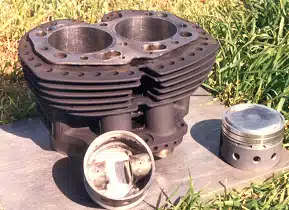
My race cranks stayed together when I radiused the PTO stub (after checking with magnaflux). I checked my 850 race cases and found 7 cracks. So I reinforced the cases by welding a plate around the drive side output.
Then I had Wiseco make my first lightweight pistons (around 1987) and all my breakage problems went away.

johnm
VIP MEMBER
- Joined
- Feb 26, 2008
- Messages
- 2,014
Thread 'Preventing Broken cranks' https://www.accessnorton.com/NortonCommando/preventing-broken-cranks.6877/Rolling the radius is far more fatigue resistant than grinding/cutting... just like in the thread making world. Though I cant for the life of me figure out how this process could be applied to a crank?
Similar threads


- Replies
- 27
- Views
- 2,569

- Replies
- 18
- Views
- 875


- Replies
- 9
- Views
- 1,819
- Replies
- 5
- Views
- 2,292