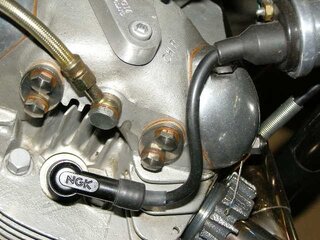
Guys,
I flew over the entries of this thread, and really missed an in-depth discussion of the various HT leads, so I fetched a contribution off another forum.
In "Speed Talk", poster "Schurkey" wrote Dec. 22, 2020, quote:
There are three kinds of plug wires in typical use.
1. "Solid core". Uses a stranded conductor like ordinary primary wire, inside a heavily insulated sheath. Conductor can be copper, or stainless steel. I had a set of GM "Packard" wires like this, drove the TVs and Radios in the neighborhood crazy with static. Which is why they're very uncommon any more. The Japanese used solid-core wires long after other folks went to "resistor wires", but they merely installed a 5,000-ohm discrete resistor in the spark plug cap to reduce that TV-Radio interference.
2. "Resistor" plug wires, typically using powdered carbon on "rope", inside a heavily insulated sheath. The carbon-rope wires have high inherent resistance--2000 ohms per foot is not uncommon; increasing with use. The resistance reduces current flow, which suppresses TV-Radio interference. OEM-specified for many major brands.
3a. "Helical-wound" (sometimes called "Spiral") using a thin conductor wound around a sturdy core. The helical winding creates an inductor or electrical "choke" which limits current flow. Deceptively advertised as "low resistance" as if that would result in a stronger spark. The current flow--and therefore the TV-Radio interference--is suppressed by inductance instead of resistance, but either way the current flow is reduced.
3b. "Conductive Latex" is just a subset of the helical-wound plug wire. After applying the helical-wound conductor, it's sealed in conductive latex. The "conductive" latex has some inherent resistance. I guess whatever spark energy that isn't transmitted by the helical conductor goes through the latex instead.
End quote.
Because #2 is susceptibility to breakage in a NHT, it is better avoided. So we are left with #1 or #3a/b, and for most of us, #3a/b only. Resistance of the latter is usually within the range of 500-5K Ohm/ft. Resistance of #1 is expected within 20 to 500 Ohm/ft.
The interesting part is, how do helically wound plug wires behave when subjected to HV pulses generated by a coil? They behave like a combination of a resistor and an inductor, allowing the spark to fire while suppressing radio-frequency interference (RFI). How?
* A helical wound conductor has
low DC resistance compared to carbon-core wires, so voltage drop is minimal (U=R*I ; the low primary current flow is not limited by inductance).
* The spiral winding introduces a small inductance. When the high-voltage pulse travels down the wire, the inductance resists rapid changes in current. This slows the rise time (i.e., gradient) of the pulse slightly, reducing RFI that would otherwise interfere with surrounding electronics. Peak voltage is still reached.
* The spiral winding also provides distributed resistance, as mentioned above. This limits (secondary phase) voltage once the spark has jumped the gap, further suppressing noise. Unlike solid-core copper wires, which deliver maximum voltage but radiate interference, spiral wires balance spark energy with suppression.
* As for pulse behavior, before the spark fires, the circuit is “open,” so the wire charges and simply holds the voltage. Once the spark gap ionizes, current flows; the wire’s inductance and resistance shape the pulse, preventing excessive ringing or noise. The spark itself is still hot and reliable, because the energy produced by the coil is delivered to the spark plug with hardly no loss. The initial spike produces a sharp rise to tens of kilovolts. Secondary voltage oscillations are dampened by inductance and resistance, causing ringing to decay quickly.
The Spark discharges like this: Once the plug gap ionizes, voltage collapses and the gross secondary current stored in the conductor flows across the gap, see figure below.
Here is the voltage-time domain plot of a pulse delivered by a solid copper core HT lead:
The plot shows the a sharp rise, as the pulse climbs almost vertically to ~30 kV in under a microsecond. There is minimal suppression, because the copper core has no inductive winding, the pulse edge is extremely steep.
There are ringing oscillations: After the peak, you see high-frequency oscillations (coil resonance) with very little damping. This delivers maximum spark energy within the first microseconds, but for the entire discharge a strong electromagnetic interference (RFI) is radiated,
which is why solid-core wires are unsuitable for modern vehicles with sensitive electronics.
Waveforms superimposed is shown in the next picture. The effect of inductance to voltage ringing is apparent.
Compiled with the help of AI. I hope this is of interest.
- Knut


 Plus I could be repeating myself.