
swooshdave
MEMBER
- Joined
- Apr 2009
- Messages
- 11,584

This isn't life or death. It's just spark plugs.Sorry.


This isn't life or death. It's just spark plugs.Sorry.


The total resistance from coil to plug is what matters...a short bit of ht supressor ht cable should not add much...less than 1k? Just avoid using a 5k ohm cap with a 5k ohm plug.Better to not double. IMHO, Bad to use resistor wire on a motorcycle, too much vibration for carbon-core wire. I use copper wire and resistor plugs.
So just measure the resistance in the wire and see where it is? What's the max resistance for the entire chain that would be acceptable?The total resistance from coil to plug is what matters...a short bit of ht supressor ht cable should not add much...less than 1k? Just avoid using a 5k ohm cap with a 5k ohm plug.


I use resistor plugs, copper wire and resistor caps. Trispark - no problem!I assumed it was because I have resistor wires. Isn't it bad to double resist?

So just measure the resistance in the wire and see where it is? What's the max resistance for the entire chain that would be acceptable?
Some searching show maybe a max of 10k ohms. NGK Resistor plugs are specced at 5k. I'm checking with DynaTek as to what their wires are at per foot (or meter). That should give me a total estimate.
Who said I was using cheap wires?I've got two never used and never will be used by me NGK BP7ES plugs and some V-Power NGK non-resistor racing plugs in the 7 heat range. If you were closer you could stop by and get them for your experiments. I'd be surprised if they worked without an occasional misfire with cheap plug wires, but who knows.

No one should - resistor wires cost more and are much harder to make!Who said I was using cheap wires?

Yes, just check with your Ohmmeter how much resistance from coil end of HT lead to the plug boot contact, add in the spark plug resistance...that's your total. Suppressor HT wire typically states (sometime printed on the outer coating) how many Ohm's per foot of length....its not much. Max allowed depends on the EI you have...most spec no more than 5k Ohm total (ie TriSpark, Wassel, Boyer)...but the small added resistance from the short run of suppressor cable will not hurt things.So just measure the resistance in the wire and see where it is? What's the max resistance for the entire chain that would be acceptable?
Some searching show maybe a max of 10k ohms. NGK Resistor plugs are specced at 5k. I'm checking with DynaTek as to what their wires are at per foot (or meter). That should give me a total estimate.
While it will work, Trispark and other common EI's call specifically for no more than 5k Ohm....unsure if this is due to the electric circuitry with the EI hitting heat limits or something to do with the coil limits.I use resistor plugs, copper wire and resistor caps. Trispark - no problem!
Total resistance measured at about 10k
Cheers
I guess I did.Who said I was using cheap wires?
 Oopsie
Unsure how you can use much more the 5 or 6 inches on a Commando HT lead?DynaTek doesn't publish the specs but they responded very rapidly to an email. Their 8mm wire is 3k per foot. So if I were to use resistor plugs (NGK for example at 5k) that puts me not quite where @robs ss is. But it looks like the non-resistor Champions are readily available.
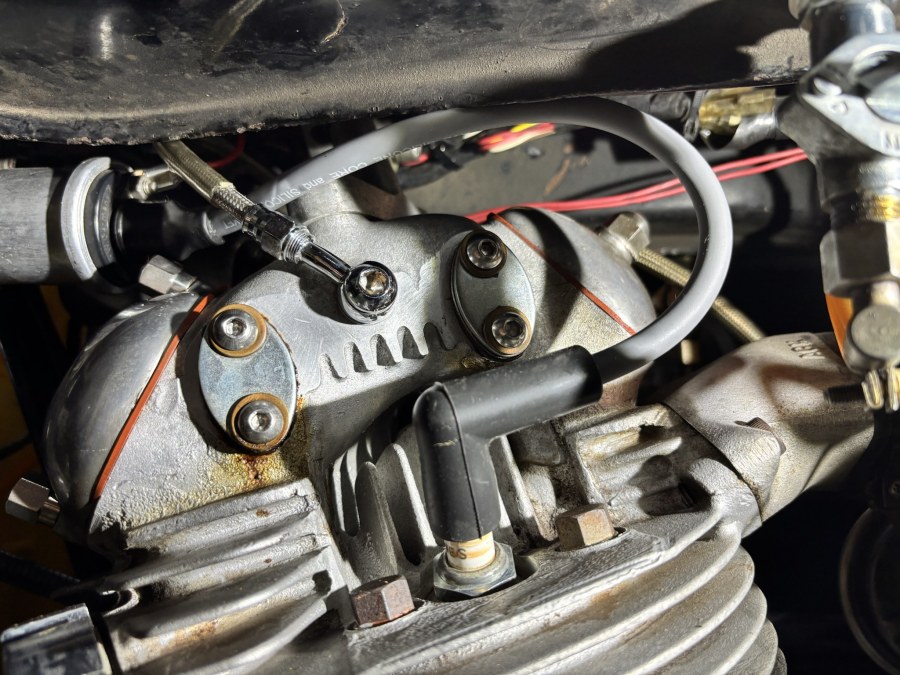
There are two typical routes for the wires. One uses an angled plug at the coil and drops the wire right onto the spark plug. The other way is to use a straight plug at the coil, go backwards and curl back to the plug. Both are acceptable and one is longer than the other.Unsure how you can use much more the 5 or 6 inches on a Commando HT lead?


I carry one of those at all times. It tests for spark under actual compression and reduces risk of damage to Trispark:There is a tool for testing plug wires and caps which I didn't know about.
It looks like a very usable tool.
- Knut
Not going to argue this again. It's a simple quick test and even if you were right, which you are not, the test is still valid.I carry one of those at all times. It tests for spark under actual compression and reduces risk of damage to Trispark:
I disagree - they act as filters, removing the AC current through the points, AC current gives a much weaker spark, with that characteristic yellow/orange colour. Will spark in open atmosphere but not under compression.To see if the condensers have anything to do with your problem, remove them. Their primary job is to prevent sparking at the points. A little running without them won't hurt. If they fail open, the engine will run fine but the points won't last. If they fail closed there will be no spark. If they fail partly closed the spark will be diminished.
I am somewhat...
Cheers
If you open the link I talk about and post a link to that tester - that's whyNot going to argue this again. It's a simple quick test and even if you were right, which you are not, the test is still valid.
I don't understand why you tied that old post into a post about an inline spark tester which I also use. There are no condensers when Tri-Spark is installed.


