MY Commando won't stay running...

Status
Not open for further replies.
SierrasCafe530 said:
Hey all,

Thanks for the responses... I should clarify a few things... She never ran great. I only have had her running about two-three months. I got her off a guy that said it just stopped running one day (in 1982) and he never fixed it.

-Sierra

With that said what you have there is a square one bike which will require testers, gauges and measuring tools to diagnose properly.
I'd start with the electrics, test coils resistance, Boyer leads, charging sys, etc.
Boil out carbs, clear idle circuit, check wear on needles and jets, looseness of the slides, you can grease up the slides to help take up some slop.
Compression test, leak down test.
If the wiring harness is old, nasty, stiff then just check every connection. Those bar switches get crusty too.
You have a lot of work ahead of you, diagnosticly speaking.
 
Just to add another 2 pence, like others have said, make sure the electronics is all copacetic. With the carbs, yes, there is no adjusting them other than changing the jets, and messing with the choke. Go here and read it until you turn blue. Adjusting the slide just changes the idle speed, it does nothing for the jetting. Float level is critical, find the spot where it runs best at idle with 1 1/2 turns out on the idle screws. Make sure your float bowls are flat and not sucking air. Make sure your balance hose is not sucking air, and the heat gaskets and flange to manifold. Make sure the slides are synchronized. Read the JBA site again. They're not magic, and run great when right. Don't know how many miles on the carbs, slides will be worn at 15-20K miles, new hard anodized slides or $200 for Lund's sleeving. Or second party carbys, but not my choice.

Dave
69S
 
SierrasCafe530 said:
Hey all,

Thanks for the responses... I should clarify a few things... She never ran great. I only have had her running about two-three months. I got her off a guy that said it just stopped running one day (in 1982) and he never fixed it.

If anyone has any other ideas, please keep them coming. I'm open minded!

-Sierra

You did state 1982 :?:

You may have answered your own question.
The carbs may need a thorough clean if gasoline/petrol was left inside them for any long length of time, why? Because fuel has a habit of evocating and leaving a white residue behind that ends up blocking the jets, particularly the pilot T or Y tubes inside the carbs.
I would at least take off the float bowels to have a look.
 
SierrasCafe530 said:
Steve D said:
I have a 1973 850 and I had a similar problem. The bike would start and tick over but when I pulled away it would either stall or run really poorly for around a mile, after which it would clear and run cleanly. I put in new NGK plugs and cleaned the carbs right out. I got a proper C spanner and re-set the exhausts in the head. I don't have the problem anymore but I'm not sure which of the things I did cured it, my suspicion is the amals. The left carb takes ages to flood (about a minute) when I use the tickler. After stripping and rebuilding the carb will flood easily for about a week and then slow right down again. I don't know if that helps but it worked for me.

Interesting. A lot Of these issues happened after I put strait drag pipes on her. I just rebuilt my carbs a couple months ago and put new NGK plugs, caps and wires. I always use my ticklers when starting my amals so I may be flooding her out. Idk

Sierras
you changed the plugs and wires. Copper core or suppressed?
Try putting your old wires back on. Are you using a Boyer analogue Mk 3?
CNN
 
The carbs may need a thorough clean if gasoline/petrol was left inside them for any long length of time, why? Because fuel has a habit of evocating and leaving a white residue behind that ends up blocking the jets, particularly the pilot T or Y tubes inside the carbs.
I would at least take off the float bowels to have a look.
Don't forget the tank, that could have a lot of c**p inside, the fine stuff of which filters through to the idle passages. That tank also looks like its fibreglass? Ethanol breakdown? For sure those carbs have to be pulled off and thoroughly cleaned as well as the killswitch and all electricals checked over carefully.
 
Now a days its very rare to get crappy dirty fuel and it does not evaporate to leave fine white deposits nor barely any varnish either. The white crust is the Zinc Oxide of the Pot metal participating to surface and can happen in carbs that have never seen fuel and nothing but a mild acid boil or physical removal can clear the pilot jet or the layer in bottom of bowls. Only very caustic carb cleaners can remove this w/o scrubbing or poking away.
 
Bernhard said:
SierrasCafe530 said:
Hey all,

Thanks for the responses... I should clarify a few things... She never ran great. I only have had her running about two-three months. I got her off a guy that said it just stopped running one day (in 1982) and he never fixed it.

If anyone has any other ideas, please keep them coming. I'm open minded!

-Sierra

You did state 1982 :?:

You may have answered your own question.
The carbs may need a thorough clean if gasoline/petrol was left inside them for any long length of time, why? Because fuel has a habit of evocating and leaving a white residue behind that ends up blocking the jets, particularly the pilot T or Y tubes inside the carbs.
I would at least take off the float bowels to have a look.

I have cleaned them. I took them apart, cleaned, and bought a rebuild kit for the carbs. I'm pretty convinced with all the feed back that they are set to lean. I plan to take them apart tomorrow and adjust them.
 
CanukNortonNut said:
SierrasCafe530 said:
Steve D said:
I have a 1973 850 and I had a similar problem. The bike would start and tick over but when I pulled away it would either stall or run really poorly for around a mile, after which it would clear and run cleanly. I put in new NGK plugs and cleaned the carbs right out. I got a proper C spanner and re-set the exhausts in the head. I don't have the problem anymore but I'm not sure which of the things I did cured it, my suspicion is the amals. The left carb takes ages to flood (about a minute) when I use the tickler. After stripping and rebuilding the carb will flood easily for about a week and then slow right down again. I don't know if that helps but it worked for me.

Interesting. A lot Of these issues happened after I put strait drag pipes on her. I just rebuilt my carbs a couple months ago and put new NGK plugs, caps and wires. I always use my ticklers when starting my amals so I may be flooding her out. Idk

Sierras
you changed the plugs and wires. Copper core or suppressed?
Try putting your old wires back on. Are you using a Boyer analogue Mk 3?
CNN

They are copper... I have some new plugs on order too. I hope with that and the carb readjustment she will run a lot smoother.
 
Keith1069 said:
The carbs may need a thorough clean if gasoline/petrol was left inside them for any long length of time, why? Because fuel has a habit of evocating and leaving a white residue behind that ends up blocking the jets, particularly the pilot T or Y tubes inside the carbs.
I would at least take off the float bowels to have a look.
Don't forget the tank, that could have a lot of c**p inside, the fine stuff of which filters through to the idle passages. That tank also looks like its fibreglass? Ethanol breakdown? For sure those carbs have to be pulled off and thoroughly cleaned as well as the killswitch and all electricals checked over carefully.

The tank is fine. I had it sealed about four months ago. I keep my eye on it and only use Chevron gas. It suppose to has the lowest amount of etho. I don't have filters.
 
Sierra, It seems to me that you are going round in circles, even a fairly roughly set up Norton will run without stopping all the time, regardless of exhaust configuration or carb choice or even moderate carb wear or maladjustment. You should bite the bullet and trailer the bike to Rabers and get it sorted once and for all, There are all sort of things from dirty kill switches to bad ignition wires, carb problems etc which someone like Bob Raber can diagnose in no time. I'm sure you've spent more time than the trip to San Jose will take and seemingly with no result. Once the bike is running and giving you reliable service you can think about upgrades, improvements, etc. as well as improving your own experience and technical knowledge with these bikes. You will also fall in love with a Norton that starts and runs when required.
 
SierrasCafe530 said:
Mark said:
SierrasCafe530 said:
I don't have filters.
Why Not?

Because its fiberglass and lined... I was told by I person that I would consider an expert on Norton's that it is unnecessary. He told me I only need filters if I put a steel tank on.

When you have a sealed tank filters can catch any sealant that comes loose. Because it will.
 
swooshdave said:
When you have a sealed tank filters can catch any sealant that comes loose. Because it will.

actually only partly so - only if it is in particulate/solid form and larger than the size of the pours in your filter, some sealers may/will dissolved in the ethanol based fuel and they'll pass right though any/most filters only to gumup your intake system -
 
when we are talking about filters in the gas line are we talking about filters in addition to those that are on the petcocks (at least which are on mine), or just those ones?
 
I have filters attached to the petcocks, and also filters in the banjo that connects to the float bowl. I thought everyone had at least that much?

Dave
69S
 
Reading through this thread, I do not see much detail on pilot jet/circuit cleaning. If this is clogged, a bike will shut off after the choke is relieved and no idle will be attained. Do some searching on this. Cleaning and rebuilding is all well and good but there is no rebuild kit for the pilot circuit.

Here is a start. post102261.html?hilit=pilot circuit#p102247
 
pvisseriii said:
Reading through this thread, I do not see much detail on pilot jet/circuit cleaning. If this is clogged, a bike will shut off after the choke is relieved and no idle will be attained. Do some searching on this. Cleaning and rebuilding is all well and good but there is no rebuild kit for the pilot circuit.

Here is a start. post102261.html?hilit=pilot circuit#p102247

This post of using wire in the pilot holes is very bad advice indeed, you should use compressed air to determine if there is a blockage in the pilot hole circuit, it’s safer and you will not break any wire off round the internally sharp corners in side the carb.
Assuming you have used compressed air to check that the holes are clear on the internal Y holes, you have to check and set the float height with preferably, the carb upside down.
Turn in the pilot screw fully then turn out 1/12 – 2 full turns each
The slide stop screw can be left a little high on starting a cold engine, before adjusting to a constant tick over.
With this method, the engine should be kicked over with throttle closed. If the plugs don’t wet when engine is kicked over then no fuel is getting in via the pilot jet(s).
 
Bernhard said:
pvisseriii said:
Reading through this thread, I do not see much detail on pilot jet/circuit cleaning. If this is clogged, a bike will shut off after the choke is relieved and no idle will be attained. Do some searching on this. Cleaning and rebuilding is all well and good but there is no rebuild kit for the pilot circuit.

Here is a start. post102261.html?hilit=pilot circuit#p102247

This post of using wire in the pilot holes is very bad advice indeed, you should use compressed air to determine if there is a blockage in the pilot hole circuit, it’s safer and you will not break any wire off round the internally sharp corners in side the carb.
Assuming you have used compressed air to check that the holes are clear on the internal Y holes, you have to check and set the float height with preferably, the carb upside down.
Turn in the pilot screw fully then turn out 1/12 – 2 full turns each
The slide stop screw can be left a little high on starting a cold engine, before adjusting to a constant tick over.
With this method, the engine should be kicked over with throttle closed. If the plugs don’t wet when engine is kicked over then no fuel is getting in via the pilot jet(s).

I would use a #78 drill epoxied to a q-Tip because not only is the drill tiny, it is also too short to reach in there.
Well anyways, that was just suggested reading. Actually I would suggest drilling out and tap the back side where the pressed in pilot reside, drill it out the jet with a 1/8" drill, blank the back side with a chopped off idle screw with a fresh oring and add a screw in #25 jet on the bottom of the body in the float chamber, but that's just me.
 
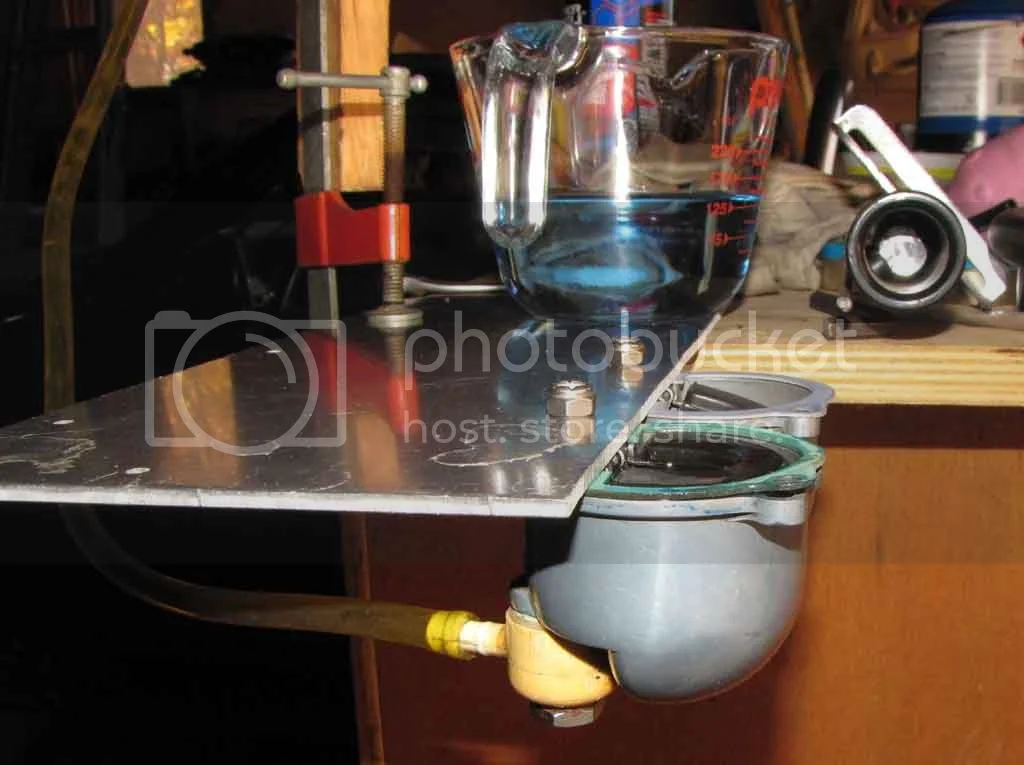
It's easy enough to bolt the float bowls to a piece of metal and run a 1/4" line to each one and actually see where the float level is. You can use alcohol or mineral spirits instead of the blue avgas if you want. This also checks the needle seat in case it's leaking. Of course the new stay up floats make it a lot easier to adjust the level instead of trying to punch the seat up and down.

MY Commando won't stay running...


Dave
69S
 
Status
Not open for further replies.
Back
Top