A bung welded in the right hand pipe only, a couple of inches forward of the muffler join. When I had mine dyno tested, it showed that the mixture was lean in the low end and midrange. However, when I added the O2 sensor to the exhaust, it showed that the mixture in these areas was quite rich, so I jetted down to suit. As I've said before, a Commando will run quite well across a range of jetting, but when jetted right, you will notice the difference.Ken, did you weld O2 adapters into the headers, or stick probes in the end of the peashooters ?

You are using an out of date browser. It may not display this or other websites correctly.
You should upgrade or use an alternative browser.
You should upgrade or use an alternative browser.
Modern fuel and jetting...
- Thread starter Fast Eddie
- Start date
- Status
- Not open for further replies.


Fast Eddie
FULL MEMBER
- Joined
- Oct 2013
- Messages
- 23,382

A bung welded in the right hand pipe only, a couple of inches forward of the muffler join. When I had mine dyno tested, it showed that the mixture was lean in the low end and midrange. However, when I added the O2 sensor to the exhaust, it showed that the mixture in these areas was quite rich, so I jetted down to suit. As I've said before, a Commando will run quite well across a range of jetting, but when jetted right, you will notice the difference.
Yeah, I have long since thought that normal dynos aren’t good for accurate mixture readings at partial throttle openings. I have tried, and I ‘think’ it's better than nothing (Although your evidence is that it is not), but even if you can educate the dyno operator to hold the throttle at a steady state, on an inertia dyno, it ain’t gonna keep the engine under load.
I know you posted this stuff before Ken, but I can’t seem to find it, can you remind us what kit you used?
seattle##gs
FULL MEMBER
- Joined
- Oct 2014
- Messages
- 2,311

so what carbs are you using and what is the current jetting?A bung welded in the right hand pipe only, a couple of inches forward of the muffler join. When I had mine dyno tested, it showed that the mixture was lean in the low end and midrange. However, when I added the O2 sensor to the exhaust, it showed that the mixture in these areas was quite rich, so I jetted down to suit. As I've said before, a Commando will run quite well across a range of jetting, but when jetted right, you will notice the difference.
Can't remember in my current state, but you can find various stuff that will do the job, I just did a search of the net. Got the stuff in from Texas.Yeah, I have long since thought that normal dynos aren’t good for accurate mixture readings at partial throttle openings. I have tried, and I ‘think’ it's better than nothing (Although your evidence is that it is not), but even if you can educate the dyno operator to hold the throttle at a steady state, on an inertia dyno, it ain’t gonna keep the engine under load.
I know you posted this stuff before Ken, but I can’t seem to find it, can you remind us what kit you used?
VM34 Mikuni. Jetting is a little bit hazy. 3.5 slide is about all I remember. The Mikuni outlasts about four sets of standard Amals. It was on the bike when I bought it fourteen years ago. It's been quite trouble free.so what carbs are you using and what is the current jetting?

acadian
FULL MEMBER
- Joined
- Mar 2010
- Messages
- 1,486

Something like this?
A bit spendy, but maybe worth it. I'd likely weld bungs into both headers, run the gauge, with the opposing bung plugged
A bit spendy, but maybe worth it. I'd likely weld bungs into both headers, run the gauge, with the opposing bung plugged

baz
FULL MEMBER
- Joined
- May 2010
- Messages
- 8,793
I use a narrow band KosoSomething like this?
A bit spendy, but maybe worth it. I'd likely weld bungs into both headers, run the gauge, with the opposing bung plugged
I welded a bung in one downpipe within 200mm of the exhaust valve
I mark the throttle drum and set the carbs up accordingly
My mate uses a twin chanel wide band
He has built a universal throttle position data logger for his
Cheers
Fast Eddie
FULL MEMBER
- Joined
- Oct 2013
- Messages
- 23,382
I use a narrow band Koso
I welded a bung in one downpipe within 200mm of the exhaust valve
I mark the throttle drum and set the carbs up accordingly
My mate uses a twin chanel wide band
He has built a universal throttle position data logger for his
Cheers
Gotta link Baz ?
Does ‘200mm from the exhaust valve’ mean from the back of the valve head?
Fast Eddie
FULL MEMBER
- Joined
- Oct 2013
- Messages
- 23,382
Is it this one Bazza....
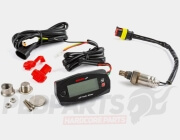
 www.pedparts.co.uk
Koso Mini Narrowband Air/Fuel AFR Meter
A lambda probe determines the ratio of air to fuel in the exhaust gas with 4-stroke engines. About the easy to read LCD display the residual oxygen content is displayed. The higher this value is, the higher is the residual proportion of oxygen.
www.pedparts.co.uk
All well and good spending that vast amount of money - but how did we get on in the good old days? Are you going to be looking down whilst riding admiring your new clock and not watching where you're going?
I do get the air / fuel mixture just as correct for far less just by buying a second hand Gunsons Colourtune and only using it at night or in the dark.
OK I have to go out and do plug chops to determine the rest of the carb mixture at higher revs - but it works.
I do get the air / fuel mixture just as correct for far less just by buying a second hand Gunsons Colourtune and only using it at night or in the dark.
OK I have to go out and do plug chops to determine the rest of the carb mixture at higher revs - but it works.
baz
FULL MEMBER
- Joined
- May 2010
- Messages
- 8,793
Yep that's the one I haveIs it this one Bazza....
Koso Mini Narrowband Air/Fuel AFR Meter
A lambda probe determines the ratio of air to fuel in the exhaust gas with 4-stroke engines. About the easy to read LCD display the residual oxygen content is displayed. The higher this value is, the higher is the residual proportion of oxygen.
baz
FULL MEMBER
- Joined
- May 2010
- Messages
- 8,793
Do you ever glance at your speedometer whilst riding?All well and good spending that vast amount of money - but how did we get on in the good old days? Are you going to be looking down whilst riding admiring your new clock and not watching where you're going?
I do get the air / fuel mixture just as correct for far less just by buying a second hand Gunsons Colourtune and only using it at night or in the dark.
OK I have to go out and do plug chops to determine the rest of the carb mixture at higher revs - but it works.
Yes I have a gunson colour tune also,are you saying it works the same or even in the same league? Are you speaking from experience or opinion?
Cheers
Fast Eddie
FULL MEMBER
- Joined
- Oct 2013
- Messages
- 23,382
Colour tune is only for idle / air screw settings I thought...
If you want to spend vasts vast amounts of your money on clock gauges, you have become another victim to making moden cars/ bikes to electronic, but be my guest.Do you ever glance at your speedometer whilst riding?
Yes I have a gunson colour tune also,are you saying it works the same or even in the same league? Are you speaking from experience or opinion?
Cheers
baz
FULL MEMBER
- Joined
- May 2010
- Messages
- 8,793
So people like me that temporarily fit a vastly expensive gage to a bike to get the best possible performance are responsible for the world moving towards electric vehicles?If you want to spend vasts vast amounts of your money on clock gauges, you have become another victim to making moden cars/ bikes to electronic, but be my guest.
Last edited:
seattle##gs
FULL MEMBER
- Joined
- Oct 2014
- Messages
- 2,311
I have spent countless hours adjusting Amal and Mikuni carburetors, I can do it very well but in the end it's just educated guessing...and it takes hours, days, etc. Using an AFR gauge will make it so much faster and accurate. It will be interesting to compare runs at different months or seasons of the year. One thing that surprised me was how much the pilot jet influenced average riding.

acotrel
Flagged
- Joined
- Jun 2012
- Messages
- 15,046

When you use methanol fuel the jets are twice the size of petrol jets. Half a thou of an inch in the needle jet internal diameter when you use methanol, is the difference between fast and slow. So if you are using petrol, it is a quarter of a thou in internal diameter. Common sizes in needle jets in Commandos are 0.106 inch and 0.107 inch and you have 5 clip positions on the needles. If you use a 0.107 inch needle jet and it is a thou too large, your adjustment steps going down in size, are each one fifth of a thou of an inch. With Amal carbs on petrol, you barely get there. I use methanol fuel whenever I race - , in 34mm Mk2 Amal carbs. But I always use Mikuni needles of the right length. Amal needles are very crude. The needle taper has only to be very slightly wrong and you will be slower - especially when you are using petrol. With methanol, you can be slightly rich and still fast enough to be competitive. But not with petrol.A bung welded in the right hand pipe only, a couple of inches forward of the muffler join. When I had mine dyno tested, it showed that the mixture was lean in the low end and midrange. However, when I added the O2 sensor to the exhaust, it showed that the mixture in these areas was quite rich, so I jetted down to suit. As I've said before, a Commando will run quite well across a range of jetting, but when jetted right, you will notice the difference.
6D Mikuni needles are the right length for 34mm Mk2 Amal carbs, and the diameter at their top is exactly the same as it is with Amal needles. With Mikuni needles, you have much more choice in the tapers you can use.
acotrel
Flagged
- Joined
- Jun 2012
- Messages
- 15,046
My Seeley 850 is tuned like a two-stroke. You cannot whack the throttle open, you need to feed it on in a controlled fashion, or you will just get a gasp. When you use methanol fuel, changes in the weather are less important, because it hides-up the tuning errors. You don't have that luxury when you use petrol for racing. It has to be spot-on every time. My bike is only fast because it is tuned right - which is much easier to achieve with methanol than it is with petrol. Methanol has half the calorific value of petrol and you use twice as much of it, so if you use it at low comp., there is probably no net gain - the benefit is that it is much easier to get right. The British were always able to achieve that in the old days with petrol, but you need a lot of patience.
Last edited:
- Status
- Not open for further replies.
Similar threads

- Replies
- 81
- Views
- 24,115

- Replies
- 3
- Views
- 1,634

