Fuel tank corrosion

Status
Not open for further replies.

jbruney

VIP MEMBER
Joined
Jan 5, 2019
Messages
2,264
Country flag
Okay, first not my idea. I saw mentioned someplace an electrolytic method of removing rust from an otherwise trashed looking gas tank and gave it a shot.
Last year I tried everything to clean out my 850's tank with poor results and finally surrendered to what I then took to be reality. Did my best and installed filters multiple times until I caught the garbage as it came clean with use. A real PITA and waste of time because I didn't want to line the tank.
I read on this process while currently bringing back my Goldwing which has been sitting for 21yrs and was heavily rusted inside. A battery charger, box of washing soda, 5gal. of water, 1/8"x1" piece of sacrificial steel, & 36hrs. produced an almost new looking interior in the tank.
It does work extremely well for anyone restoring things from the past & shall leave you feeling pretty good about things when you see the results. I felt the need to share the news that it is not a youtube BS dream because I've yet to see mention from my fellow garbage hounds.
 
Pretty cool when science works for the simple stuff , you must be very pleased with your results ... will you now line your tank ..... photos ?
 
Nope. No lining necessary. Rinse well & sic'd the shop vac on it a after rinses. Dissolved most rust & floated off the rest in flakes leaving a pretty nice surface...Norton ..maybe entertain coating, but have you ever extracted an old Goldwing tank?. Gotta come out to line..Ain't gonna happen on my watch unless there's a hole I can't plug. That's right up there with replacing the water pump in pains.
We can cuss & gripe as we work on our Norton's, but they are very friendly to work on in comparison to other 'better designed' & 'engineered' motorcycles out there. The English tended to be very considerate to the owner/operator/mechanic with limited resources, whereas Honda figured go to the dealer. Sorry for beginning a rant. Wars are lost because of attitudes, or at least greatly influenced.
 
Ive done several tanks with the electro approach, They come out fine and dont hurt the paint. However it can be slow and your power source
if an old battery charger can die doing it from over work. New chargers dont seem to work.
Ive tried chemicals as well and they are faster and will leave a coating or residue.
 
Good to hear your success. I did my HiRider 2 gallon tank a month ago. Rust was not major by any means but wanted to see how well it could be made. I used a soapy decreaser to first flush out stuff, then tossed in some aquarium gravel to shake around for scraping inners. Then after thorough rinsing, hit it with EnviroRust treatment...which is a chelating agent, not a phosphoric acid agent. Let it sit at over 70 F for a few days. Seems like it did a good job.
 
Once the tank is de-rusted, I rinse them with straight ethanol. That way they won't flash rust from using water. Kerosene works as well.
 
Tried my new charger..No das. The 40yr. old one worked fine at a continuous 3-4 amps. Also mixed in more soda than suggested..perhaps 5x.
The combination of cost, time, & labor are hard to beat. To add more truth is the fact that restoring my Norton was a labor of love, while battling this old behemoth is anything but. Motorcycle vs 2wheel car.
 
Done correctly electrolysis can work like magic, glad to hear of your results. Personally I like the process of washing and rinsing and shaking out nuts and bolts, and rinsing again, and soaking and drying and rinsing... Not on a 5+ gallon GoldWing tank though!
 
Does anyone ever try plating their steel tanks, with something less corrodable like Nickel etc? Seems a short step to plating the innards if you've already setup an electrolytic de-rusting process.
 
Nickel plating kits are readily available. Personally never tried it, would be easiest to plate entire tank prior to painting.
All in the prep, application harder than removal.
 
You would have the price of a new tank in the cost of the plating. Might as well buy a new tank and learn to do your own paint. A lot easier.
 
You would have the price of a new tank in the cost of the plating. Might as well buy a new tank and learn to do your own paint. A lot easier.
Plating should be possible to perform DIY...just like the electrolytic rust removal. Lots of YouTube videos showing the process. My thoughts were only for the innard of tank, not for external, beautification reasons.
 
Caswell has plating stuff of various methods, from heat to electronic and anodize to gold. I tried the 'copy chrome' with some of my hardware and the stuff I prepped right wasn't bad, but if not prepped completely and very clean the results can be pretty bad. It takes a lot of time. Really not to expensive. Not sure how one would do the inside of a tank, though it should be possible. Nickel plate would probably be good. There's also anodize. Nickel is what they use for 'copy chrome'. It's a nickel plate and not bad, but it does look like nickel especially after it ages, but easy to polish. I did my one of my fork 'nolts' with it and it's just a bet yellower than the chrome. But the setup and work is a a bit of a haul. I'd almost be willing to pay a chromer if he did it right. There's not much guarantee of that though unless you pay for it. You pays your money and you takes your chances.
 
I have used a product called Evapo-Rust. Less than $20 per gallon. I think I soaked it for a couple of days. I was bragging as to how good it worked to a racer friend of mine and he said that distilled white vinegar works just as well.
Also, short drywall screws work real well for shaking. lots of sharp hard edges.
 
Evaporust is great. You can dilute with water as well. Non toxic, reusable (to a degree). Really a great product.
 
Interesting, I didn't know about the electro process; I just did my 850 tank with vinegar, about 7 days of sloshing it around. I didn't think it was salvageable but it looks great now.
 
I tried the evaporust stuff and wasn't impressed with it, even several day use, I think vinegar did as good and have never been impressed with it either. Polishing wheel works good if you can get at it with the black compound. Mercuric acid (dilute hydrochloric acid) works pretty good, but it's not good to breathe, and it rusts in a big hurry, can't avoid it, sure works fast though and will remove the metal in about 5 minutes. I don't mind phosphoric acid much, it leaves a coating on which can be removed, but not sure how it would work in a tank and large items are not an option. I saw a utube thing on some guy in OZ that used molasses in a stock tank. He had some good results on large items like antique fenders over several days. Of course if the rust has eaten stuff away it won't restore that. Electro removal is prolly the best option if you have a supply that will handle it. Then the problem is coating it properly. Another issue.
 
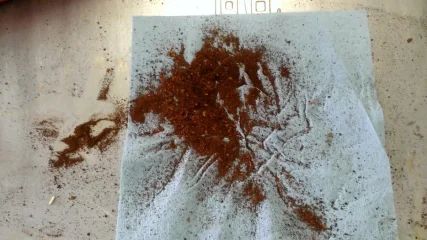
A while back, I got a 69 BSA B25 on the road for a guy. The tank was original with original paint so it was important to use it. However, the rust was terrible inside. Here's the rust that came out with an initial dry nut and bolt shake:

Fuel tank corrosion

Next, I plugged the petcock holes, poured in about 8 ounces of Mercuric acid, sealed the filler hole and turned it every which way for about three minutes. Then I used a pressure washer with the wand inside the tank turning at every angle and dumped that out - still got some flakes so when back to Mercuric acid for about three minutes and then back to the pressure washer. It was now clean as best I could tell so I dumped out the water and put in a few ounces of WD40 and turned it every which way, dumped that out, air dried it, did WD40 one more time, and then put it in service. I told the owner to keep the tank as full as reasonable. That was two years ago and the bike is still running fine.

Cautions: The fumes when Mercuric acid is eating rust will hurt you! If you get Mercuric acid on concrete, the concrete will become lighter colored. Getting it on chrome or stainless is not good for them. If you get it on your skin (bad idea), rinse with water quickly.
 
Citric acid will do the same, not damage the steel or give off bad fumes but will take longer. Comes as a powder so easy to handle, muriatic acid is hydrochloric acid and nasty stuff, it is used in the steel industry to pickle steel but if you fall in the tank you ain't getting out alive.
 
Citric acid will do the same, not damage the steel or give off bad fumes but will take longer. Comes as a powder so easy to handle, muriatic acid is hydrochloric acid and nasty stuff, it is used in the steel industry to pickle steel but if you fall in the tank you ain't getting out alive.

The muriatic acid you buy in the hardware store for cleaning concrete and for removing mortar stains after brick laying does contain 20% hydrochloric acid - certainly not the high concentration hydrochloric acid we used on the tin line at Granite City Steel (gone now) when I worked there.

BTW, you're right about falling in the tank, but getting splashed was a matter of standing under the showerhead and pulling the chain - the shower heads were every 6 feet or so all along all sides of the tank - about 60 feet long and 8 feet wide.
 
Status
Not open for further replies.
Back
Top