750cc Norton Commando Salt Flats Build

I’ve been pondering your Nickasil bore clearance topic a bit more…

Salt flat LSR is freakin’ tough on motors. Many people don’t appreciate the stresses that amount of constant WOT puts on a motor. Add to that it’s in a warm climate and at a high altitude. It won’t take much of an error to turn it into a recipe for a seizure!

In my experience, provided rings are good and gapped correctly, or gapless rings are used, there is little to no perceptible power loss from running slightly (sometimes more than slightly) generous piston to bore clearances. Conversely, running them slightly too tight will result in a seizure. And at the speeds you’ll be doing, you’ll have to be quick with the clutch, and have some good luck, for a seizure to not result in an off.

I would put some time into researching this topic if I were you. Between the piston maker, barrel maker and liner expert a reasonably safe figure should be able to be arrived at I would suggest.

FWIW I run a 920 and a 1007 and for both I basically chickened out and opted for iron lined alloy barrels purely because clearance requirements are well established for these but not quite so clear for Nickasil.
 
Last edited:
To run such a short time, the pistons wouldn't get very warm, there are other reasons to figure out. I've seen High tech builders have all sorts of problems. All 3 of my street bikes won AHRMA Sportsman and F 750 races. And lots of USCRA Championships.
 
In his start up video, no. Half way through the traps on the salt at WOT and peak revs, yes. It’s the latter I’m thinking about.
I'm just pointing out that the bore damage wasn't caused by a hot piston that grew and F-ed up the bore. You can have a too tight piston lock up a on an initial street ride street at low rpms too.
 
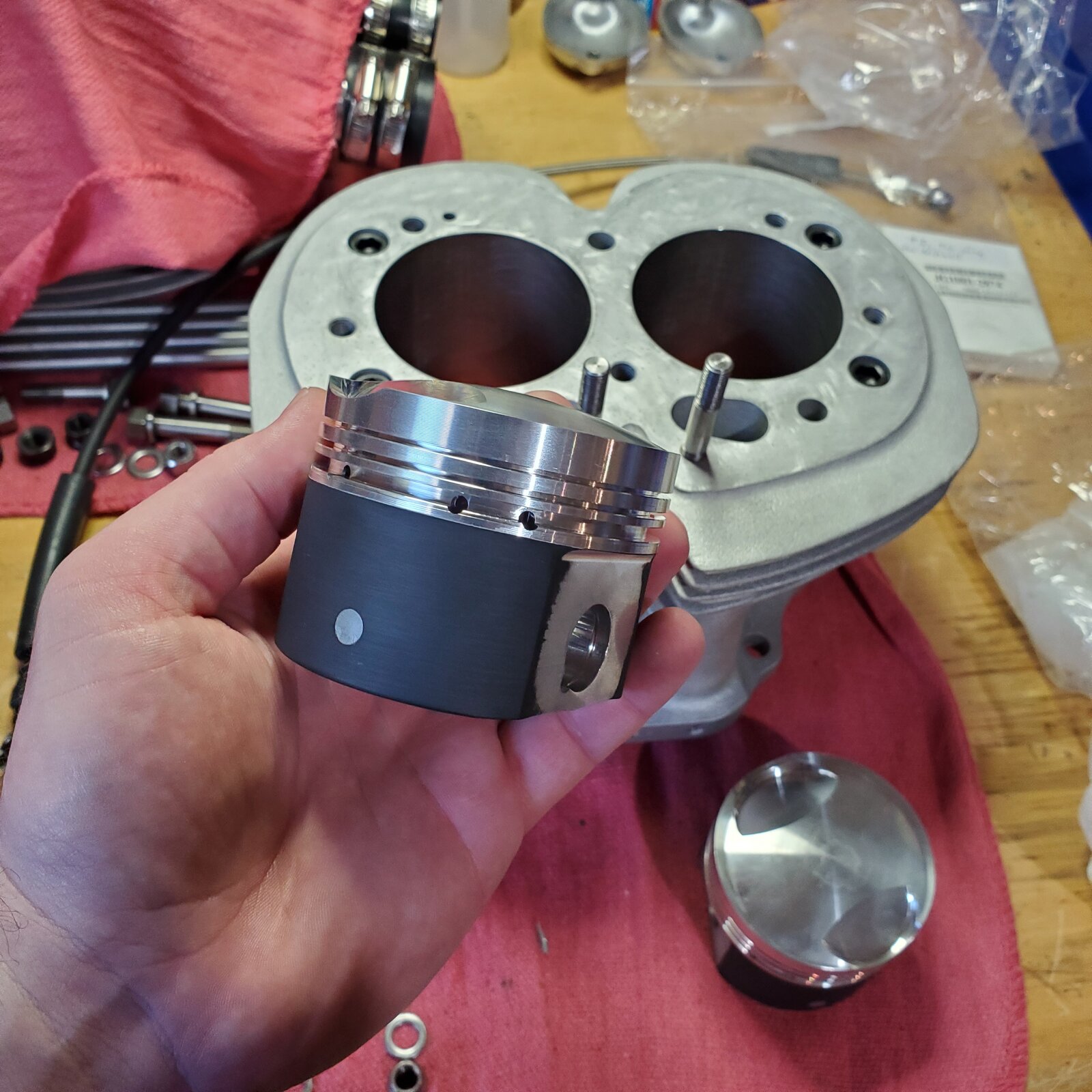
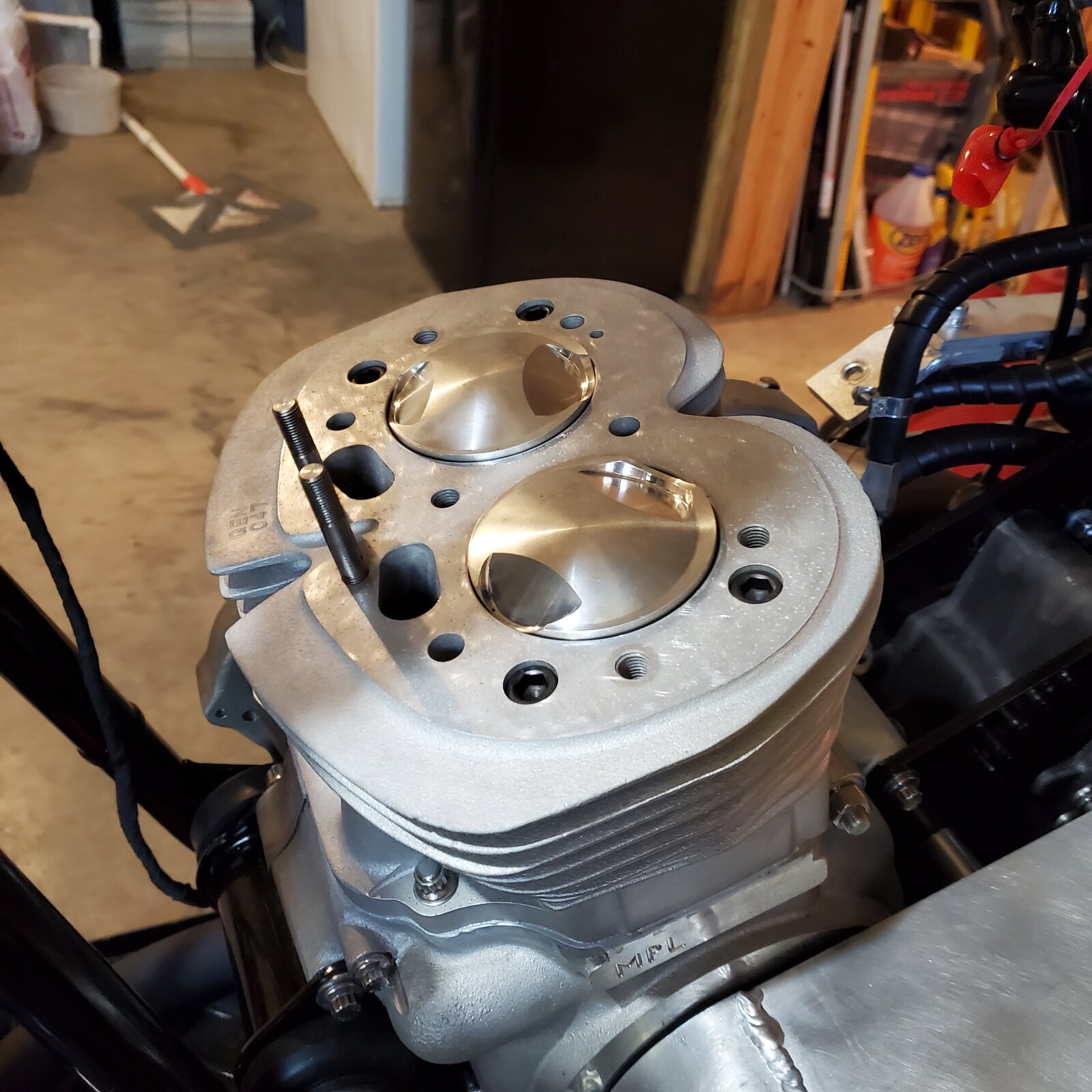
Alright. Finally got enough for an update. Sorry for the delay but replacement pistons from JSM/JE took alot longer than expected. Got the JSM domed pistons for stock rods with graphite coated skirts and TiN rings for nikasil bored. Beautiful units! Almost hate to put them to the flames haha. Checked ring gaps and deburred everything before getting them into the freshly redone bores. Big thanks to Millennium Technologies for getting those done so fast! While I waited for the pistons, I decided to go ahead and get the exhaust ceramic coated by a local shop Battle Born Coating. They did great work and it turned out amazing!
750cc Norton Commando Salt Flats Build

Now for the best news. IT'S ALIVE!!!!! I still have a ton of tuning, tweaking, and testing to do, but she will start and idle on her own. And as some will notice in the video below, for the sake of removing pieces of a puzzle I'm unfamiliar with, I've mounted the FCR carbs in "stock" location to get things more squared away before including the long runners.

As soon as its in a much better running state (or god willing I can find a dyno and get some numbers) I'll give a better video of her under some throttle response.
 
View attachment 122304
Now for the best news. IT'S ALIVE!!!!! I still have a ton of tuning, tweaking, and testing to do, but she will start and idle on her own. And as some will notice in the video below, for the sake of removing pieces of a puzzle I'm unfamiliar with, I've mounted the FCR carbs in "stock" location to get things more squared away before including the long runners.

As soon as its in a much better running state (or god willing I can find a dyno and get some numbers) I'll give a better video of her under some throttle response.

Nice sound. Potato potato

I sure like those combustion chamber filling domes on the pistons. 👍

I think you'll find throttle response with the FCRs is impressive.

Very tunable carburetion. Have fun with it.
 
I cannot figure out what would be better on the salt - a motor which pulls hard from low revs and gets up near top speed quicker, or one which is stronger at high revs. It affects the type of exhaust system and inlet tract, as well as the cam and gearing. If you get up near top speed quicker, you have more time to winde-up before you go through the speed trap. I think that with this stuff, you cannot just presume. You probably would not get many practice runs, and would probably only be able to change gearing and jetting on the day. A Commando engine is a very strange thing. It does not do what some people might predict. I like it a lot. It is not as simple as getting maximum power on a dyno. The shape of the torque curve and gearing are important. They need to suit the application.
 
Last edited:
Put the long intake runners in place, added a few more degrees of timing, a little carb tweaking, and now she runs like a top. Still trying to locate a dyno to get some numbers but she's already in much better shape now.

Engine cam companies send directions not idle new engines to break in cams and lifters. I never idle a bike I build for quite a few miles and just drop the revs to shift into 1st when I go for my test and break in drives. I don't even concern myself with idle speed setting for many rides/ days as I do other things like plug chops. When I get into coasting distance to my shop, I "kill" the engine at various mid speed revs and coast into my driveway to the shop door. I have already set the timing and carb syncn with my mercury sticks during the first or second start up, so I'm good to go and can feel how the engine is running with the bike tuned properly. I work the engines after a few miles of warm up and then start laying on the coal progressively to properly seat rings.
 
I cannot figure out what would be better on the salt - a motor which pulls hard from low revs and gets up near top speed quicker, or one which is stronger at high revs. It affects the type of exhaust system and inlet tract, as well as the cam and gearing. If you get up near top speed quicker, you have more time to winde-up before you go through the speed trap. I think that with this stuff, you cannot just presume. You probably would not get many practice runs, and would probably only be able to change gearing and jetting on the day. A Commando engine is a very strange thing. It does not do what some people might predict. I like it a lot. It is not as simple as getting maximum power on a dyno. The shape of the torque curve and gearing are important. They need to suit the application.
From my understanding at Bonneville. You have lots of distance to get to top speed, so it is all about getting to high revs and top speed thru the Duration of the traps in the "thin" air. I know in road racing some builders had great dyno HP, but on the track could not get to those RPMs to get to max HP and speed. I would think you need to be spinning up the engine to over 7,000 to get to where you need to be. I always shifted my bikes at 7k on the track and on the street (if I was hot-rodding) and if you miss a gear. the revs go way over that. Way over! Luckily my Commando engines can take it. Leo G could tell you lots more about how to drive a bike at Bonneville. Having experience riding and tuning a bike on the salt is a "good thing".
 
Engine cam companies send directions not idle new engines to break in cams and lifters. I never idle a bike I build for quite a few miles and just drop the revs to shift into 1st when I go for my test and break in drives. I don't even concern myself with idle speed setting for many rides/ days as I do other things like plug chops. When I get into coasting distance to my shop, I "kill" the engine at various mid speed revs and coast into my driveway to the shop door. I have already set the timing and carb syncn with my mercury sticks during the first or second start up, so I'm good to go and can feel how the engine is running with the bike tuned properly. I work the engines after a few miles of warm up and then start laying on the coal progressively to properly seat rings.
It idles at most (outside of the sake of the video) for maybe 10 secs at a time while I'm checking for issues. I keep the RPMs around 2.5-3k for the rest of the time spent running. Wanted to get a few heat cycles in on the motor before I tried taking it out for an actual run. Need to go through and re-torque the head, check valves, and clear out the sump screen. Then it's going out to get some plug chops done and seating in the rings.

From my understanding at Bonneville. You have lots of distance to get to top speed, so it is all about getting to high revs and top speed thru the Duration of the traps in the "thin" air. I know in road racing some builders had great dyno HP, but on the track could not get to those RPMs to get to max HP and speed. I would think you need to be spinning up the engine to over 7,000 to get to where you need to be. I always shifted my bikes at 7k on the track and on the street (if I was hot-rodding) and if you miss a gear. the revs go way over that. Way over! Luckily my Commando engines can take it. Leo G could tell you lots more about how to drive a bike at Bonneville. Having experience riding and tuning a bike on the salt is a "good thing".
Correct. Even on the short track you have 1 mile to get up to speed before the traps. That's why I planned the engine to aim for high RPMs and not pulling off the line like a drag bike. Built several street/hot street Norton motors before but this is my first time going for a full race profile. Planned on getting Leo's input on the tuning. He's offered to come with me to a test run if I can make it work so that will be invaluable for the project.
 
👍Nice to get some tuner advice on site in real time from someone with land speed motorcycle development experience.
Every run that an experienced rider has done, can decrease your costs with knowledge. I have used motorcycles on both large race circuits and small. It often takes a lot of changes to get a bike optimised to suit the circuit.
 
Every run that an experienced rider has done, can decrease your costs with knowledge. I have used motorcycles on both large race circuits and small. It often takes a lot of changes to get a bike optimised to suit the circuit.
Yes indeed tuning is a lot of attention to a lot of small details. Gotta put in the tuning time or get some people together that know more about tuning for land speed record chasing than talking about it in a forum. Straight line land speed world record chasing is as far a I can tell above the pocket book, dedication level, and tuning knowledge of most.

I doubt optimal road race circuit tuning be it for large or small circuits would be that useful running nearly 4 miles WOT on the salt. More than likely would be too lean with the throttles fully open that long. I'll never know for sure though since I have zero experience running a stoutly built Norton 750 engine with FCR carburetion WOT throttle that long. The adrenaline rush must be wild.

I've done 173 MPH indicated on long straight sections of road out in the middle on nowhere, but that was not on salt and on a fuel injected Ducati that was rock solid at that speed. 173 mph on a motorcycle as short and as poorly built as a stock Commando would be unique and I'm sure scare the hell out of me when it started wiggling like a wet noodle.
 
Back
Top