Excess Oil in Primary Chain Case - 72 Combat case in 73 750

I have a manual oil supply shutoff valve with ignition cutoff. I am happy with it.


I don't forget to open and shut it because my ignition key is on the end of a 12 inch string with a clip. After putting the key in the ignition, I attach the clip through the carb area to the timing cover side of the bike which is a reminder to turn on the manual oil switch. When I shut off the bike, I need to unclip it to take the ignition key with me which is a reminder to shut the oil shutoff switch. Also I have the main fuel shutoff positioned on the right hand side of tank which is a reminder to me to turn the oil shut off on or off.

A few times I have forgotten to turn on the oil switch and I have cranked the engine with my Alton e-starter. I have an electronic ignition with wasted spark. If I then turn on the oil switch and crank, I get an enormous backfire due to wasted spark stroke igniting mixture. So what I have to do is first clear out the fuel before turning on the ignition (oil shutoff). With choke off and oil shutoff closed I open throttle, crank a few seconds which clears out the fuel.
Then ignition and oil switch on and start engine.
Dennis
 
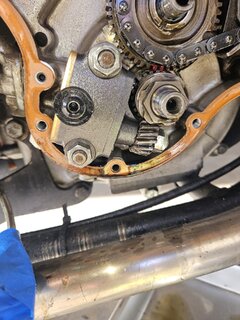
Fast Eddie - You might be right, maybe I misunderstood Matt at CONortonWOrks, but that's not what I thought he said. I just removed the oil pump to be sure that I had not put the gasket between the pump and case on backward, blocking the return orifice. The gasket is correct. (At least I'm not that dumb!!) See photo.

Ahh wait!! .... I re-read the notes from the mechanic who got the bike started a few weeks ago after it had sat for a long time. Before starting the bike he drained 1100 ccs from the sump! So it was leaking oil past the AMR modification during the approximately 2 years that it sat.

When the mechanic got it started he obeserved "Bike returns oil to tank, not as strong as it should, but can't keep bike running long enough to make sure oil system is fully primmed." The next day he ran the bike and observed, " Oil return to tank is better, still a bit anemic." THen after bike sat for 10 days in his shop, he observed, ""attempt to start bike, bike has already wet sumped from sitting (10 days). Drain oil from sump ..., refill oil tank. Start bike, check oil return to tank (returning as it had prior, minor smoking from both pipes)." By "as it had prior," he means "anemic." His final note about future work is to "fix ongoing wet sumping ... and restore oil flow to the tank" which he suspected was due to an oil pump problem. But the oil pump is a MKIII with under 750 miles on it. Unless the AMR modification to the pump has failed, I can't see the pump being the problem, but at this point ... I duno what to Think!?

And maybe the main seal has been leaking for years and the 800 ccs or more of oil I drained out of the primary was building up there for a long time.

So, I'm still thinking that even if the AMR mod has not stopped wet sumping, the ColoradoNortonWorks reed breather valve would be a good addition - and maybe I'll consider also adding a mechanical shut off valve with a built in electronic cut off switch to the supply line to the pump.

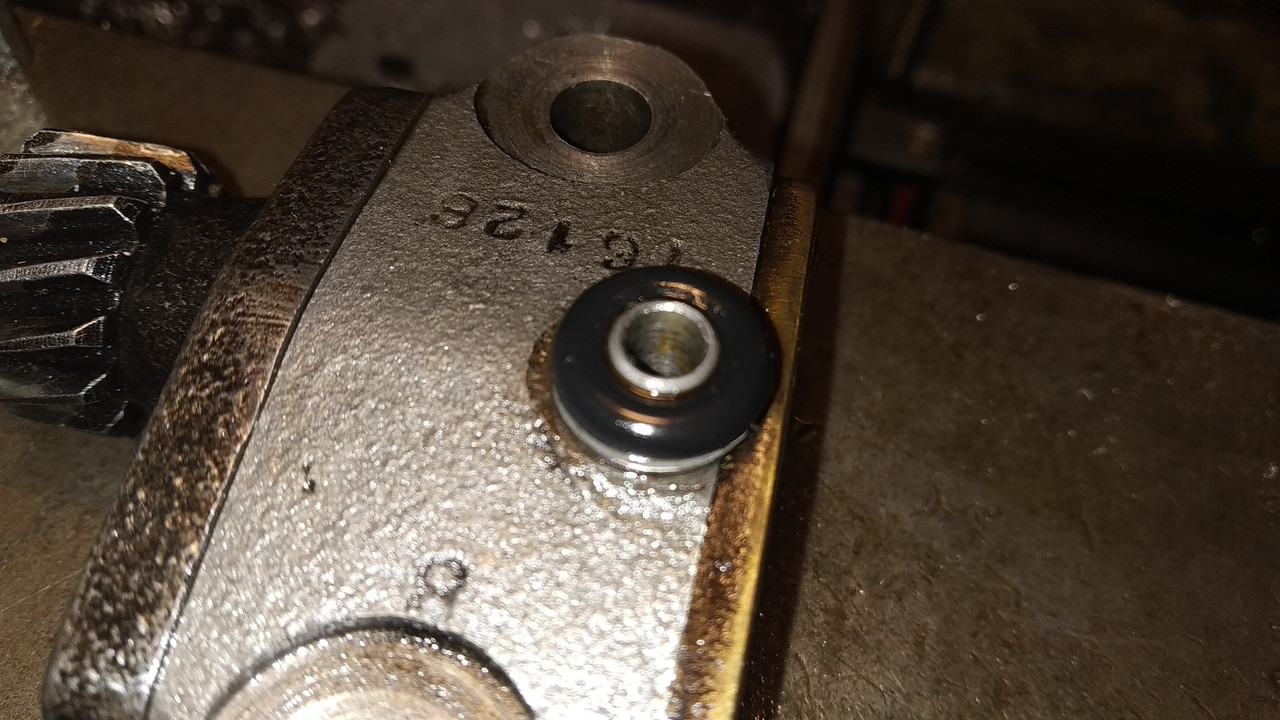
Cliffa - The best source for that info is AMR. It was 2017, so I really don't remember, and that means whatever I tell you is not likely to be compeltely accurate or reliable. But here's my feable memory and understanding:. As far as I remember, I think the orignial housing in the MKIII cover for the check valve is rectangular and the stopper for the check vavle is a square block. I think AMR changes the mating surface on the check valve by machining the flat surface that receives the original square block to be curved to receive a ball bearing instead of the square stopper, and machines the housing for the check valve springand stopper to make it a cylinder for the ball bearing stopper, instead of a rectangle. And I recall they also machine the pump itself to add a seal in there. This is what the inside of the timing case looks like now. See photos. That's how the timing case came off: clean as new, so I don't think dirt was holding the bal check vavle open. The dark at the bottom of the small cylinder that houses the check valve is oil, not dirt. I'm sorry if I can't shed any more light on this - and AMR might correct some or all of what I'm explaining!
Many thanks for taking the time to post the pics. So it looks as though they simply replace the piston plunger with a ball bearing. Would you mind telling me what diameter the bearing is please? And could I ask you one final favour, and post a picture of the oil pump if you still have the case open. I’m interested to see if they retain the MkIII seal, or replace it with an O-ring.

You may want to have a look at this thread, where @robs ss did extensive testing to find the culprit for his bikes incontinence. It’s a long thread, so this link takes you to his input.

 
Many thanks for taking the time to post the pics. So it looks as though they simply replace the piston plunger with a ball bearing. Would you mind telling me what diameter the bearing is please? And could I ask you one final favour, and post a picture of the oil pump if you still have the case open. I’m interested to see if they retain the MkIII seal, or replace it with an O-ring.

You may want to have a look at this thread, where @robs ss did extensive testing to find the culprit for his bikes incontinence. It’s a long thread, so this link takes you to his input.

cliffa

I don't know and don't have a way to measure the diameter of the ball bearing. this picture shows the seal on the oil pump to the cover.
 

Attachments

  • Excess Oil in Primary Chain Case - 72 Combat case in 73 750
    20260314_171024.jpg
    457.4 KB · Views: 46
This is the pre MK3 AMR setup on the pump, well my copy.

Excess Oil in Primary Chain Case - 72 Combat case in 73 750


In this case the ball sits on the steel outlet which I internally chamfered to increase the contact surface.
 
cliffa

I don't know and don't have a way to measure the diameter of the ball bearing. this picture shows the seal on the oil pump to the cover.
Ok, no worries, I was just generally interested. Anyway, thanks for posting the picture of the pump, but that seal doesn’t look great. Any chance of a better picture of it?
 
Last edited:
It looks as though the seal is being flattened each side by the timing cover castings, so I guess it must be pretty tight up against it.

AC982009-71DB-4F53-9B18-4DA57E959019.jpeg
 
I have a manual oil supply shutoff valve with ignition cutoff. I am happy with it.


I don't forget to open and shut it because my ignition key is on the end of a 12 inch string with a clip. After putting the key in the ignition, I attach the clip through the carb area to the timing cover side of the bike which is a reminder to turn on the manual oil switch. When I shut off the bike, I need to unclip it to take the ignition key with me which is a reminder to shut the oil shutoff switch. Also I have the main fuel shutoff positioned on the right hand side of tank which is a reminder to me to turn the oil shut off on or off.

A few times I have forgotten to turn on the oil switch and I have cranked the engine with my Alton e-starter. I have an electronic ignition with wasted spark. If I then turn on the oil switch and crank, I get an enormous backfire due to wasted spark stroke igniting mixture. So what I have to do is first clear out the fuel before turning on the ignition (oil shutoff). With choke off and oil shutoff closed I open throttle, crank a few seconds which clears out the fuel.
Then ignition and oil switch on and start engine.
Dennis

We wired the oil cut-off switch directly through the ignition switch anticipating the issue you describe. When I turn the key, no power anywhere in the bike until
I engage the oil cut off switch....
 
In my case, I just intercepted power to the coils with the oil shutoff switch. I forget the Amps rating of the oil cutoff switch but I was concerned about too many amps going through it while the bike was running leading to possible failure one day.
Dennis
 
We wired the oil cut-off switch directly through the ignition switch anticipating the issue you describe. When I turn the key, no power anywhere in the bike until
I engage the oil cut off switch....
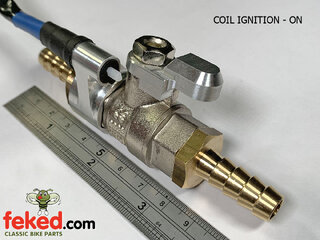
In addition to the Feked shut off valve with electrical cut out switch (from UK), there's one from Kingpin Components in the UK that looks solid https://www.kingpincomponents.co.uk/product-page/oil-tap-with-cutout-switch And one from motorradrestauration in Germany that looks solid https://www.motorradrestauration.de/oelabsperrhahn_mit_zuendunterbrechung1.html

From what I see on the websites, the Feked one for coils looks like it pushes a plastic plunger into the electrical switch to disconnect the power, and relies on an internal spring in the electrical switch to make the connection when the plunger is released by the valve lever (the Feked for magneto is the opposite). The German one looks like it also has the lever push a plastic plunger into the electrical switch, but when it is pushed in it connects the power, relying on an internal spring to disconnect the power. The Kingpin one seems to rely on making and breaking the electrical connection mechanically within the switch, rather than relying on a spring like the Feked and the German one .


German anti wet sump valve with electrical switch.jpg
Kingpin wet sump valve with electrical switch.png
Kingpin anti wet sump valve.jpg
Feked anti wet sump valve.jpg
 

Attachments

  • Excess Oil in Primary Chain Case - 72 Combat case in 73 750
    Feked anti wet sump valve.jpg
    177.1 KB · Views: 1
I don't know about the German one at the time. It looks the best especially since the relay contact looks like an easily available part.
Dennis
 
The Feked one has a serious fault. The switch only operates when the valve is fully closed, the valve could be almost completely closed and the ignition will still be on
 
I don't know about the German one at the time. It looks the best especially since the relay contact looks like an easily available part.
Dennis
I've emailed the German folks to ask for a picture of the inside of the electrical switch to see how the connection is made and broken. I'm thinking if it does not rely on a spring, it might be more reliable ...?? With these mechanical shut off valves that have electrical cut off switches, I suppose there's at least some risk that as you're motoring down the road the electrical switch might fail and cut off the electricity. Adding connectors in the wires to the switch that you can use to temporarily bypass the switch would get you on your way.

And Andy makes a good point about the Feked - That the switch only operates to cut off the electricity when the valve is fully closed, and the valve could be almost completely closed and the ignition will still be on
 
I've emailed the German folks to ask for a picture of the inside of the electrical switch to see how the connection is made and broken. I'm thinking if it does not rely on a spring, it might be more reliable ...?? With these mechanical shut off valves that have electrical cut off switches, I suppose there's at least some risk that as you're motoring down the road the electrical switch might fail and cut off the electricity. Adding connectors in the wires to the switch that you can use to temporarily bypass the switch would get you on your way.

And Andy makes a good point about the Feked - That the switch only operates to cut off the electricity when the valve is fully closed, and the valve could be almost completely closed and the ignition will still be on
Pretty much every set of switchable contacts relies on spring pressure. Various iterations thereof.
 
Back
Top