Removal of rear brake drum side bearing

solbero

VIP MEMBER
Joined
Mar 21, 2025
Messages
53
Country flag
I am trying to remove the rear brake drum side bearing on my 1970 model. I have hit two problems which hopefully someone knows a good solution to.

The service manual explains that I should insert the rear axel with the plated spacer from the lockring side and drive out the drum side bearing. But it is not possible to hit the top of the axel with a mallet as the plated spacer is not long enough to make the axel head clear the hub.

The other problem is that it seems like the breake drum side of the hub has been punch-crimped. Will I be able to remove the felt retaining washer just by driving the brake side bearing from the lockring side? ?
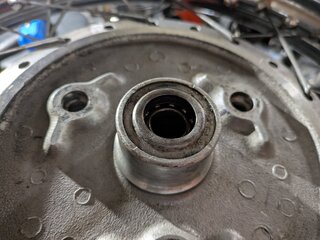
PXL_20260217_205024529.jpg
 
Last edited:
For the dished washer, you can just tap the staked bits back with a drift/chisel. There is an updates dished washer from AN with notches in the periphery.

Do a search for rear bearing removal..
Lots of older threads on procedure and equencing of parts..schematic not clear on at least one shim placement.

Hot tip, keep to 45-50 ftlbs torque on axle nut, not the 70 book spec...prevent squashing of speedo housing leading black star of death phenomenon.
 
For the dished washer, you can just tap the staked bits back with a drift/chisel. There is an updates dished washer from AN with notches in the periphery.

Do a search for rear bearing removal..
Lots of older threads on procedure and equencing of parts..schematic not clear on at least one shim placement.

Hot tip, keep to 45-50 ftlbs torque on axle nut, not the 70 book spec...prevent squashing of speedo housing leading black star of death phenomenon.
Hot tip : heat gun to the hub area with penetrant . Same without penetrant , to put in the new frozen bearing .
 
That is a 4203 double row ball bearing , It is a special bearing with tight tolerances, I would inspect it and re grease it and not remove it. If it moves freely, I would not remove it. if you do remove it, you can clean it and reuse it, IF it looks and spins OK. IT is a very expensive bearing and they don't make them like they used to. The new bearings are C3 not as tight a clearance as the OEM ones. Removing it can damage it!
 
Hot tip : heat gun to the hub area with penetrant . Same without penetrant , to put in the new frozen bearing .
I used lots of heat and penetrant oil. The lockring side bearing and bearing spacer came out without any problem.

Do a search for rear bearing removal..
Lots of older threads on procedure and equencing of parts..schematic not clear on at least one shim placement.
I have looked at the older threads. I found this thread, but the person there had had the same problem with the rear axel and plated spacer not being long enough.

That is a 4203 double row ball bearing , It is a special bearing with tight tolerances, I would inspect it and re grease it and not remove it. If it moves freely, I would not remove it. if you do remove it, you can clean it and reuse it, IF it looks and spins OK. IT is a very expensive bearing and they don't make them like they used to. The new bearings are C3 not as tight a clearance as the OEM ones. Removing it can damage it!
Good tip, I will consider it. But the oil felt washer looks like it should be replaced. The felt washer was completely missing/disintegrated on the lockring side.
 
I used lots of heat and penetrant oil. The lockring side bearing and bearing spacer came out without any problem.


I have looked at the older threads. I found this thread, but the person there had had the same problem with the rear axel and plated spacer not being long enough.


Good tip, I will consider it. But the oil felt washer looks like it should be replaced. The felt washer was completely missing/disintegrated on the lockring side.
I used to replace bearings thinking it was the right thing to do, But after putting in a few modern C3 replacements, I found that the clutch hubs had play in them as well as when I put in a new replacement 4203 in the Drum Sprocket of a 850 Commando. Luckily Years ago I brought a few OEM replacements on E bay cheap. It is shocking to see what a local bearing supply house would charge for a CN clearance clutch bearing , about 100$ and to get a bearing as good as the OEM 4203 double row, could double that as it is that special or complex to make.

The only problem bearing is the brass cage Layshaft bearing, but the older steel cage ball bearing that they replaced stood up very well. I split the trans case wide open on my new MK2A 850, while the bike was on warrantee pulling a hole shot, Luckily the dealer made good on a trans replacement. The road was stained with a hundred foot oil trail and the rear wheel was spinning like a top in the oil slick. I have seen or replaced the layshaft bearing in several other customers bikes and learned how to replace them quite fast. To do a whole gear box renewal today would cost over 4,000$ today. 8 gears, 2 shafts, proper bearings, Trans case and labor.
 
I am still stuck on the problem of drifting out the drum side bearing. Any suggestions given the procedure described in the service manual seems to not work
 
I got a direct message from @Carl H making a good case for leaving the 4203 bearing in the hub. I will have a closer look and see if I am able to replace the felt washer on the drum side, and clean and re-grease the bearing. There is a gap between the felt retaining washer and the bearing after drifting it up to the shoulder in the hub as described in the service manual.

It seems like the drum side bearing has never been replaced. The lockring, however, has marks from being drifted with a punch. Considering that the felt washer was missing I suspect that the lock ring bearing has been removed and perhaps replaced at some point.

Also, to clarify, both bearings rotate smoothly. I have used gentle tapping, heat and penetration oil when drifting the bearings. I can see that I might have given the impression that the bearings have been drifted using excessive force and were not functional.

Out of curiosity. I am able to source these bearing: 4203 and 6203. Would they work as replacements if I needed to replace the original bearings?
 
Last edited:
Yes should do. Also fit the later retaining washer. Always fully fit the lock ring side bearing and lock ring first.
The later felt retaining washer won't fit the bolt-up hub on the drive side.
It's designed to fit in a ~5mm depth bore with an interference fit, whereas the bolt up hub only has a ~1mm bore to fit the flat retaining washer.
Fitting zz spec bearings would negate the necessity of the felt seal arrangement.
 
Hot tip, keep to 45-50 ftlbs torque on axle nut, not the 70 book spec...prevent squashing of speedo housing leading black star of death phenomenon.
i think the info you have provided here is with regard to stated & advised rear axle torque wrench settings and are specific only to the earlier bolt up hub???
 
Last edited:
i think the info you have provided here is with regard to stated & advised rear axle torque wrench settings and are specific only to the earlier bolt up hub???
No, 70 ft lb is too much for a Commando, Triumph, BSA, et. Al. rear wheel in general but is way too much for a Commando and will deform the speedo drive. It is worse on a Commando because Norton and Smiths never got together and made a speedo drive that matched the spindle diameter, so Norton used a spacer to take up the gap and that gets crushed and the speedo drive deforms.

Removal of rear brake drum side bearing
 
I am still stuck on the problem of drifting out the drum side bearing. Any suggestions given the procedure described in the service manual seems to not work
Here is my best advice IF you haven't damaged the bearing yet and you removed the other side's bearing a 6203. Now you can clean and remove all the old grease and dirt out of the hole and the 4203 bearing still in the brake drum side and feel it for smooth rotation and no play in it. Then you can apply high quality grease to it and install a new felt seal and a new 6203 bearing in the other side. It really pays to have proper tools and a good fitting drift to put bearings in with, and to heat the Aluminum to make the bearings a very light press so they go in with minimum force and YOU don't want to pound them in so tight that they get hard to spin. This is a tricky thing to do without some tools and experience and parts are easily damaged.
I got a direct message from @Carl H making a good case for leaving the 4203 bearing in the hub. I will have a closer look and see if I am able to replace the felt washer on the drum side, and clean and re-grease the bearing. There is a gap between the felt retaining washer and the bearing after drifting it up to the shoulder in the hub as described in the service manual.

It seems like the drum side bearing has never been replaced. The lockring, however, has marks from being drifted with a punch. Considering that the felt washer was missing I suspect that the lock ring bearing has been removed and perhaps replaced at some point.

Also, to clarify, both bearings rotate smoothly. I have used gentle tapping, heat and penetration oil when drifting the bearings. I can see that I might have given the impression that the bearings have been drifted using excessive force and were not functional.

Out of curiosity. I am able to source these bearing: 4203 and 6203. Would they work as replacements if I needed to replace the original bearings?

I got a direct message from @Carl H making a good case for leaving the 4203 bearing in the hub. I will have a closer look and see if I am able to replace the felt washer on the drum side, and clean and re-grease the bearing. There is a gap between the felt retaining washer and the bearing after drifting it up to the shoulder in the hub as described in the service manual.

It seems like the drum side bearing has never been replaced. The lockring, however, has marks from being drifted with a punch. Considering that the felt washer was missing I suspect that the lock ring bearing has been removed and perhaps replaced at some point.

Also, to clarify, both bearings rotate smoothly. I have used gentle tapping, heat and penetration oil when drifting the bearings. I can see that I might have given the impression that the bearings have been drifted using excessive force and were not functional.

Out of curiosity. I am able to source these bearing: 4203 and 6203. Would they work as replacements if I needed to replace the original bearings?
Norton "Bean counters" did not spend the extra money to buy all the "fancy"C2 bearings that are in a bike. Luckily for me, I always used OEM bearings when I could find them or did not replace them, after I saw all the slop in the C3 when I installed them.

I have never seen a 4203 bearing in a condition that needed to have them replaced and It seems the "Old fashioned" felt seals performed very well in keeping them in good shape for over 50 years. I've pulled thousands of all out hole shots and really put them to the test.

Part of the reason, Is the machining of the parts and the shafts fits were not all that precise as would be used in High precision "military spec" stuff and the C2 helped tighten things up. The 4203 C2 not only take axial forces, but radial and thrust forces that the brakes and the HP of the Commando engine produces. On A front disc brake or even a drum, you want the parts to run very true.

I always tried to do the best I could on my bikes and with the race results we got, Apparently Norton did things good enough with some careful assembly and thought.


Removal of rear brake drum side bearing


[td]C2[/td][td]Tight (Less than Normal)[/td][td]Low noise, high precision, low heat. Requires very precise machining of shaft/housing.[/td][td]Precision Spindles, Gyroscopes, Micro-motors.[/td][td]CN (C0)[/td][td]Normal (Standard)[/td][td]Standard temperatures (-20°C to +100°C) and normal fits. The default choice.[/td][td]Conveyors, Standard Fans, Water Pumps, Agricultural Machinery.[/td][td]C3[/td][td]Loose (Greater than Normal)[/td][td]High speeds, moderate heat, or heavy press fits. Allows for thermal expansion.[/td][td]Electric Motors, Motorcycle Engines, Automotive Alternators.[/td][td]C4[/td][td]Extra Loose[/td][td]High heat or severe vibration.[/td][td]Vibrating Screens, Mining Crushers, Paper Mill Dryers.[/td][td]C5[/td][td]Extra Extra Loose[/td][td]Extreme heat environments.[/td][td]Kiln Cars, Steel Mill Rollers, High-Temp Ovens.
[/td]
 
Last edited:
Back
Top