Head installed on the bench, then motor into the frame.... It can be done

Jonez69

VIP MEMBER
Joined
Aug 15, 2024
Messages
137
Country flag
I just did this this afternoon without much difficulty. I am 66 years old next week and do not work out. I'm pretty sure I could not bench press my own weight- 185lbs. I am not trying to brag here, I just wanted to let people know how I did it. This project is a complete rebuild, crank grind, fresh bore +.020, pistons of course and complete head rebuild. The bike also received new Isolastics front and rear, new swing arm bushes and spindle, the list goes on. My method requires the rear wheel and shocks to be removed as you will see in the pictures.
My goal was to install the pushrods on the bench. This was easy with gravity as your friend. I used a wooden brass brush handle to hold the head just above the jug and quickly positioned the pushrods into place. With this done, I torqued the head. Next, I removed the engine from my engine stand and installed the front ISO. It will safely lean forward and rest on the front ISO, once installed, while on the bench. With the shell of the gear box in the cradle loosely and a large wood block to rest the engine on, plus all my hardware ready beside the frame along with pry bar and alignment tools, I was ready to carry the unit to the frame, which was only a full 180 turn and a couple of steps from the bench.
In order to not feel the pain of the drive side of the crank pressing hard into my belly, I used a Haynes manual tucked in my belt. The crank rested against it and made it easy. There is no reason I can think of that would prevent doing this from the timing side with the timing cover on to protect your tummy, but this is how I had the bike on the table and so I did it from the drive side. Once the motor was attached to the frame via the front ISO, I only had to swing the cradle back to meet the engine and wiggle both around until the holes lined up using alignment tools. If you feel that your method works better/safer, or what have you, hey, that's great! This worked for me and I finally found a good use for a Haynes manual!
Head installed on the bench, then motor into the frame.... It can be done

Head installed on the bench, then motor into the frame.... It can be done
 
When you got the engine to the frame what did you set it down on to take the weight off your arms? Prior to pinning the iso.
 
When you got the engine to the frame what did you set it down on to take the weight off your arms? Prior to pinning the iso.
The large wood block that is supported by 2x4s. (see first picture) The height of the block plus the 2x4s brought it up between the frame rails. I set it on that block and then was able to maneuver it forward to the ISO mounting. I used a pry bar to gently flex the down tube to open up and accept the ISO and not rip the boot of the ISO. Once bolted to the frame, I removed the 2x4s and rear block. Then the engine rested nicely on the front block that has been supporting the frame through out the tear down and rebuild. With the rear block out of the way, I could then swing the cradle into position and bolt it to the cases.
 
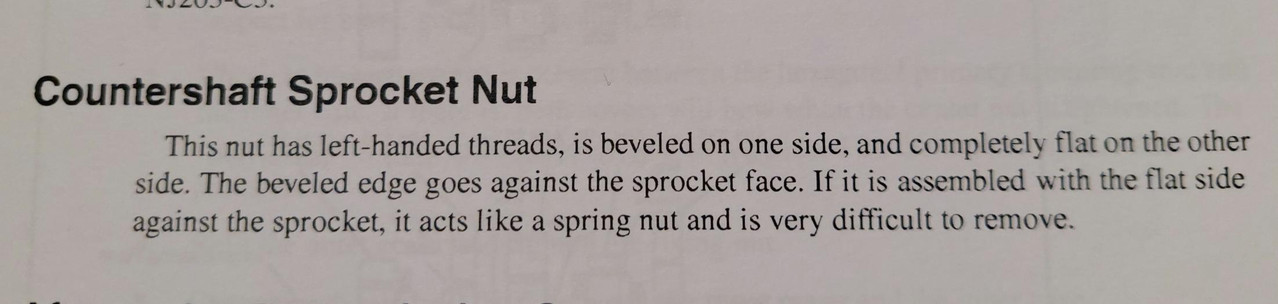
Is that gearbox sprocket nut on the right way round?

I had it in my head that the bevelled edge of the nut sat against the sprocket?
 
Is that gearbox sprocket nut on the right way round?

I had it in my head that the bevelled edge of the nut sat against the sprocket?
The workshop manual does not specify and the parts manual illustration shows bevels outward, so that's the way I went. Perhaps someone will correct me if I'm wrong.
 
Thanks.

Isn’t lock nut the more common parlance ? Googling lock nut brings up lock nuts… googling spring nut doesn’t !

His description (acting like a lock nut) makes it sound like a GOOD thing to me though !

I would have thought that the bigger risk / issue was the corners digging in when tightening the nut and thus preventing the torque being applied translating into correct clamping force and thus increasing the likelihood of it coming loose at some point ?
 
As some of you know, I’ve just recently been this deep into mine and replaced this nut. A friend of mine swears Norman White recommends flat side in and indeed the illustrations on AN exploded diagrams seems to agree. Matt @ cNw definitely doesn’t, stating the inside of the sprocket is concave and needs to marry to the chamfers of the nut.

So, as I had it all in my hand I had a very close look. Actually on my sprocket (not a AN piece) there is a flat area before the concave. The flat side of the nut is actually very slightly chamfered at each point so the nut lays perfectly flat in the centre of the spocket.

What I did notice however was the milling on that side was noticeably rougher than the chamfered side. Naturally I went with Matt. Once tightened to the recommended 80ft/lb I struck lucky, or at least I thought I did, as the locking washer exactly aligned with one of the holes in the sprocket, unfortunately it was in line with one point of the nut and there was no way the screw would get past it. I sorted that by gently filling the point down and a little off the circumference of the screw.
IMG_8317.jpeg
 
Thanks.

Isn’t lock nut the more common parlance ? Googling lock nut brings up lock nuts… googling spring nut doesn’t !

His description (acting like a lock nut) makes it sound like a GOOD thing to me though !

I would have thought that the bigger risk / issue was the corners digging in when tightening the nut and thus preventing the torque being applied translating into correct clamping force and thus increasing the likelihood of it coming loose at some point ?
Reading that implies that it drags with resistance as you tighten or loosen. It is meant to warn a person who may be a non mechanic, or in a big hurry. The inference is, when the nut is correctly oriented, it free runs and feels as expected when nipped up (tightened).
Any skilled mechanic can look at that fastener, and the surface it contacts, and know straight away how to install it. The "spring nut" reference was a warning to laymen.
 
As some of you know, I’ve just recently been this deep into mine and replaced this nut. A friend of mine swears Norman White recommends flat side in and indeed the illustrations on AN exploded diagrams seems to agree. Matt @ cNw definitely doesn’t, stating the inside of the sprocket is concave and needs to marry to the chamfers of the nut.

So, as I had it all in my hand I had a very close look. Actually on my sprocket (not a AN piece) there is a flat area before the concave. The flat side of the nut is actually very slightly chamfered at each point so the nut lays perfectly flat in the centre of the spocket.

What I did notice however was the milling on that side was noticeably rougher than the chamfered side. Naturally I went with Matt. Once tightened to the recommended 80ft/lb I struck lucky, or at least I thought I did, as the locking washer exactly aligned with one of the holes in the sprocket, unfortunately it was in line with one point of the nut and there was no way the screw would get past it. I sorted that by gently filling the point down and a little off the circumference of the screw.
View attachment 123691
That's why there is more than one hole for the screw. "Half stations"
Head installed on the bench, then motor into the frame.... It can be done
 
If I recall, the locking washer can also be flipped to provide more possibilities of alignment to line up the screw hole if needed as the screw hole is offset from the points
 
You got me second-guessing myself now. Will have to bundle up and head out to the shed in the morning with a flashlight to try and get a look at that nut.
 
That's why there is more than one hole for the screw. "Half stations"View attachment 123692
Yes I’m aware of that but such is the spacing that only one aligns at a time. Being a LH thread it would have meant over torquing. As a layman I chose the safer solution.

FTR the locking washer cannot be flipped as the tab with the screw hole is bent to accommodate the curvature of the sprocket’s face.
 
Back
Top