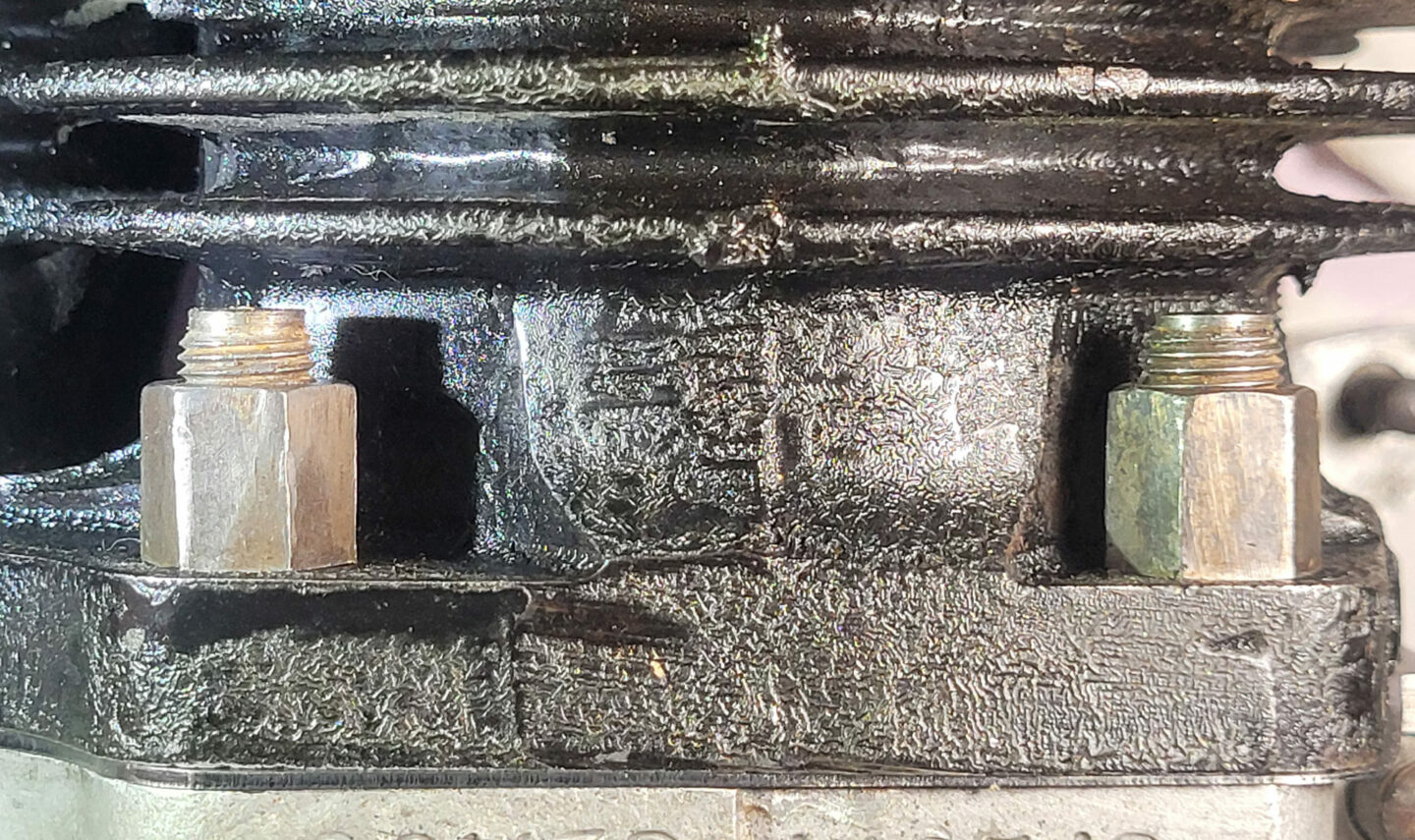
The Desaxe head gasket for correcting cylinder alignment is here

Seattle - yes I tested this and many other things on my monoshock when I was racing.. See vid at:


MarshG246 - there is enough play in the engine cradle bolts etc to align the head steady.

mtd-son - In real life there is no gap on one side of the nut. I tried it and could not even get a .0015" feeler gauge to slip under the nut because there is some free play in the threads - try it yourself and you'll see. You don't need to modify the nuts and washers - I've already tested it.

I'm not saying you should tear your motor down for this. But its an easy thing to do on the next rebuild.
 
Seattle - yes I tested this and many other things on my monoshock when I was racing.. See vid at:


MarshG246 - there is enough play in the engine cradle bolts etc to align the head steady.

mtd-son - In real life there is no gap on one side of the nut. I tried it and could not even get a .0015" feeler gauge to slip under the nut because there is some free play in the threads - try it yourself and you'll see. You don't need to modify the nuts and washers - I've already tested it.

I'm not saying you should tear your motor down for this. But its an easy thing to do on the next rebuild.

I think what @seattle##gs was asking was similar to what I was asking. Reworded: Have you tried it on a standard Commando street bike and what's the point on a standard Commando street bike.

There are LOTs of things you can do that don't make a "hill of beans" of difference to most riders on street bikes!

Of course, some want to make their bike "all it can be" and have more time and money than sense so for them, go forth and enjoy yet another itty bitty (possible) improvement!
 
"Some people" have time, money, and sense enough to know when enough is enough. I have a good balance of parts in a pre-Commando 750 from various vendors, but I live in a one off make it go fast world of my own that requires a lot of odd modifications most would never bother with. Plus my bike wouldn't work for the majority of people on this site. It's not that user friendly. Yep, a waste of money. I should detune it so I can sell it before I forget where my garage is. lol
 
Building a Norton Commando to factory original is not a hard thing to do. Any child with some Lego experience can do that. Just follow the book, and from a financial pov, probably the smartest way to go.
But at the end, all you have achieved is recreating the same POS that left the factory.
OTOH, if you take a critical look , there is a long list of points where a Commando can be improved upon. Most of these mods, taken separately, can be brushed aside as unnecessary, not worth the effort, etc.. but together they can make for a better, safer and more enjoyable motorcycle.
JS gets my vote.
 
There is no problem at all with the nuts, studs or through bolts as shown below. The nuts come down perfectly flat. The 850 through bolts are only deflected 1/32" at the top (the bolt holes are oversize). The re-angle correction is only about 1/2 a degree (.6). Note the installed wedge base gasket.
The Desaxe head gasket for correcting cylinder alignment is here
 
I don't see a problem with the angled base and I very much doubt that the original case threads, studs and nuts / throughbolt threads can be relied on to be perfectly true anyway.

Jseng1 thanks for sharing your mods much appreciated as are yours Ludwig 👍
 
I bought the gasket/spacer and I did some of my own research. The 1/2 degree slope to the rear will move the cylinder center line just forward of the crank center line. One article said Henry Ford used this technique on early V8 engines. Yamaha offsets the CRF450 by 10mm which seems like a lot. The point is that it is a proven technology. I built a paper model of the case and cylinder so that I could rotate the cylinder back and forth. To get 3/16s forward of the crank it appears that you would need to mill almost 1/4 inch off of the back of the deck.
 
I bought the gasket/spacer and I did some of my own research. The 1/2 degree slope to the rear will move the cylinder center line just forward of the crank center line. One article said Henry Ford used this technique on early V8 engines. Yamaha offsets the CRF450 by 10mm which seems like a lot. The point is that it is a proven technology. I built a paper model of the case and cylinder so that I could rotate the cylinder back and forth. To get 3/16s forward of the crank it appears that you would need to mill almost 1/4 inch off of the back of the deck.
Just for fun-fun-fun , can we see your model ?
 
I bought the gasket/spacer and I did some of my own research. The 1/2 degree slope to the rear will move the cylinder center line just forward of the crank center line. One article said Henry Ford used this technique on early V8 engines. Yamaha offsets the CRF450 by 10mm which seems like a lot. The point is that it is a proven technology. I built a paper model of the case and cylinder so that I could rotate the cylinder back and forth. To get 3/16s forward of the crank it appears that you would need to mill almost 1/4 inch off of the back of the deck.
I'm thinking of moving the pins .020" forward in the pistons as well.
 
I am reluctant to have things on my motorcycle which require memory when I am assembling it. To rev a vertical twin motor high, the crankshaft balance is very important, regardless of discomfort at low revs. If the desaxe thing has been proven to work well, it should be incorporated in after-market motors, and replacement parts. Somebody might see a dollar in it. With the reshaped cylinder head gasket - whatever compression ratio the motor finally has, the jetting and ignition timing need to be adjusted to achieve the optimum balance between the three factors. A motor which is jetted rich will be slow, raising the compression ratio has the same effect as leaning-off the jetting or increasing the ignition advance - the three factors are in balance for optimum combustion. Carburetors do not deliver enough control over mixture for maximum performance , especially when using petrol. Moving ignition timing on a dyno to get maximum torque might be a better way to go, but the question of desaxe also becomes an issue. - the matter of angularity and thrust. - At what crank angle does maximum thrust occur, and where should it occur ? People who ride push-bikes would know this. -In an engine, I would suggest 85 degrees after top dead centre, just before the exhaust valve opens.
 
Last edited:
I am reluctant to have things on my motorcycle which require memory when I am assembling it. To rev a vertical twin motor high, the crankshaft balance is very important, regardless of discomfort at low revs. If the desaxe thing has been proven to work well, it should be incorporated in after-market motors, and replacement parts. Somebody might see a dollar in it. With the reshaped cylinder head gasket - whatever compression ratio the motor finally has, the jetting and ignition timing need to be adjusted to achieve the optimum balance between the three factors. A motor which is jetted rich will be slow, raising the compression ratio has the same effect as leaning-off the jetting or increasing the ignition advance - the three factors are in balance for optimum combustion. Carburetors do not deliver enough control over mixture for maximum performance , especially when using petrol. Moving ignition timing on a dyno to get maximum torque might be a better way to go, but the question of desaxe also becomes an issue. - the matter of angularity and thrust. - At what crank angle does maximum thrust occur, and where should it occur ? People who ride push-bikes would know this. -In an engine, I would suggest 85 degrees after top dead centre, just before the exhaust valve opens.
It's nothing to do with re shaping the cylinder head gasket
It's to do with a wedge shaped shim under the cylinder barrel
 
Moving the pins forward in the piston is something I can do whenever I order new pistons. It will be a transitional thing if I decide to do it and I'm pretty sure I will.
Won't that require longer rods to keep the compression ratio? Won't that increase the wear/pressure on the front of the piston skirt? What gain do you expect for a street bike?
 
Won't that require longer rods to keep the compression ratio? Won't that increase the wear/pressure on the front of the piston skirt? What gain do you expect for a street bike?
They benefits should outweigh whatever else might worry you. Note that I'm not taking things too far. I'm only taking them as far or not as far as other manufacturers have found works best. I'll be transitioning the pistons but you can always special order if you don't want to wait. I'm not expecting a stupendous improvement - just a step in the right direction towards more efficiency and reduced wear/vibration/noise. Its a few little helpful things that add up to a better running motor.
 
Back
Top