Back to the future P11 shenanigans

Done putting it back together. Started right away. Higher compression makes it sound different. Idled quick. Sitting still blipping the throttle is impressive, but that doesn't mean it will translate directly to street power. My gut however says it'll be fun. Probably lift the nose some turning the wick up. The light internal parts are working well. No smoke.

I'll get out tomorrow and give it 15 minutes before going WOT.

Next project is doing something about the crappy swing arm spindle bearing situation. The rubber coated sleeves are not working that well after being in there since 1967. After that an action camera might make it to the short list.
 
Finally got out for a quick test loop. I did not go WOT, and it was not easy to act like an adult I got to tell you. Mellow ride mostly 1st and 2nd gear up to 35mph. One shift into 3rd to see if it got sluggish, but it ran well. Engine performed basically almost the same as it did with the JS2 cam, but the compression and resulting engine braking combined with the lighter crank was really nice letting off the throttle. Also the SS cam has a very distinctive off throttle burble. I like that. Definitely a little noisier with the flat tappets, but it did not miss a beat. Tune is really close, but won't know for sure until I get out in the open country after I put some more miles on the engine. If anything it is a little rich. Oh yeah and first gear is kinda tall, so I have to slip the clutch a little from full stops and try not to run into any cars in front of me when I launch. lol

No complaints with the engine yet...
 
This setup is harder to kick over than it was previously with the JS2 cam and MAP medium compression pistons and long rods. I absolutely have to get the pistons over TDC or I can't get a good kick. Even then it is harder to kick. It's probably me getting old, and the SS cam profile combined with the increased compression.

When I had the SS cam in this engine with Commando Combat spec +.020 pistons, stock rods, and a heavier crank it was hard to kick over randomly when cold. I was hoping it wouldn't be the same, cuz I did not get younger between 1993 and 2025. It runs great, but I'm paying for that higher compression.
 
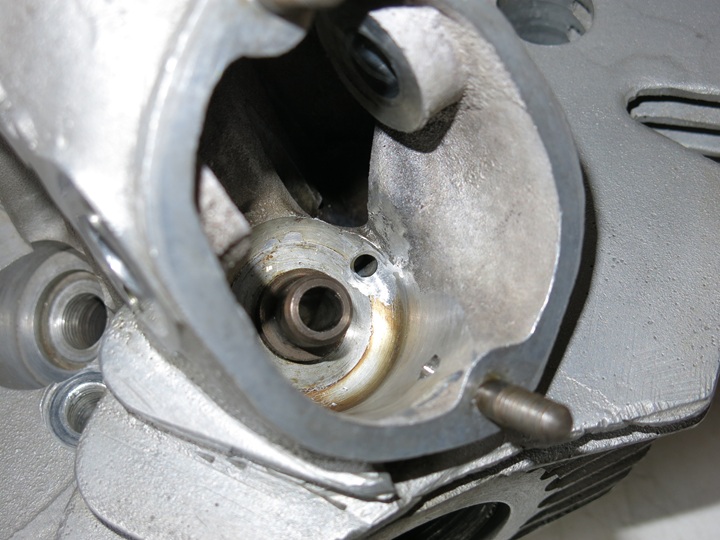
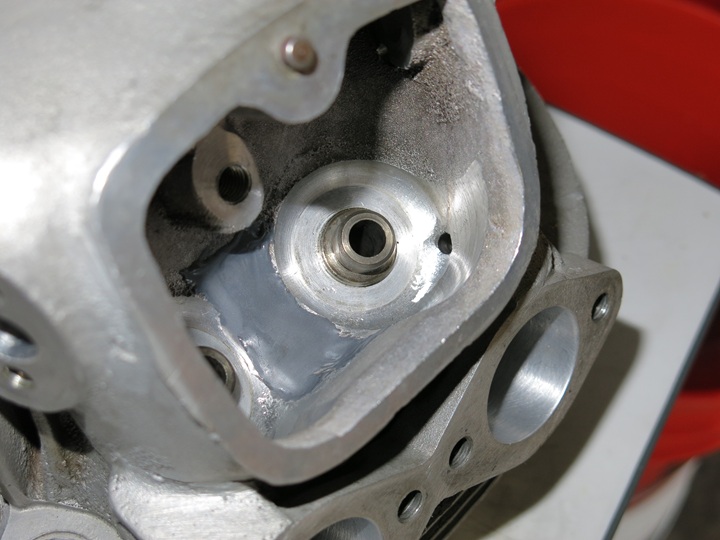
Simple oil drain modifications for the old P11 head. I never did show how minimal these modifications were. Only hard part about it is getting all the aluminum out of the head after doing the grinding. Also filled the pocket between the two intake valve pockets with epoxy. I'm fairly certain this makes a difference, but like most of the stuff I do how much of a positive difference it makes is an unknown. The point of doing the modifications was to get more oil that has already lubricated the rocker spindles out of the head and down to the lifters and sump quicker.

Intake side
Back to the future P11 shenanigans


Exhaust side
Back to the future P11 shenanigans
 
Last edited:
What's the maximum sustained temperature limit of the epoxy you used? I trust it's a heat-resistant type. Temperature at the valve spring seat is expected to be within the range of 150 - 180 deg C (310 -360 'F). Yes, there are epoxy bondings which will handle sustained temperatures up to 232 'C (450 'F) and and for some compositions beyond that, but I doubt they have been rated for coincident hot oil resistance. For instance, "JB Weld High Heat" exhibits moderate chemical resistance, particularly to gasoline and other petroleum-based substances, but it is not suitable for long-term exposure, especially with ethanol-blended fuels. So, what happens if your bonding cracks and is flushed away? You need to keep a watchful eye on your bonding.

- Knut
 
There is a open area in the head casting beneath that pocket. It is not sitting on top of the combustion chambers. I'll shoot at it with a temp reading gun next time I get back from a ride. I'm not sure I can get the valve cover off fast enough to get a good reading though. Fuel tank is kind of in the way.

It's JB Weld. My experience with JB Weld is it takes impact to loosen it once cured on a clean surface, but it could come off in one chunk I suppose if oil migrated under it and get chopped to bits. Engine would possibly come to an abrupt halt due to lack of oil. Hopefully it would get really noisy and give me some warning. :)

In the meantime I'll take a peak in there once in a while to see if it is coming loose.

Edit: I just got through adjusting the valve lash cold to the combat spec, which may or may not be right for this version of SS cam, and looked at the epoxy patch. Looks the same, but has an motor oil sheen on it.
 
Last edited:
What's the maximum sustained temperature limit of the epoxy you used? I trust it's a heat-resistant type. Temperature at the valve spring seat is expected to be within the range of 150 - 180 deg C (310 -360 'F). Yes, there are epoxy bondings which will handle sustained temperatures up to 232 'C (450 'F) and and for some compositions beyond that, but I doubt they have been rated for coincident hot oil resistance. For instance, "JB Weld High Heat" exhibits moderate chemical resistance, particularly to gasoline and other petroleum-based substances, but it is not suitable for long-term exposure, especially with ethanol-blended fuels. So, what happens if your bonding cracks and is flushed away? You need to keep a watchful eye on your bonding.

- Knut
212F measured at the epoxy filled pocket shown up above between the intake valve pockets after a short 9 mile surface street ride with some idling stops, one short hill, and all at reasonable street legal speed. Nothing for me to worry about. 45 minutes of WOT racing on a track might be a little different, but me racing on a track is never going to happen. I do ride at a good clip out in the foothills, but it probably runs cooler overall with all the air running over, around, and through the head.
 
Anecdotal stories but funny - my friend had Yamaha 850 triple, and one night he took off and rode right over a curb, cracking the case. Probably at a bar. He laid it down, JB welded the case and it held just fine. Story 2 - I had a disintegrating cast-iron spa heater; it was pretty massive, could have heated a pool. The problem was that the fittings were leaking and I had no money. I JB welded them, some very close to the hottest area - I got 3 years of California groovin' out of that damn thing LOL.
 
JB weld will work where I'm using it in the head. It's not providing any structural adhesion that is under stress. I'd have to use a hammer and cold chisel to get it to chip out.

One thing I have not been able to use JB weld for is sealing up an air compressor tank leak. I'm gonna have to buy a new air compressor one of these days. I'd practice stick welding on the tank, but I think they can explode and I'm not bullet proof.

I used JB Weld on a Mercuiser I/O outdrive to fix a broken trim tab. That lasted 30 years and was still good when I sold the boat. Knut would not have approved. lol
 
I suggest it is not possible, when using petrol in carburetors, to get the jetting fine enough by changing jets and needle positions. So the motor is either jetted too lean or too rich - the latter being normal. If you raise the compression ratio, it has the same effect as leaning-off the jetting or advancing the ignition timing. I think in Lectron carburetors, finer adjustment is achieved by turning the needles - they were used on some racing two-strokes in the 1970s
 
Last edited:
I suggest it is not possible, when using petrol in carburetors, to get the jetting fine enough by changing jets and needle positions. So the motor is either jetted too lean or too rich - the latter being normal. If you raise the compression ratio, it has the same effect as leaning-off the jetting or advancing the ignition timing. I think in Lectron carburetors, finer adjustment is achieved by turning the needles - they were used on some racing two-strokes in the 1970s
Fine enough for what? The pumper Keihin FCRs are only rich when blipping the throttle in the garage and pumping excess fuel into the combustion chambers. Out on the road, yes the road, riding they are extremely fuel efficient and do not disappoint when twisting the throttle. Moving the needles can make a significant difference if you have the experience to feel and hear the difference and determine if the engine is running lean or rich. You claim to have the knowledge, so get you some. I know you won't be getting the FCRs. Silly it would be for bench racing.

I've never touched a Lectron. I thought about it when I was riding ATK dirt bikes powered by Rotax 560's, but thinking about it was as far as I ever got.
 
JB weld will work where I'm using it in the head. It's not providing any structural adhesion that is under stress. I'd have to use a hammer and cold chisel to get it to chip out.

One thing I have not been able to use JB weld for is sealing up an air compressor tank leak. I'm gonna have to buy a new air compressor one of these days. I'd practice stick welding on the tank, but I think they can explode and I'm not bullet proof.

I used JB Weld on a Mercuiser I/O outdrive to fix a broken trim tab. That lasted 30 years and was still good when I sold the boat. Knut would not have approved. lol
Replace the air compressor. I had a portable tank with a leak (rust holes) that I patched with epoxy.
Pretty impressive when it let go and spun across the garage floor. Less impressive was the rusty dust cloud that covered everything.
Luckily, I was 10 feet away so the jagged edges of the tank weren't close to my ankles.
 
Replace the air compressor. I had a portable tank with a leak (rust holes) that I patched with epoxy.
Pretty impressive when it let go and spun across the garage floor. Less impressive was the rusty dust cloud that covered everything.
Luckily, I was 10 feet away so the jagged edges of the tank weren't close to my ankles.
The epoxy has never worked and is basically a slow pressure release valve. It's not likely to spin around in the garage, due to the size, but I suppose anything is possible.

I will take your experience under advisement. Next time Harbor Freight has one on sale I might run down and pick one up. Only thing holding me back has been where am I going to put the one with the leak? The dumps are getting real picky here in the greenie run Seattle area. Another first world problem to solve.
 
Back
Top