1967 Atlas Head and Cylinder Torque

jms

VIP MEMBER
Joined
Jul 26, 2005
Messages
389
Country flag
Got a question. When torquing the cylinder and head on an 1967 Atlas ( 5/16" head bolts) at the specified 30 ft lbs for 8 out of the 10 bolts and studs and 20 ft lbs for the from two 5/16" studs

1. Has anyone pulled out based on these values? I know that a service bulletin exists that increases each by 5 ft lbs but that's Commando I think.

2. What torquing tool are you actually using that enables you get on the head nuts in position #2, #7, #8. Also on the cylinder base nuts? It would seem like an extended british crows foot is needed.
 
This more than likely will not satisfy your curiosity. Sticking with the stock fasteners has never been a high priority for me after the first time I freshened up a basket case Norton P11 engine in 1972.

Pulled threads out of the barrels... No. However later I had 3/8-whatever pitch threaded into the barrels for the 5 head bolts and used the same bolts as would be used for the Commando heads. I drilled the 5/16 holes out for the 3/8 bolts in my P11 head. I got lucky on that and did not screw it up.

Pulled the 3 studs out of the head.... eventually Yes. Had 3/8-16 inserts installed. There was a kit for doing it that came with the studs and possibly the shouldered nuts. I did not do the inserts myself.

First time around in '72 I did not use a torque wrench. I did all the fasteners by feel. Probably warped the head doing it, and put too much torque on the #2, #7, and #8 studs which I pulled out 20 years later doing "upgrades". That first shade tree mechanic rebuild in '72 was tight though. Later I used a clicker torque wrench I got at a flea market. I now use a few from different places, which all might as well be flea market torque wrenches.

There are techniques for using a clicker with a box end wrench for the nuts and bolts you can't get a socket on. You can also buy tools that supposedly make it easier. I never tried an extended British crows foot, but that is a good idea for a clicker torque wrench.

Good luck. Norton's require creativity and a little bit of insanity.

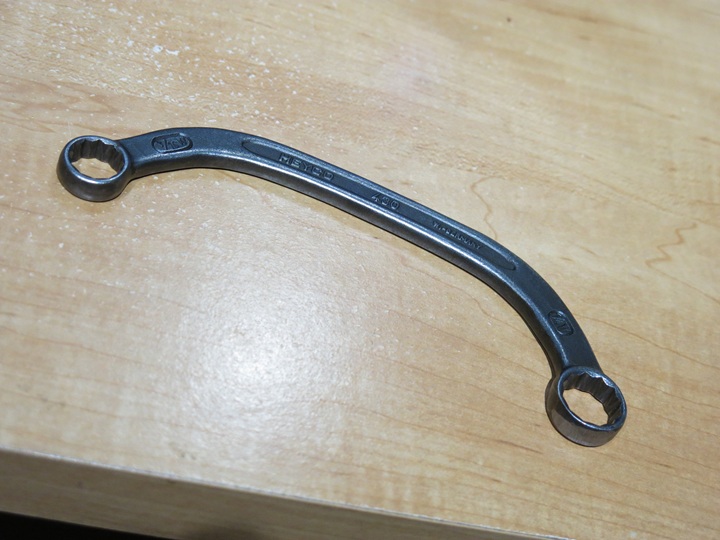
Edit: I used this tool for tight spaces and the #2, #7, and #8 stud nuts. Still do use it sometimes if I can remember where it is.

1967 Atlas Head and Cylinder Torque
 
Last edited:
I choke up on the wrench when doing those fasteners by feel. Closer your hand is to the bolt, less likely to over do it. Give it a practice run on something else to get a feel for 30 ftlbs-ish.
 
Thanks all.
Was able to get it done with the Motion Pro 08-0308 adjustable torque wrench adapter. Was able to get position # 2 at 90 degrees so no recalculation required and #7 and #8 straight on requiring a recall. Worked very well.
 
Got a question. When torquing the cylinder and head on an 1967 Atlas ( 5/16" head bolts) at the specified 30 ft lbs for 8 out of the 10 bolts and studs and 20 ft lbs for the from two 5/16" studs

1. Has anyone pulled out based on these values? I know that a service bulletin exists that increases each by 5 ft lbs but that's Commando I think.

2. What torquing tool are you actually using that enables you get on the head nuts in position #2, #7, #8. Also on the cylinder base nuts? It would seem like an extended british crows foot is needed.
To quote Sgt Schulz: "I know nothing" about Atlas but 30 ft lb seems too much for 5/16".

Norton Service Bulletin N3/68 states that for the 750 Commando the 3/8” bolt/stud torque should be increased to 35 ft-lb and the 5/16” bolts (studs) should be increased to 25 ft-lb. However, the 850 workshop manuals still say 30 ft-lb and 20 ft-lb

Using a right angle adapter and combination wrenches will let you use a torque wrench on all without any math requirement. https://www.motosport.com/product/?...p.ds&msclkid=9dfafe8bdae1181823209621f6cdbab7
 
For a '67 Atlas based 750 in a P11 30 ft-lb for 3/8" and 20 ft-lb for 5/16" is plenty with flat surfaces, a copper head gasket, and copper make a gasket spray on both sides of the copper gasket. That is with 10:1 compression. I use a thin coat of Permatex Ultra Max Torque sealer and no gasket on the base. I'm using Molnar barrels which are flatter and seal better for me than the Norton iron barrels ever did. Probably too far into irrelevantville due to the modifications for youz do it all stock and I never use sealer guys. :)
 
Wow guys. Glad I checked in because I got it totally wrong. What I essentially did was torque my Atlas head to Commando values but stopped short at 27 ft lbs as it seemed like too much except for Commando position 9 and 10 which was set to 20 ft lbs. So now that I go back and read everything again it's pretty clear that 5/16" bolts are torqued to 20 ft lbs and 3/8" to 30 ft lbs. What's probably more confusing are these two pages taken from Norton Twin Cylinder Re-build manual for lightweight twins and heavyweight twins ClassicBike.biz publication page 11 and 14. It shows a different tightening sequence than the Commando and also identifies the torque value at 25 ft lbs for everything. Most everything else, Clymer, RGM, AN, says 20 ft lbs. I'm using the RGM stainless 5/16" bolts. Not really sure why Norton departed from the Atlas tightening sequence and introduced the current approach.
 

Attachments

  • 1967 Atlas Head and Cylinder Torque
    IMG_1794.jpeg
    951.4 KB · Views: 69
  • 1967 Atlas Head and Cylinder Torque
    IMG_1795 (1).jpeg
    1 MB · Views: 76
Further in the above pages there is no differentiation between 5/16 and 3/8. My Atlas has three 3/8" studs fastened into the head and captured by nuts ( two are special) from below and these nuts apparently go on without washers.
 
I used and still use the Commando sequence since it starts in the center line of the head. All I had in the 70's was a Haynes manual for the pre-Commando models, and it showed the later sequence. My Scrambles Motor Cycles Red book shows the older sequence. I bought the Red book about 5 years ago from Andover Norton just so I could say I have it. lol
 
Last but not least 7 out of 9 barrel base studs are 3/8". Why are those spec'd at 25 ft lbs and not 30 ft lbs?

No wonder people get confused
 
the flatness of the surfaces the nuts/bolts sit on are worth getting good, as that will help them to KEEP exerting force on the head gasket in the long term, from what I have read.
 
as
Much of it has to due with studs into aluminum with relatively fine threads. Course threads are much less likely to pull but Norton didn't use very course threads. Also the length of the thread matters.

See this study I did on Commando head studs that explains both issues: https://gregmarsh.com/MC/Norton/Info/HeadStudStudy.aspx
Interesting analysis you performed Gregg! In my case I used all of the original studs and didn’t experience a problem dropping the head on.
 
Back
Top