Charging system test

YING

Pittsboro,NC
VIP MEMBER
Joined
Aug 12, 2011
Messages
1,402
Country flag
Can someone explain to me how to check my charging system using my basic multi-meter? I understand how to check the voltage right at the battery but don’t know how to see if there is a problem,how do I check to see if it is the stator output or a problem with the regulator/rectifier.
Thanks,Mike
 
Why do you think there’s a problem?

Quickest test is the headlight should get a bit brighter as you rev up from idling rpm.

Anyway, with engine stopped, the battery voltage is likely to be something slightly over 12 V.

If the charging system is working, that voltage will rise with increasing revs, to something over 13.5 V and not over 15 V. Try it with lights on and lights off.
 
If you are not by the side of the road then if you had to ask then its likely fine. Multimeter on battery, 12.5 to 12.6V all turned off is a good battery, once engine is running and ticking over anything over 12V is good and then it should climb to 14.5V as the revs increase.
 
Can someone explain to me how to check my charging system using my basic multi-meter? I understand how to check the voltage right at the battery but don’t know how to see if there is a problem,how do I check to see if it is the stator output or a problem with the regulator/rectifier.
Thanks,Mike
Measure the DC voltage with the bike turned off. Start the bike with lights off. Rev to about 2500. Measure the voltage. If it is any higher than when turned off, you are charging and all is well.

If not higher, then disconnect the stator wires. Connect the meter to the two stator wires (if 2-wire, or any two if 3-wire). Put the meter on AC volts. Start the bike. Rev to about 2500. You should see around 30 volts (more than 20 at least). If 3-wire, check all combinations.

If you have AC from the stator and are not charging and the battery is good, then the regulator or wiring is suspect.

A bad battery can confuse the whole issue!
 
I have no problem at this point but would like to know how to check both the stator and regulator separately.This is with a 3-phase set up and an LI battery
 
I have no problem at this point but would like to know how to check both the stator and regulator separately.This is with a 3-phase set up and an LI battery
The very short answer is that if the voltage across the battery is higher when running than when off you are charging. How to test individually is what I wrote.
 
Quickest test is the headlight should get a bit brighter as you rev up from idling rpm.

Good advice for a generator system, but an alternator/stator won't give you that. If it does, then there is a fault in the system.
 
Quickest test is the headlight should get a bit brighter as you rev up from idling rpm.

Good advice for a generator system, but an alternator/stator won't give you that. If it does, then there is a fault in the system.
Maybe with a 3-phase 180W, but not with a 120W system. I've never seen a 120W system at idle with the headlight on over 13 volts.
 
I’d expect even a 3-phase alternator to give a brighter headlight at 3000 rpm than at 900 rpm.

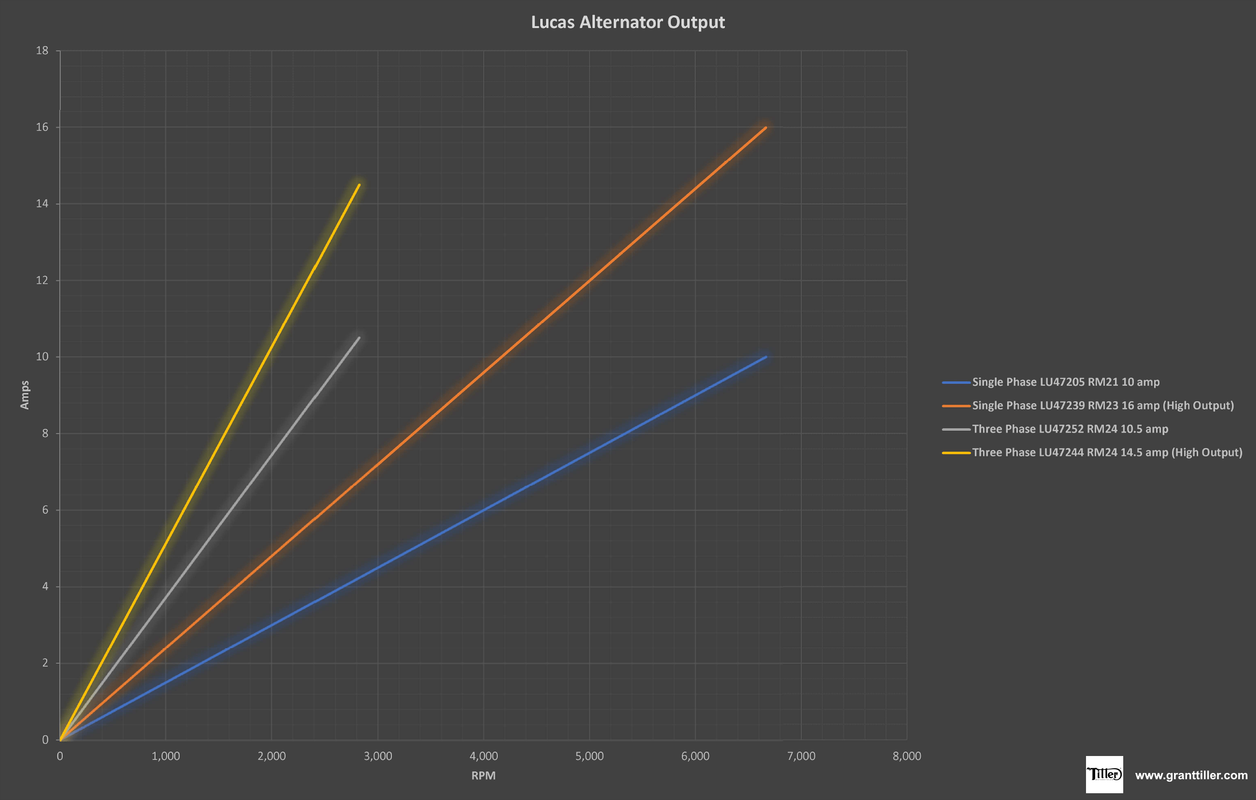
Mr G. Tiller’s graph appears to show 5 amp output (I’m guessing that’s @ 12 volts) at 1000 rpm, which is impressive but is not balancing a 60 watt headlight, 5 watt tail light and 30 watts of ignition load.


Charging system test
 
I have no problem at this point but would like to know how to check both the stator and regulator separately.This is with a 3-phase set up and an LI battery
Must admit that is a very intelligent approach.
To get familiar with a Multi meter and learn how a system is supposed to work BEFORE it goes bad.
It's very hard to troubleshoot anything when one doesn't know when it's right.
Basic shop 101.
Good Job!! Carry on......
 
Thanks to all of you for the replies.Maybe in my next life I will have a better grasp on electricity!

Must admit that is a very intelligent approach.
To get familiar with a Multi meter and learn how a system is supposed to work BEFORE it goes bad.
It's very hard to troubleshoot anything when one doesn't know when it's right.
Basic shop 101.
Good Job!! Carry on......
💡🏁
 
Must admit that is a very intelligent approach.
To get familiar with a Multi meter and learn how a system is supposed to work BEFORE it goes bad.
It's very hard to troubleshoot anything when one doesn't know when it's right.
Basic shop 101.
Good Job!! Carry on......
Michael,
That was the reason I originally posted this question.Why have a multi-meter if I don’t know how to use it for testing my charging system.
Mike
 
Be warned that some cheaper digital multi meters do not cope well with the electrical "noise" in a Norton charging system with the engine running and can give strange readings. I had a cheap one that read 17 volts when I revved the engine but a better quality one read a more sensible voltage.
 
Be warned that some cheaper digital multi meters do not cope well with the electrical "noise" in a Norton charging system with the engine running and can give strange readings. I had a cheap one that read 17 volts when I revved the engine but a better quality one read a more sensible voltage.
IMHO, digital meters, regardless of cost, have no place in automotive (especially vintage motorcycle) work.

A cheap analog meter is much less frustrating to use as the minor variations in the readings (spikes) are automatically smoothed out by them. This is especially true if you have the original charging system or a Podtronics regulator. It's less of an issue with others such as the Tri-Spark MOSFET regulator.

My favorite meter cost me $3 years ago and it's my favorite because it has a 15 volt DC range. My "better" (cost $29, now $35) analog meter has 10 volt and 50 volt so not as appropriate for 12v automotive charge testing but when used for resistance reading is much better than my cheap one. https://a.co/d/378Jh8h

My expensive Fluke digital meter is never used for automotive work.
 
IMHO, digital meters, regardless of cost, have no place in automotive (especially vintage motorcycle) work.

A cheap analog meter is much less frustrating to use as the minor variations in the readings (spikes) are automatically smoothed out by them. This is especially true if you have the original charging system or a Podtronics regulator. It's less of an issue with others such as the Tri-Spark MOSFET regulator.

My favorite meter cost me $3 years ago and it's my favorite because it has a 15 volt DC range. My "better" (cost $29, now $35) analog meter has 10 volt and 50 volt so not as appropriate for 12v automotive charge testing but when used for resistance reading is much better than my cheap one. https://a.co/d/378Jh8h

My expensive Fluke digital meter is never used for automotive work.
My Fluke works just fine measuring both AC and DC in automotive/motorcycle applications.

Used it last night.

Mine must be special.

Charging system test
 
My Fluke works just fine measuring both AC and DC in automotive/motorcycle applications.

Used it last night.

Mine must be special.

View attachment 121151
I agree, I'm still using a Fluke 73 bought in the '90s and I've abused that thing like nothing else (besides my bikes) and it just keeps on going. Dead steady readings always no matter the ignition or charging systems. Fluke meters have to be one of the best products ever made. You can pick them up used for about twice the cost of a cheap piece of shit and they're worth every penny.
 
Back
Top