Rod ratios

Joined
Nov 26, 2009
Messages
3,381
Country flag
ROD RATIOS

Norton 750/850 5.875” rod with 89mm/3.5” stroke = 1.67 to 1 ratio

Norton JS long 6.4” rod with 89mm/3.5” stroke = 1.83 to 1 ratio

Triumph 650 6.5” rod with 82mm/3.23” stroke = 2 to 1 ratio

Triumph 750 6” rod with 82mm/3.23” stroke = 1.86 to 1 ratio

BSA 650 6” rod with 74mm/2.91” stroke = 2 to 1 ratio

Harley XR 750 6.4” rod with 76mm/2.98” stroke = 2.16 to 1 ratio

Modern F1 race bikes use rod ratios between 2.2 and 2.8 to 1

Note that the stock Norton has the lowest rod stroke ratio listed

Even the JS 6.4” long rod ratio is still lower than all the others except the stock Norton

Norton 750 (top) to Triumph 650 rod (bottom) comparison below.
Rod ratios
 
Surprisingly the Norton Dominator 500 has a 6 inch con rod and a rod stroke ration of 2.1 to 1.

The 500 motor has a longer conrod than the 750 and 850 Commando..
 
I think that the major advantage with Jim's long rods is the reduction in piston weight, because the pistons are shorter. At the top and bottom of every stroke, the pistons reverse direction - the inertia is significant. It is a thing which many people who race old British singles do not recognise. Two valve Jawa speedway motors have forged Mahle pistons which are extremely light. I have only ever fitted lighter pistons to two motors, and there was a significant difference in each. One was a two-stroke - motocross motors had lighter pistons.
 
When I first started playing with the 850 motor, there were questions in my mind about the rod length to stroke ratio, but I could not think of a valid reason to change it. The crank balance factor was wrong for high revs, so I increased it to 72%. When I tried to race the bike, I found it to be very strange, however I now believe in it. It is just different, and I really like it. I was surprised that the taper on the needles in the carbs made a difference to the way the bike accelerates.
I don't know the development history of Norton racers - there might have been a single which had the characteristics of the Commando motor - the SOHC International motors might have been an alternative approach. The short stroke Manx was much quicker than the long stroke Manx.
 
Last edited:
The MAP 750 log rods currently in my engine are 6.362 with 3.5" stroke 1.81 to 1 ratio. The lower compression MAP long rod 8.5:1 pistons I'm using are short skirt light weight. Works well with no base gasket and a composite head gasket re-torqued 3 times, but I plan to eventually slip a thinner JS copper gasket in there to up the compression. When I blow the motor up, or decide it is tired and needs an over bore, I'll put the JSM long rods and higher CR pistons I have boxed up in. Idle is a little smoother with the lighter weight small end on the JSM long rod, and more compression is always welcome.
 
Surprisingly the Norton Dominator 500 has a 6 inch con rod and a rod stroke ration of 2.1 to 1.

The 500 motor has a longer conrod than the 750 and 850 Commando..
Instead of redesigning everything they stroked the 500/600 which made shorter rods necessary. Then when they went from 650 to 750 they didn't redesign the head - they just offset it and left the valves about the same. If they had retained the proportions of the 500 and made everything bigger it would have resulted in a better motor.
 
When Bob Rosenthal was racing his Atlas in the late 60s, he had MAP rods and pistons in it - he was quite successful. I sometimes wonder about the compression ratio thing. Some people do not seem to know that the slightest bit too rich makes the engine slower and that raising the compression ratio or advancing the ignition timing has a similar effect to leaning-off the jetting. You cannot get blood from a stone. If raising the compression means you can burn more fuel efficiently, you might get more power. But does it mean that ? What is 'quench effect' ?
 
Instead of redesigning everything they stroked the 500/600 which made shorter rods necessary. Then when they went from 650 to 750 they didn't redesign the head - they just offset it and left the valves about the same. If they had retained the proportions of the 500 and made everything bigger it would have resulted in a better motor.
If gearing and tuning are adjusted to suit the torque characteristics of the motor, the internal geometry might not matter. I don't know why I like the heavy crank. I find I can really use the bike without being super-careful. It means I can corner faster, and it still accelerates fast enough.
 
Last edited:
I forgot to include the Norton short stroke and the 1007 - see below

ROD RATIOS

Norton 750/850 5.875” rod with 89mm/3.5” stroke = 1.67 to 1 ratio

Norton JS long 6.4” rod with 89mm/3.5” stroke = 1.83 to 1 ratio

Norton factory short stroke 6.2” rod with 80.4mm/3.16” stroke = 1.96 ratio

Norton short stroke JS long 6.57” rod with 80.4mm/3.16” stroke = 2.1 ratio

Norton 1007 stock 5.875” rod with 93mm/3.66” stroke = 1.6 ratio

Triumph 650 6.5” rod with 82mm/3.23” stroke = 2 to 1 ratio

Triumph 750 6” rod with 82mm/3.23” stroke = 1.86 to 1 ratio

BSA 650 6” rod with 74mm/2.91” stroke = 2 to 1 ratio

Harley XR 750 6.4” rod with 76mm/2.98” stroke = 2.16 to 1 ratio

Modern F1 race bikes use rod ratios between 2.2 and 2.8 to 1

Rods lined up according to length L to R

Stock Norton 5.875" JS 6.4" Triumph 650 6.5" JS short stroke 6.57"

Rod ratios


JS 6.57" left factoriy 6.2" short stroke right below
Rod ratios
 
Instead of redesigning everything they stroked the 500/600 which made shorter rods necessary. Then when they went from 650 to 750 they didn't redesign the head - they just offset it and left the valves about the same. If they had retained the proportions of the 500 and made everything bigger it would have resulted in a better motor.
The 500 motor is "undersquare" (66 x 72.6 mm). The 600 motor was stroked too. It's a continuing story of cutting corners. If Norton had considered mass forces, they should have made the engine oversquare like BMW did, rather than create a Diesel-like engine.

In keeping with the proportions of the 500 engine, the resulting dimensions would have been

750 cc : B x S = 75.7 x 83.3 mm
850 cc : B x S = 78.8 x 86.7 mm

Interestingly, the Matchless G9 had almost identical dimensions to the Dominator (66 x 72.8 mm) and ended up with (77 x 79.3 mm) for the G15/45 (750 cc). Matchless bikes ran sweeter than competing British bikes at the time, the sweetest being the G11 - 600 cc,
which was almost "square" (72 x 72.8 mm). This hints at what Norton should have done.

A "square" engine layout would have resulted in these dimensions:

500 cc : B x S = 68.3 x 68.3 mm
750 cc : B x S = 78.2 x 78.2 mm
850 cc : B x S = 81.5 x 81.5 mm

By comparison, the Commando 961 conceived by Kenny Dreer has dimensions B x S = 88 x 79 mm (961 cc). A downsized 750 cc engine would have had dimensions B x S = 81 x 72.7 mm. Building a classic Commando with an "oversquare" engine like this is possible.

- Knut
 
The 500 motor is "undersquare" (66 x 72.6 mm). The 600 motor was stroked too. It's a continuing story of cutting corners. If Norton had considered mass forces, they should have made the engine oversquare like BMW did, rather than create a Diesel-like engine.

In keeping with the proportions of the 500 engine, the resulting dimensions would have been

750 cc : B x S = 75.7 x 83.3 mm
850 cc : B x S = 78.8 x 86.7 mm

Interestingly, the Matchless G9 had almost identical dimensions to the Dominator (66 x 72.8 mm) and ended up with (77 x 79.3 mm) for the G15/45 (750 cc). Matchless bikes ran sweeter than competing British bikes at the time, the sweetest being the G11 - 600 cc,
which was almost "square" (72 x 72.8 mm). This hints at what Norton should have done.

A "square" engine layout would have resulted in these dimensions:

500 cc : B x S = 68.3 x 68.3 mm
750 cc : B x S = 78.2 x 78.2 mm
850 cc : B x S = 81.5 x 81.5 mm

By comparison, the Commando 961 conceived by Kenny Dreer has dimensions B x S = 88 x 79 mm (961 cc). A downsized 750 cc engine would have had dimensions B x S = 81 x 72.7 mm. Building a classic Commando with an "oversquare" engine like this is possible.

- Knut
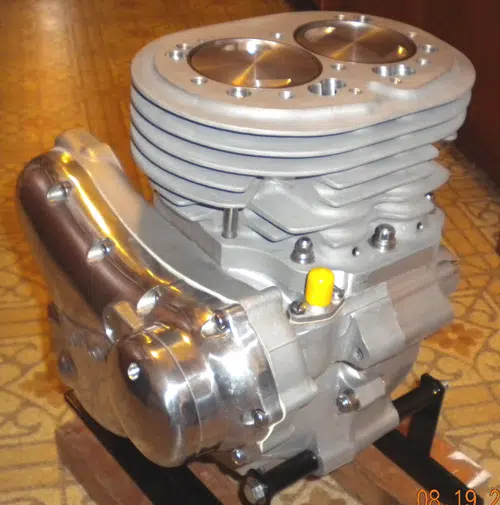
You can go 81mm bore and 80.4mm stroke with parts currently available and get a short stroke 830cc - I have a customer who went this way. I believe its the photo below.

Or spend more money for a 83mm bore with 80.4 stroke and get a short stroke 870cc

Rod ratios
 
You can go 81mm bore and 80.4mm stroke with parts currently available and get a short stroke 830cc
Crankshafts for this stroke are available off the shelf for pre-Mk3 engines only. Sadly, a one-piece 80.4 mm stroke crankshaft is not available off the shelf. (Hear, AN!)

- Knut
 
It is what works which counts - not the theory or speculation. When I built my Seeley 850, I did not believe in the motor. I now believe its design to be excellent. However the heavy crank did not work properly with wide ratio gears because too many revs were lost on each up-change. With my bike, the revs drop about 1500 RPM on each upchange so lack of throttle response is less important. Even so, lean needles in the carbs are better. With a Commando motor you are working with torque - mid-range - not top end. I run very high overall gearing with close ratios - once the crank is spinning high- nothing stops it. My motor peaks near 7000 RPM, but does not drop below 5,500 RPM.
One thing I have learned is that copying new bikes is not always good for old bikes. When you short-stroke a motor the way the power is delivered usually changes, and that affects the way the power can be used. An early two stroke usually has to be upright and pointed before it can be given the berries. Big 4 cylinder bikes can be similar. A lot of them really wallow in corners.
For a Commando-based bike, a decent bevel Ducati would be hard to beat.

 
I am pretty much of the opinion that it does mot matter much what configuration the motor might be, it can be worked with - the limiting factors are the gearbox and the frame. Some bikes go like buggery down the straights, but are horrible in corners. Others are fast in corners but slower down straights. My mate's 650cc Triton is nice and neutral and moderately quick in corners and fast enough down the straights. It is made to pull strongly. It might be the best option. My 500cc Triton had the long Triumph 650 rods and 63mm stroke instead of 82mm stroke. On a big circuit, it would winde out forever. On a short circuit, its gearbox limited what it could do - geared low it was dangerous - superquick in corners but too slow towards the ends of the straights. There is an old saying - 'be careful what you wish for, you just might get it'.
 
In theory, the longer the rods for a given stroke the less side thrust (friction) there is, meaning the longer rods give more power. It also gives the pistons more "dwell" near the top-of-stroke , meaning more fuel burns at higher compression, again giving more power.
But... the cost is the weight and space of the taller barrel/crankcase assembly. There's also the additional rod weight.
I guess for each engine/frame combo there will be a sweet spot.
Cheers
 
Last edited:
A bit further to the above, there should be an "ideal" amount of Desaxe so that the rods are more vertical on the power/thrust stroke.
For a forward rotating crankshaft this would mean the crankshaft C/L should be forward of the barrel centreline. It would mean more rod angle on the exhaust stroke, but unlikely to be as important.

Of course, the Desaxe of the Commando engine, driven by the cam position inherited from earlier and smaller Dominators, is exactly the opposite if the ideal. :rolleyes: :rolleyes:

Oh, and what @acotrel said in post #15 about geometry not mattering is, consistently, total BS!
Cheers

EDIT: SOME OF THE ABOVE IS WRONG. SEE POST #22 BELOW FOR AN EXPLANATION - thanks @mdt-son!
 
Last edited:
Rob SS
There is a reduction of vibration and stress with a longer rod because the reversal "snap" is less severe (even though a longer rod is slightly heavier) - for the same reason that there is more "dwell time" at TDC - Its a win win situation.

This is why the current F1 bikes with their extreme RPMs have rod ratios in the 2.3 to 2.8 range -otherwise they wouldn't stay together. Its all about vibration and stress.

Also the pistons are shorter for the longer rods and the lightweight pistons more than make up for the longer rod length weight. A lightweight 750 bare piston weighs about 175 gms whereas a stock 750 bare piston weight about 250 grams.
 
Last edited:
Shorter rods give greater angularity, so the torque characteristic is different, Torque is twisting power. Long rods are better for top end power. But in the end, any rod length can probably be made to work well. However multi-speed close ratio gearboxes are expensive. If you are considering building a race bike - think about the gearbox first. In Suzukis - the GSXR750L is the one with the close ratio gearbox. I was talking to a guy who was using a Bandit motor in a race car. He had used the L model gearbox and said it was excellent, but it blew-up. A really good gearbox can be a major advantage in a race bike.
In Australia, there is a race class for bikes of the 1970s which includes 1000cc Suzukis. Most people have not ridden race bikes which have close ratio gearboxes and do not know how to work with them. What you get is often not what you might expect. What I always watch is the drop in revs on the up-change. If the revs drop too far, they return slower, and you lose throttle response.
With the standard gear box, my Seeley 850 was far too slow. The Manx gear cluster is much better. One of my mates told me, that with a torquey motor I should not need a close ratio gearbox. I did not contradict him. Some things make me laugh. - Great theory !
 
Last edited:
Rod ratios and balance factors affect the way the motor revs out. Long rods cause the motor to be able to spin higher, but the balance factor also needs to be high. The angularity factor of short rods can cause loads on the rear of cylinders to be higher, - more friction, but give more torque. With a Commando engine we usually have more than enough torque, but spinning the crank above 7000 RPM is not smart. So raising the overall gearing and having close ratios is a good answer. With long rods, piston weights tend to be lower, so acceleration is better. Jim Schmidt offers long rods and 12 to 1 comp. light pistons - perfect for methanol.
 
Back
Top