Your advice about whether to use a crankcase to cylinders gasket or not on my 1973 850

I use a gasket, slightly overtorque and then put the assembled engine minus head in the oven at 100 C for 30 min. (When the wife is away..) to let it go trough at least one heat cycle. Retorque after cooling. Probably makes little difference.

Edit: I do wrap the engine in aluminum foil to minimize smell.
Wouldn't like to get caught..
As well as whatever needs to be run through the dishwasher while she's out.........
:cool:
 
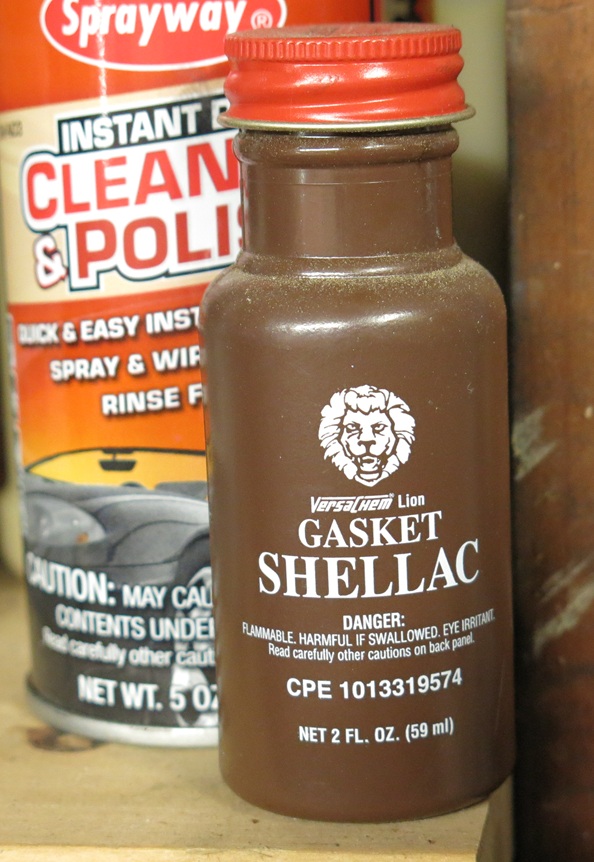
I thought I had some Indian Head gasket shellac, but turns out it's a Lion's head on the bottle.

Big pic for shock and awe. This stuff doesn't work that well for me, but it is still on the shelf in my pack rat garage.

Your advice about whether to use a crankcase to cylinders gasket or not on my 1973 850


More off topic stuff:
For grins I used the last bit of a tube of the Permatex Optimum Max Torque gasket goo to patch a split ridge shingle on my roof 5 years ago. Still holding it together. Not the same as getting 40,000 miles on it, but it is working in extreme weather. ;)

First time I worked on my Norton 750 engine around 1972 I used Gasgacinch Gasket Sealer and the very thin paper base gaskets that were being used at the time. Far as I can remember it held up. I didn't take the engine apart again until the late 1980's, early 1990's to do some crazy stuff to it. I used another thin paper gasket and Gasgacinch then as well. That was with stock iron barrels. The barrels I'm using now are aluminum with iron liners, which might be why the Max Torque sealer works as well as it does on the cases and barrels base.
 
Are they, I never noticed but then I've never fitted a 750 one.


The late Mick Hemmings said the base gasket should be fitted dry.


I thought it was more to do with the fact that the 850 through bolts couldn't be retorqued without removing the cylinder head,
They tend to grab the gasket especially at the drive side rear - 750s do not. To be clear, these are all AN base gaskets from the complete gasket sets.

I do many more 750s (usually Combat) than 850s but I've had problems with all 850s. At it's worst, having to stop and replace the gasket while lowering.

I agree that they should be dry - I just consider a little grease to be better than glue (sealer).

Someone talked about the through bolts - I consider that a non-issue and (I thought) stayed away from it.
 
I also use 3 Bond. Compression ratio is not relevant. Three things form a balance, comp. ratio, ignition timing and jetting. When the compression ratio is raised, it has a similar effect as advancing the ignition timing or leaning-off the jetting. When using carburetors with petrol as fuel, it is extremely difficult to get the jetting right. My friend once raced a CB750 Honda which had a bore kit - it detonated, and he wondered about the reason. When you look at the needles and needle jets in a Japanese motorcycle - a lot of work has usually gone into making them - each different model of Japanese motorcycle has different needles and needles, even when the motor is the same. On most British motorcycles mixture adjustment is by raising or lowering the needle the Japanese also do that, but they have more adjustment by drilling holes into the sides of the needle jets, and mods to other jets. It looks to me as though the Japanese build a motorcycle, then jet it to perform regardless of any other modification between models.
I am as bad as anyone else, I believed that rich is always better, and I believed in high compression. Then I found out the relationship. If you are compressing a bigger volume, or using higher comp. - you might need to jet richer or alternatively, you might hit the point at which the balance is optimum.
 
I've ordered in the JS steel (angled cut) base gasket , for my 850 rebuild to correct to ideal . Whatever sealant Jim reccommends is the sealant I will be using .
 
I also use 3 Bond. Compression ratio is not relevant. Three things form a balance, comp. ratio, ignition timing and jetting. When the compression ratio is raised, it has a similar effect as advancing the ignition timing or leaning-off the jetting. When using carburetors with petrol as fuel, it is extremely difficult to get the jetting right. My friend once raced a CB750 Honda which had a bore kit - it detonated, and he wondered about the reason. When you look at the needles and needle jets in a Japanese motorcycle - a lot of work has usually gone into making them - each different model of Japanese motorcycle has different needles and needles, even when the motor is the same. On most British motorcycles mixture adjustment is by raising or lowering the needle the Japanese also do that, but they have more adjustment by drilling holes into the sides of the needle jets, and mods to other jets. It looks to me as though the Japanese build a motorcycle, then jet it to perform regardless of any other modification between models.
I am as bad as anyone else, I believed that rich is always better, and I believed in high compression. Then I found out the relationship. If you are compressing a bigger volume, or using higher comp. - you might need to jet richer or alternatively, you might hit the point at which the balance is optimum.
Drum brakes?
What gearbox ratios?
 
Compression ratio is not relevant.
Right, more compression shouldn't make a difference at the base of the barrels. Although more compression is going to try to lift the head on every compression stroke, which might make the base wiggle a little under some odd extreme condition. My first higher compression build of the 750 engine with JS Motorsports rods and pistons started leaking enough to collect a touch of fine dust at the base after passing a long string of cars heading up into the mountains. I was only doing just over 90 mph, but it was a 90F degree day. I was using a different sealer then and a copper base gasket. That experience is what made me think about compression being a possible factor to consider. Engineering wise compression should not make any difference at all on a well designed engine. We are talking about old Nortons though.

What a higher compression ratio does in my 750 engine is make it run a little on the hot side, and that is why I use a sealant that won't be effected by the heat generated near that joint at the base without a gasket. That and what I use for a sealant is easy to apply and remove. Yamabond is cool and all that, but I don't like working with it. I used Yamabond on a Ducati 996S when I put a lighter weight fly wheel in it. By the way, that was a fun bike to ride with a lighter weight clutch and lighter flywheel in it.
 
I use a gasket, slightly overtorque and then put the assembled engine minus head in the oven at 100 C for 30 min. (When the wife is away..) to let it go trough at least one heat cycle. Retorque after cooling. Probably makes little difference.

Edit: I do wrap the engine in aluminum foil to minimize smell.
Wouldn't like to get caught..
As long as you don't baste it! :rolleyes:
 
I use a gasket, slightly overtorque and then put the assembled engine minus head in the oven at 100 C for 30 min. (When the wife is away..) to let it go trough at least one heat cycle. Retorque after cooling. Probably makes little difference.

Edit: I do wrap the engine in aluminum foil to minimize smell.
Wouldn't like to get caught..
I have my own workshop oven, it takes heads, barrels, crankcase halves, gearbox shells.....But not an engine bottom end assembled with barrels!

Probably just as well, I'm sure I would overcook it!
 
Back
Top