Your advice about whether to use a crankcase to cylinders gasket or not on my 1973 850

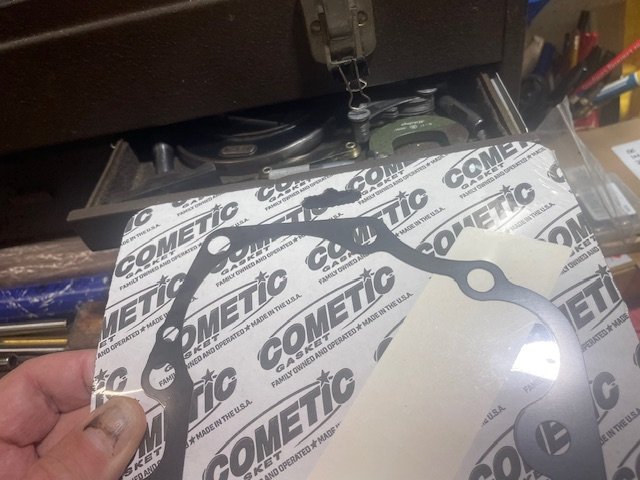
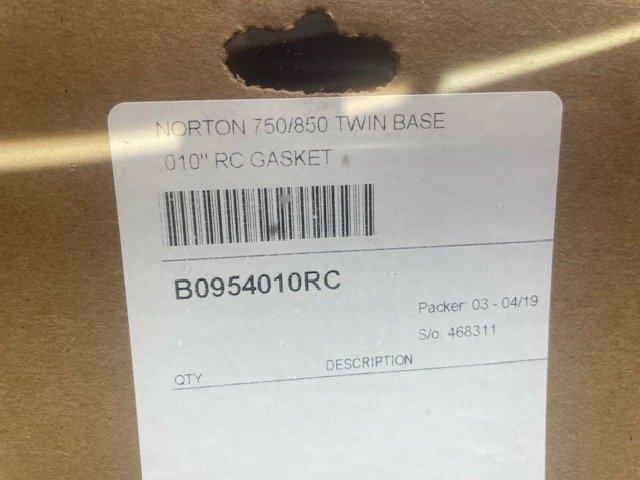
Just as a follow-up on the Cometic gaskets. They are pretty solid so I don't think they will compress much. I was going to measure my spare but according to the label they are .010" thick, I believe that translates to a 1/4 point or less lower compression. I did compensate by having the head shaved, it was either .010" or .020", I don't recall.
Your advice about whether to use a crankcase to cylinders gasket or not on my 1973 850
 
I've never used it.
Not prolific in the US.
Is it RTV?
Dry by evaporating solvent based?
Anaerobic?
The old boys always used to use it when I were a lad. Dunno when it was first used, but the story is it was used to seal the boards on the Mayflower…

Google says:

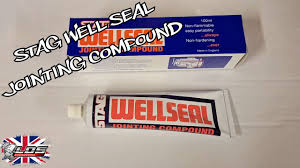
Wellseal jointing compound is a non-hardening, non-corrosive, brown sealant originally developed by Rolls-Royce for sealing machined surfaces like aluminium cylinder heads, gearboxes, and threaded connections, offering excellent resistance to fuels, lubricants, and coolants, often used with or without gaskets for classic engines and general automotive/marine applications. It provides a durable, flexible seal, prevents leaks, and won't harden in the tube or block oil ways, making it ideal for components like crankcases.

This video provides a brief overview of the product:
Related video thumbnail


Key Features & Benefits
  • Excellent Sealing:
    Creates a reliable seal on flat-faced joints and threaded connections
    .
    • Resistant: Highly resistant to common fuels, oils, lubricants, and coolants.
    • Non-Hardening: Stays flexible and doesn't become brittle, allowing easy disassembly.
    • Non-Corrosive: Safe for aluminium and other engine components.
    • Versatile: Can be used with or without paper gaskets for added security.
    • Temperature Range: Works effectively in high-temperature conditions (up to ~200°C).

Common Uses
  • Sealing aluminium cylinder heads and crankcases.
  • Transmission and gearbox casings.
  • Primary chaincases on motorcycles.
  • Pipework for various fluids.
 
The old boys always used to use it when I were a lad. Dunno when it was first used, but the story is it was used to seal the boards on the Mayflower…

Google says:

Wellseal jointing compound is a non-hardening, non-corrosive, brown sealant originally developed by Rolls-Royce for sealing machined surfaces like aluminium cylinder heads, gearboxes, and threaded connections, offering excellent resistance to fuels, lubricants, and coolants, often used with or without gaskets for classic engines and general automotive/marine applications. It provides a durable, flexible seal, prevents leaks, and won't harden in the tube or block oil ways, making it ideal for components like crankcases.

This video provides a brief overview of the product:
View attachment 123169

Key Features & Benefits
  • Excellent Sealing:
    Creates a reliable seal on flat-faced joints and threaded connections
    .
    • Resistant: Highly resistant to common fuels, oils, lubricants, and coolants.
    • Non-Hardening: Stays flexible and doesn't become brittle, allowing easy disassembly.
    • Non-Corrosive: Safe for aluminium and other engine components.
    • Versatile: Can be used with or without paper gaskets for added security.
    • Temperature Range: Works effectively in high-temperature conditions (up to ~200°C).

Common Uses
  • Sealing aluminium cylinder heads and crankcases.
  • Transmission and gearbox casings.
  • Primary chaincases on motorcycles.
  • Pipework for various fluids.
On my spanners many years ago as a truck fitter assembling Rolls Royce Eagle diesel engines, the head gasket was nothing more than a steel shim with a flame ring, pre assembly required spraying both sides of the shin liberally with wellseal in aerosol cans. This was the approved RR method..... and boy they never leaked, getting the heads back off was another story
 
The old boys always used to use it when I were a lad. Dunno when it was first used, but the story is it was used to seal the boards on the Mayflower…

Google says:

Wellseal jointing compound is a non-hardening, non-corrosive, brown sealant originally developed by Rolls-Royce for sealing machined surfaces like aluminium cylinder heads, gearboxes, and threaded connections, offering excellent resistance to fuels, lubricants, and coolants, often used with or without gaskets for classic engines and general automotive/marine applications. It provides a durable, flexible seal, prevents leaks, and won't harden in the tube or block oil ways, making it ideal for components like crankcases.

This video provides a brief overview of the product:
View attachment 123169

Key Features & Benefits
  • Excellent Sealing:
    Creates a reliable seal on flat-faced joints and threaded connections
    .
    • Resistant: Highly resistant to common fuels, oils, lubricants, and coolants.
    • Non-Hardening: Stays flexible and doesn't become brittle, allowing easy disassembly.
    • Non-Corrosive: Safe for aluminium and other engine components.
    • Versatile: Can be used with or without paper gaskets for added security.
    • Temperature Range: Works effectively in high-temperature conditions (up to ~200°C).

Common Uses
  • Sealing aluminium cylinder heads and crankcases.
  • Transmission and gearbox casings.
  • Primary chaincases on motorcycles.
  • Pipework for various fluids.
Well, if it's good enough for RR aviation, automotive & space shuttle engines... why would you change. And I know you hammer the piss out your bikes, not putt-putt parade riding.
 
Certainly your success is valid, but with so many other good choices, like anaerobic sealers that are more closely aligned with this application, choosing an RTV product is not my first choice. "Flexible" is not desired here.
You've never used the Permatex 27036 Optimum Max Torque on a Norton engine, right? I believe there might be more than one version of Permatex Optimum, but maybe it's just marketing. I use it because it works for me. It's not all that flexible in thin application. I use it because it can take high heat and my higher compression 750 engine makes some heat.

Two builds of higher performance Norton 750 engines and no leaks on the case halves or at the base of the cylinders. I do abuse the engines.

I've never had any luck with the anaerobic stuff on auto engines, so don't use it anymore. One has to use what one likes. I'm not changing what I use. My reputation is irrelevant. Looks like the OP is using a solid base gasket, which by the way can be sealed both sides, but that is again just what I would do, and it may not align with anyone else's preferred sealing method.
 
I will soon reassemble with rebored cylinders and the place I buy parts from recommends a gasket between the crankcase and cylinders.
When I pulled it apart there was no gasket, just a very hardened dark sealant that was possibly a Permatex Hi Tack type. It did work as there were no leaks.

My inclination is to not use a gasket above because it cannot be retightened once the head is on.

Also, for sealant for the crankcase to cylinders, with or without gasket, I thought to use Loctite 510 that says it seals gaps up to 10 thou and is rated up to 400 degrees.
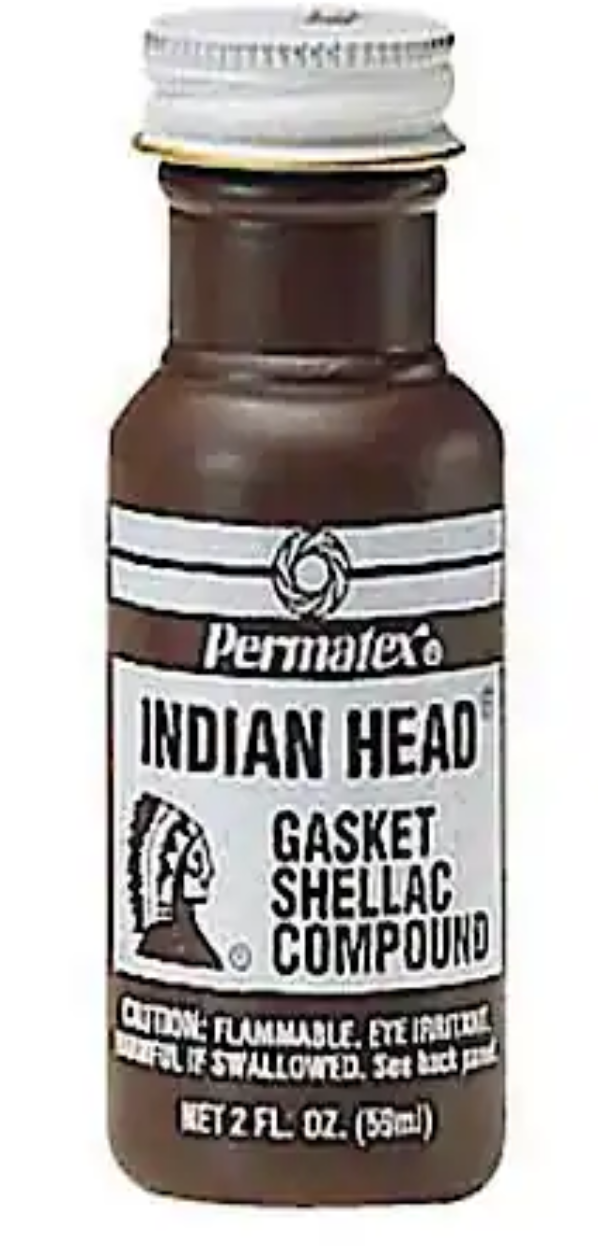
My parts supplier recommends Permatex ultra black which is rated to 400 degrees. And then there is permeated Hi Tack that is rated to 500 degrees.

I would appreciate your thoughts and patience and I am grateful as this is my first reassembly

Dennis
I use the base gasket from AN, I use no glue (sealer) - I detest glued together bikes!

If I were going to use sealer rather than a gasket, I would be extremely careful that there is NO step between the crankcase halves. I'm already very careful about that but with no gasket it is even more important. Personally, the only way I would do it is if the customer I was building the engine for insisted and then I would not guarantee no leaks. Keep in mind that the crankcases expand more than the cylinders - I'm no rocket scientist on this, but that seems to be to be am issue worth considering.
 
How "flat" are we thinking of here?

On a 1972 750 Combat, using the 'standard' gasket from the Andover Norton gasket set.

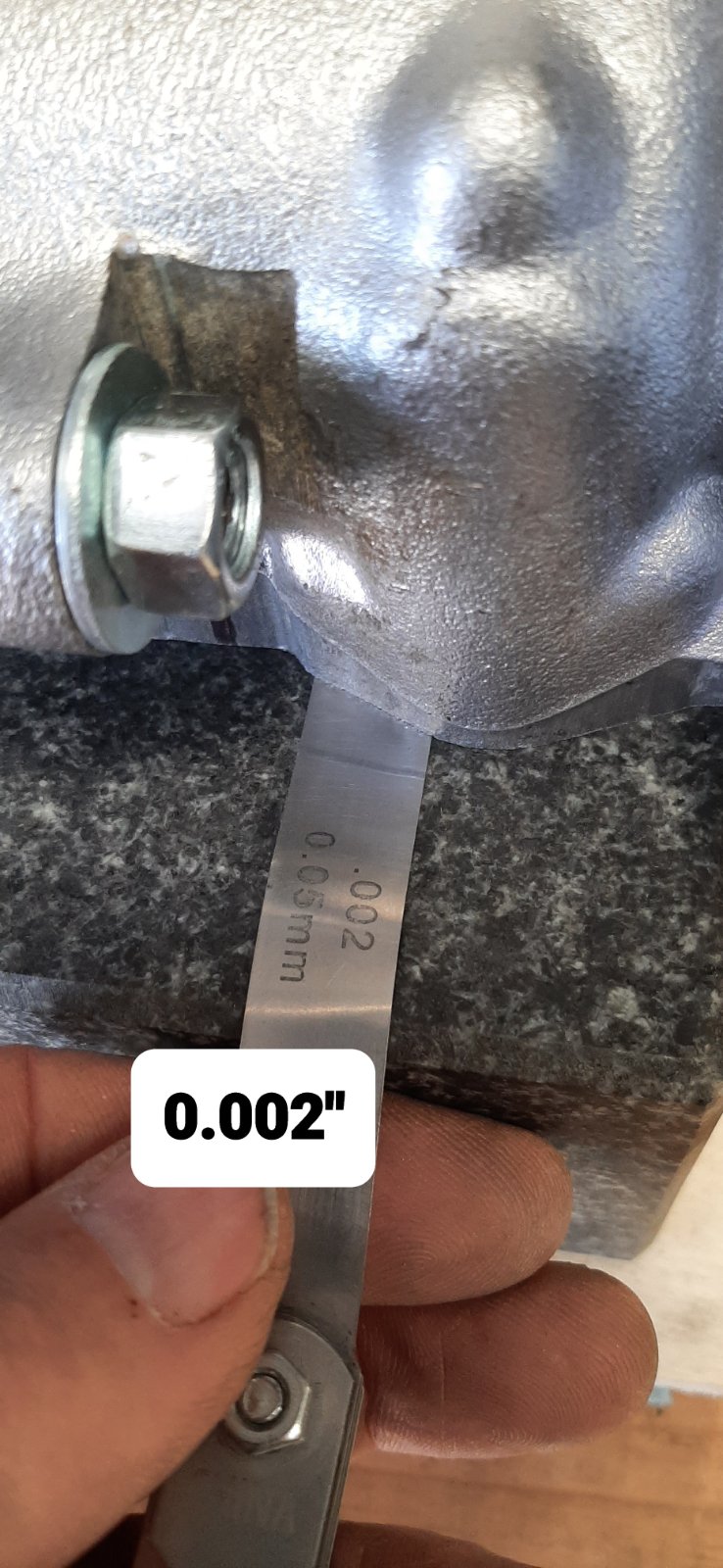
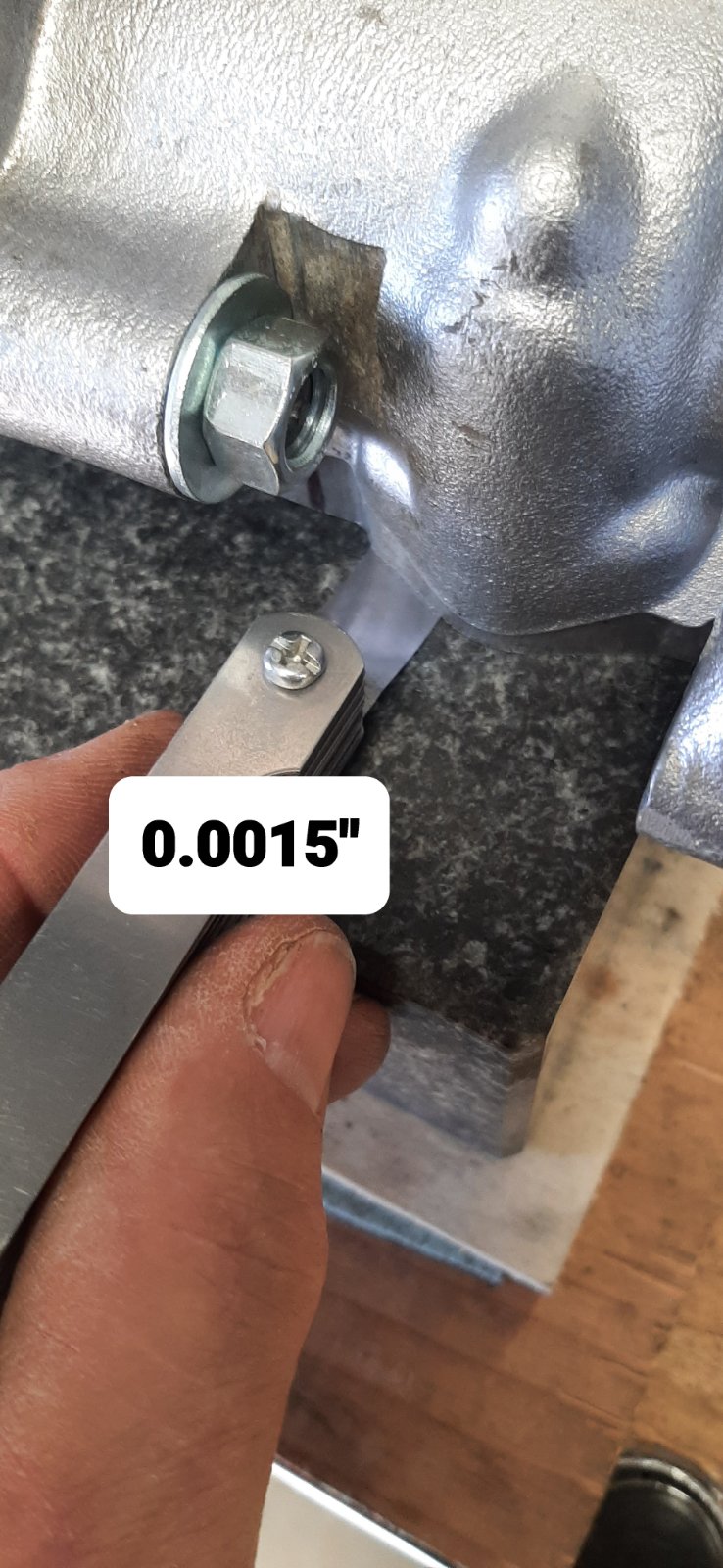
Well I guess I will elaborate. Would you trust a standard Andover Norton paper gasket with no sealant, where there is a low spot in the cases like this? Cases are inverted on a surface plate.

Your advice about whether to use a crankcase to cylinders gasket or not on my 1973 850
 
Well I guess I will elaborate. Would you trust a standard Andover Norton paper gasket with no sealant, where there is a low spot in the cases like this? Cases are inverted on a surface plate.

View attachment 123200View attachment 123199
If you're talking about the surface not being flat - by less than .002" yes the gasket will do - the aluminum will flex to match the cylinders. However, ideally, you would have already connected that before assembling and the case alignment I'm talking about would come into play. Don't go crazy - change the camshaft alignment and you'll have a mess.

As far as the gap, a machinist square across the gap and a strong light behind - in other words, flat, not kinda flat. The dowels do a good job of kinda flat. With the crankcases well snugged a rubber hammer used effectively can get them flat, and then a re-check once the crankcase is tightened to spec. No light = WAY flatter than .0015"! To get perfection, the surface plate and some flattening might be required before assembly - especially if a gorilla has been at the mating surfaces, or the crankcase bolts have been over-tightened, or the cylinder base nuts have been overtightened. I always remove the base studs and make sure the metal around them is not "up".
 
Wow! there is a million ways to skin a cat.
The Mk1 850 was the only factory built model without the base gasket and I believe the others had base gaskets fitted because owners rebuilding their motors forgot to check the head to crankcase oil drain wasn't blocked with gasket goo.
 
Mk2/2A didn't have a base gasket.
Since the 850 cylinders are hard to get on with a base gasket (often catches on the gasket), they may have taken the easy/fast way out - just a guess - I have no knowledge or proof of that.

Today, on 850s, I fit the gasket on the cylinder rather than the crankcase before lowering - not ideal but less of a struggle if you keep the cylinder as level as possible. They normally will stay but if not, a little grease fixes that.
 
Since the 850 cylinders are hard to get on with a base gasket (often catches on the gasket),

Are they, I never noticed but then I've never fitted a 750 one.
They normally will stay but if not, a little grease fixes that.

The late Mick Hemmings said the base gasket should be fitted dry.

they may have taken the easy/fast way out - just a guess - I have no knowledge or proof of that.

I thought it was more to do with the fact that the 850 through bolts couldn't be retorqued without removing the cylinder head,
 
Back
Top