Upgraded Conrods?

And, it's amazing that the small end runs directly in the conrod
The alloy used in con rods is not too different from the aluminium tin lining on bimetallic shell bearings, in fact Briggs and Stratton con rods that run directly on the crank journal with no shells are aluminium/tin.
 
The alloy used in con rods is not too different from the aluminium tin lining on bimetallic shell bearings, in fact Briggs and Stratton con rods that run directly on the crank journal with no shells are aluminium/tin.
I know little about metallurgy, but I know they last. Sure is nice to not have to replace the bushings like in the small ends of Triumph conrods.
 
And the rod journals on the crank rarely need turning. Must be made of tougher stuff than Triumphs.

Has anyone tried JUST the replacement lightweight pistons that JS and MAP offer? Any difference in vibration?
 
The strongest structural aluminium is usually Alloy Development Corporation 7000 series. I don't think it's wear properties should be a consideration. I would not run it direct on the crankshaft journals without bearing shells. And replacing shells is cheaper than replacing worn conrods. Arrow titanium conrods look good to me. But titanium does not respond well to repeated impact - it changes dimension.
 
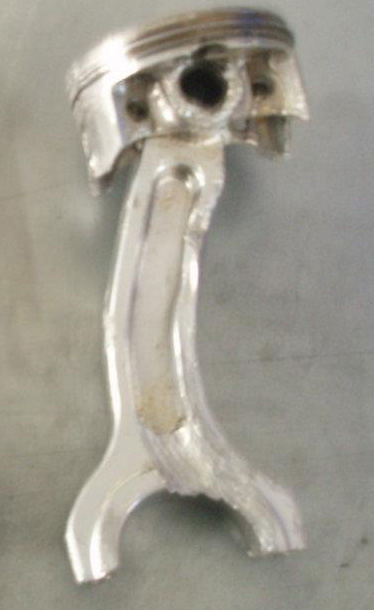
I knew of several racers who had their stock rods break. One was a Willow Springs and the broken rod went through the cases. The best thing about the stock Norton rod is that it has no bronze bushing and doesn't see to need one - only problem is that it's too short and causes too much stress as mentioned earlier. Watch for cracks radiating outward from below the pin - especially with big bore kits. Below is an Aluminum rod from the famous Yellow Pearl racer - the Cap cracked and failed.

Upgraded Conrods?


Below is a failed Commando rod
Upgraded Conrods?


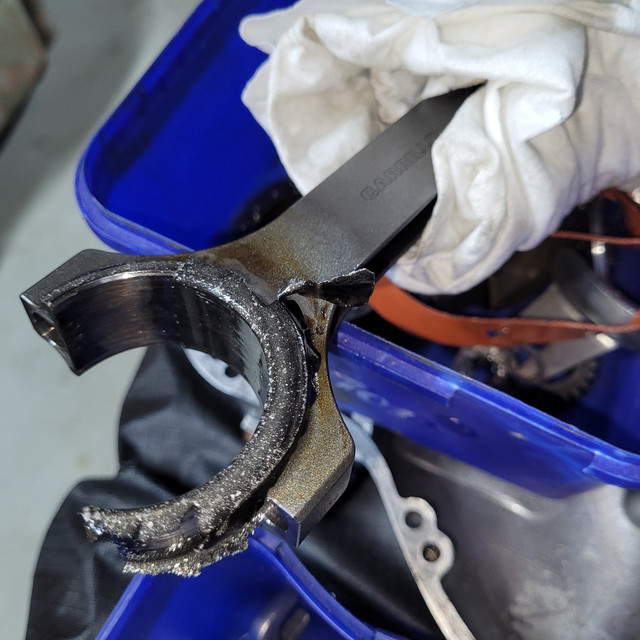
I tried and tried but couldn't get anyone to make reliable longer aluminum rods. Then I went to Carrillo (steel) and they did a perfect job 1st try.
Below is a photo of a Carrillo rod where the shell bearing siezed up and melted (oiling problem?) But the rod survived and didn't fail.

Upgraded Conrods?


Seattle##gs asked "Has anyone tried JUST the replacement lightweight pistons .... difference in vibration?

Be sure you're actually getting lightweight pistons for stock rods - check and compare gram weights before you buy.

JS Lightweight 750 med C.R. pistons at 225 grams bare compared to 250 stock for reduced vibration.

JS Lightweight 850 med C.R. pistons at 255 grams bare compared to 315 stock for reduced vibration.

Using a lighter piston without changing the balance factor will reduce vertical vibration but horizontal vibration will stay the same.
 
Last edited:
If the crankshaft is rebalanced to 72%, is there still a vibration problem ? To my mind a throb below 5000 RPM is not a vibration problem.
 
If the crankshaft is rebalanced to 72%, is there still a vibration problem ? To my mind a throb below 5000 RPM is not a vibration problem.
Al, as you don’t ride on the road, let me educate you…

Vibration is different road vs race.

On a race bike, vibration is a problem when it breaks things. Unless it’s bad enough to break things it is highly unlikely to be bad enough to upset the rider who has far more pressing things to occupy his / her brain.

A road bike is completely different, even a comparatively mild ‘buzz’ can become extremely annoying if it occurs at the cruising speed you sit at for mile after mile.
 
Remember Als brain is only set at race thinking and set at above 5k RPMs with a very high first gear and all that he keeps telling us, he hasn't been on a road going bike since he was 29 and is now in his mid 80s and hasn't ridden for sometime as well.
 
When I rode on public roads, it was always on an old British bike, and usually around town, and not on major highways. I absolutely hated droning along at 60 MPH on a motorcycle. That is not my idea of pleasure. My car is a Mazda 6 which has a 6 speed close ratio gearbox and cruise control - even that is a bit hopeless. If I drive it properly, I will not have my licence for long. A few years ago, I rode that VFR400 Honda. It was beautiful - but too fast. I was lucky that there were no cops around. When you ride a motorcycle, there is a decision to be made - fast or slow. Nothing in between.
 
I don't know Al, it's the hand on the throttle that controls the bike and old bikes back in the day were a bit rough riding at 60mph, but modern bikes are so much better these days at any speed, you just can't compare an old bike to a late model bike and of course a 360 swing crank will never be as smooth as a 270 swing at any speed, but of course every bike is different.
 
My friend Steve Oszko mentioned something which I had heard many years ago. It was the difference between singles and twins and about the way the tyre distorts and relaxes, under acceleration. A Triton might be less tractable than a Manx. Smoothness might not be an answer to appropriate power delivery. When you riding fast and are at full lean and using as much power as possible, you are usually totally committed, and cannot pull out and pass the rider in front of you. Your brain is usually attached to the rear tyre contact patch. If you sense movement, you tend to ease off - it is similar to the bike being light in the front - when you feel it. The motor well forward gives confidence, as does good grip at the rear. My bike is really stupid - it stays more vertical and self-steers if I accelerate enough to make it squat. It does not matter if it loses traction at the rear. With the weight well forward, more power can be used.
 
I have a bad habit. When I ride a motorcycle I become unrestrained. When I rode the VFR400 Honda, I did not notice it's speed until it would not go any faster. I did not know it is speed-limited. It figures when you know what it is. Kel Carruthers had the first 250cc Honda 4 racer in Australia. I only ever saw him beaten by a 500cc Manx Norton on one occasion,
I do not know the truth about speed limiting of modern motorcycles, I have heard it is 180 KPH, but one young guy in our town did 280 KPH when chased by the cops. They found him but could not book him - no proof.​
 
Last edited:
When I rode on public roads, it was always on an old British bike, and usually around town, and not on major highways. I absolutely hated droning along at 60 MPH on a motorcycle. That is not my idea of pleasure. My car is a Mazda 6 which has a 6 speed close ratio gearbox and cruise control - even that is a bit hopeless. If I drive it properly, I will not have my licence for long. A few years ago, I rode that VFR400 Honda. It was beautiful - but too fast. I was lucky that there were no cops around. When you ride a motorcycle, there is a decision to be made - fast or slow. Nothing in between.
There is an in between but it sounds like you have never experienced it. Maintaining a speed of 50 or 60 mph on a twisty mountain road is a lot of fun and, if done for a few hours, can take you to an entirely new place.
Glen
 
On the actual topic... Not that being on topic matters much at this asylum, last I heard Oldsculler1 decided to use the stock rods if they are in good enough shape and have the crank rebalanced for the parts he'll be using in the rotation mass. That route is about as good as it will ever get with vibration from a Norton 750 engine ridden on the road/street. Better way to save some money and still have a good street engine.
 
My friend Steve Oszko mentioned something which I had heard many years ago. It was the difference between singles and twins and about the way the tyre distorts and relaxes, under acceleration. A Triton might be less tractable than a Manx. Smoothness might not be an answer to appropriate power delivery. When you riding fast and are at full lean and using as much power as possible, you are usually totally committed, and cannot pull out and pass the rider in front of you. Your brain is usually attached to the rear tyre contact patch. If you sense movement, you tend to ease off - it is similar to the bike being light in the front - when you feel it. The motor well forward gives confidence, as does good grip at the rear. My bike is really stupid - it stays more vertical and self-steers if I accelerate enough to make it squat. It does not matter if it loses traction at the rear. With the weight well forward, more power can be used.

There is an in between but it sounds like you have never experienced it. Maintaining a speed of 50 or 60 mph on a twisty mountain road is a lot of fun and, if done for a few hours, can take you to an entirely new place.
Glen
...and, if some is good, MORE IS BETTER!!
 
When i assembled my basket case '72 750 the standard conrods had been stretched at the big end, was oval by at least a couple of thou. Had to file the cap ends to get them back to close to round. Bit rough but it worked well. Bearing clearance is good. Apparently previous owner was not a gentle rider! Numbers don't match so he probably destroyed the original combat engine. When assembling the engine i was not aware of the radius mod on the crank, and my pistons look like swiss cheese thanks to JS example. Consequently i only rev it to 5500 max. Point being standard rods are not the strongest on the planet and need to be checked for stretch. One day i hope to redo engine with JS parts, modify the crank, nikasil barrel, etc. Only then would i be confident of revving it to its redline. Graham
 
Back
Top