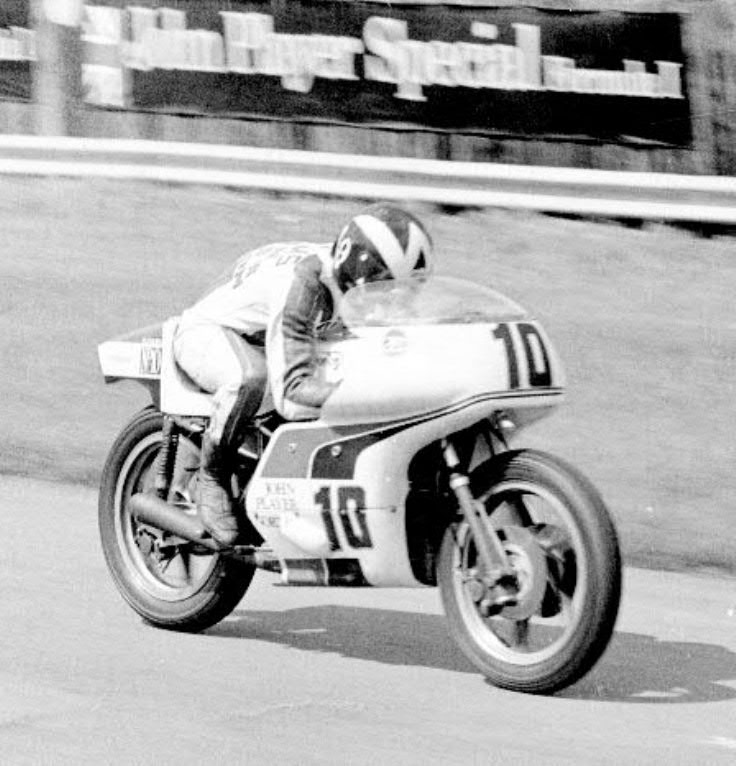
peter williams

Status
Not open for further replies.
acotrel said:
I think you have answered mny question - it was set up to be quick steering and nimble rather than stable and slow steering like a Ducati 900 ? Was it pulling a lot of gearing, or allowed to rev out down the straightaways ? In other words was it's advantage in the corners or in the way it wound out ? It sounds as though the isolastics were set up to be fairly firm. I don't doubt that PW was an excellent rider, however so are many others. The important thing is usually how the bike is set up, and whether it suits your style and mentality. I cannot imagine somebody scratching on the IOM. It could be that the isolastics were the important ingredient if the bike was being ridden really hard in every corner over such a long distance.

There's an iconic photo of PW on the monocoque during the winning F750 race and, if I remember right, you can clearly see the fairing scuffed from grinding through the corners. The IOM has some slow sections e.g Ramsey hairpin, which is uphill, and which you want to accelerate out of quickly to gain momentum to take you on up through Waterworks, onto the Gooseneck and continue the Mountain climb, so the gearing would have to reflect this as well as flat out sections like Sulby straight and Cronk-y-Voddy. If the iso thrust faces are dead square then you can run minimal clearance without transmitting uncomfortable vibration. With a smaller gap the play at the rear wheel is minimised.

PW stated during practice the bike hit 150mph (calc. from tacho) on Sulby straight I think, and took him to part of the road he normally didn't use - hit a serious bump and the bike shook him like a rag doll for a few moments, before straightening itself out. The Isle of Man is very bumpy anyway. PW said he 'toured' the rest of the lap due to being seriously, er, shook, or shaken. Lap time was still good which suggested he'd never gone faster on the lap before hitting the bump. The bike was custom built for Peter Williams, he designed it!

May have been wrong about the scuffed fairing, but some interesting photo's on http://www.italian.sakura.ne.jp/bad_toys/norton/ . See photo of the iso head steady - never knew it was designed like that. Space frame should never have replaced the monocoque - blame the whingeing mechanics!

I think the bike was a great design all over, and perfectly suited for the Island. Plus PW, a great rider and engineer.
 
Al-otment said:
acotrel said:
I think you have answered mny question - it was set up to be quick steering and nimble rather than stable and slow steering like a Ducati 900 ? Was it pulling a lot of gearing, or allowed to rev out down the straightaways ? In other words was it's advantage in the corners or in the way it wound out ? It sounds as though the isolastics were set up to be fairly firm. I don't doubt that PW was an excellent rider, however so are many others. The important thing is usually how the bike is set up, and whether it suits your style and mentality. I cannot imagine somebody scratching on the IOM. It could be that the isolastics were the important ingredient if the bike was being ridden really hard in every corner over such a long distance.

There's an iconic photo of PW on the monocoque during the winning F750 race and, if I remember right, you can clearly see the fairing scuffed from grinding through the corners. The IOM has some slow sections e.g Ramsey hairpin, which is uphill, and which you want to accelerate out of quickly to gain momentum to take you on up through Waterworks, onto the Gooseneck and continue the Mountain climb, so the gearing would have to reflect this as well as flat out sections like Sulby straight and Cronk-y-Voddy. If the iso thrust faces are dead square then you can run minimal clearance without transmitting uncomfortable vibration. With a smaller gap the play at the rear wheel is minimised.

PW stated during practice the bike hit 150mph (calc. from tacho) on Sulby straight I think, and took him to part of the road he normally didn't use - hit a serious bump and the bike shook him like a rag doll for a few moments, before straightening itself out. The Isle of Man is very bumpy anyway. PW said he 'toured' the rest of the lap due to being seriously, er, shook, or shaken. Lap time was still good which suggested he'd never gone faster on the lap before hitting the bump. The bike was custom built for Peter Williams, he designed it!

May have been wrong about the scuffed fairing, but some interesting photo's on http://www.italian.sakura.ne.jp/bad_toys/norton/ . See photo of the iso head steady - never knew it was designed like that. Space frame should never have replaced the monocoque - blame the whingeing mechanics!

I think the bike was a great design all over, and perfectly suited for the Island. Plus PW, a great rider and engineer.
The thing is just so modern under the skin. PW was lightyears ahead in thinking in this game. "What could have been?" Had he been with a factory that was going down the pan, is something that must tortue him!
Scrapping such an exquisite, forward thinking design, for a space frame was a sad step backwards. But by then, I guess it no longer mattered.
Wish I had £70k spare so I could order me a new one!
 
pommie john said:
peter williams


This one. I can't remember who built it now. I'll have to dig the magazine out to remind myself.


Norman White - as fast eddy said.

http://www.normanwhite.co.uk/
Not exactly inexperienced when it comes to JPNs...
 
If PW was scratching through the corners using high gearing which was achieved by raising it at the secondary, it might explain his gearbox problems. If the primary gearing is very high and the seconday low,the motor doesn't have as much purchase and the gearbox spins faster so the loads are lower. I use a single row primary chain with Jawa speedway sprockets on my 850,so the largest engine sprocket has 22 teeth, I'm now looking for a japanese gearbox sprocket with 24 teeth so I can spline it correctly. Think that PW probably would have used the standard commando multi-row engine srocket, and increased the secondary gearing to get his gearing high enough for a big circuit. I recently tried to ride my bike starting in 5th gear, when the clutch took up it accelerated like a blur. I was amazed the other year when Steve Maney accelerated into the back of Craig Ditchburn's bike at Phillip Island after it's sprocket carrier broke. With a close 4 speed box I always cooked the clutch too much at the start of a race, but as soon as the clutch took up it was extremely fast. Fortunately the mainshaft in the TTI box is much bigger, and an outrigger is not needed. I always have a big fight with the chains and sprockets on my bike because I don't use half links. I often have to go up in steps of two teeth due to lack of adjustment.
 
acotrel said:
I use a single row primary chain with Jawa speedway sprockets on my 850,so the largest engine sprocket has 22 teeth, I'm now looking for a japanese gearbox sprocket with 24 teeth so I can spline it correctly. .


Why not just use Norton sprockets? I run 24/48 on the rear of mine. You can buy a 24 tooth gearbox sprocket at most Norton places.
 
The link to Norman White's site did not help me find out about the way PW's bike was set up. I'll probably email him when I get home. I wonder how much variation there is between the bikes of modern IOM riders such as Guy Martin and Cameron Donald ? Surely it cannot be 'one size fits all' ? PW's achievement seems exceptional.
 
Norman White JPS replicas... possibly the same bike?

Good info on the transmission solution.

peter williams


peter williams
 
There is or was a picture or three of / from Norman white overhaul of one of the 72 F750s , showing a three row needle roller mainshaft to output shaft bearing / s .

AC , the primary gearing on the f750s swings the box faster .
 
It just looked like a scuff mark ; it was a Oil Leak , blown back by the wind . 8) :lol: :P

peter williams


seen it too , actually . dont take much of a bump , banked over like that , to mess up the paintwork .
 
Alan,

Just ask yourself how many hours PW spend on the wind tunnel....on the bike...compared to any other TT rider?

He was fanatical about frontal area at all times, and maintained his position to maximise it....he had to level the playing field somehow....

He was also a great and smooth rider.....

Do read his book.....
 
Steve, Frontal area is important, however so is torque, especially when you give away 10 BHP at the top end. I might have imagined it,however two strokes I have ridden feel as though they stall in a head wind.
 
There is a rough rule of thumb about aero and power:

At 100 MPH, to get a 5% increase in speed , you need a 5% reduction in frontal area, or a 5% reduction in drag, or a 16% increase in horsepower.
It's np wonder PW was chasing aero improvements. He wasn't going to get much more power.
 
If the bike has more midrange, you get there quicker, the last 5mph is always going to be slow ? What disturbs me on short circuits with my bike using a close box is the lack of lag once it is moving. On the IOM you probably have two choices - get up to a fairly high speed quickly, or run higher gearing and get to a higher speed more slowly. I short where is it better to go fast - corners or high speed bends and straights ? My feeling is that if you bought the monocoque replica, you would adjust to it and end up using PWs riding technique -whatever that might be, and you might learn to be brave. I've watched the video of Ago at Hilberry - it is not for me.
 
Setting up gearing for a race bike is reasonably simple. Set the final drive ratio so the you reach maximum RPM at the fastest part of the circuit. Simple as that. You want to bear in mind what the wind is doing, and if it might change, but there's not much more to it than that if you haven't got the luxury of changing internal ratios.

I have heard it said that you get a lot of over rev on the IoM because the rear wheel leaves the ground so often. That would complicate things, but I would imagine that these days the rev limiter helps in that situation.
 
Although I can't pretend to speak from experience, I've seen how the IOM bikes were set up 'back in the day', and it's evidently all about the speed down the Mountain.
One of my Ducatis did the TT a couple of times, and it was geared so tall It must have been kept in 4th and below for most of the lap, with 5th being reserved for the mountain descent.
The guy who raced it from new told me that 'back then' the speeds weren't actually all that high for the most part. I recall PW being quoted along the lines that it was all about going as slowly as possible whilst doing just enough to be fastest. Watching footage from the early '70s TTs of all the Nortons pulling out due to gearbox failures, I guess his concerns were as much reliability-based as anything else.
Incidentally, my Ducati trashed its gearbox back then too :(

A local racer was running a Daytona in the Manx (500 class), and had problems with the gearbox because it spends so much time in 3rd gear, resulting in the mainshaft high gear sleeve bearing wearing as it's a plain bush. Again, 4th was reserved for the mountain descent.

Now we have titanium engine internals and 6-speed boxes the 'traditional' Manx classes are faster than ever, but I wonder if these gearboxes would take the power of a decent short-stroke commando engine?
It would certainly be fun trying to find out!
 
From what I've heard, the fastest parts of the circuit ( TT) are Crosby where there's a steady descent for a few miles and the straight between the Creg and Brandish.

Never having raced there I can't be certain.
 
peter williams


If you look at the map there are 4 low points near to sea level on the circuit.

Douglas, Ballacraine, Kirkmichael and Ramsey. Ballacraine is the highest as the other 3 are near sea level and Crosby is at point 5 near the Highlander starting the run down to Ballacraine. The speed trap is on the Sulby Straight at point 17 on the run down into Ramsey and would be a better drop than Crosby but the Mountain drop is the fastest section of them all.
 
peter williams


This chap ran a tooth down , to get out of the bends & up the hills quicker ,
figureing a few mph extra everywhere was worth more than a few less and a few more top end in the odd place .
This got one of the wobbly old Triumphs round at Manx speeds , without it falling to bits or going into a ditch .
 
Status
Not open for further replies.
Back
Top