Commando counter balance install, why not?

I'll take you up on that offer. If you do it instead of me it will save me a lot of time. Let me know how it works out.
Jim, you are way too busy with important things to worry about this, so it is now sitting on my shelf of things I hope to live long enough to get to (doubtful) :)
 
Friction loss may have been the reason why Doug Hele's inventive idea didn't catch on. It is an attractive and cost-effective concept though which requires minimal exterior changes to the bike or the engine: I slightly revised crankcase, a new crankshaft, and the parts comprising the balancing device. As you mention, by introducing a linked rod, friction can be greatly reduced or eliminated entirely. A further reduction can be achieved by applying coating between moving parts.
Intrestingly , inkley ave dunnit with the TRIPLE . A 90 degree throw on the middle cylinder .

After Laverdas ' flat plane ' triple crank - alledgedly the couldnt afford a 120 degree machineing machine , untill later . For a 120 degree version !

As the trples a 750 twin derivative , If Triumph had introdced a 650 based triple after the 500 based , or was it 250 BSA based ? we'd ave a bigger one .

ANYWAY , it'd obviously , condidering THAT , be better to do a ' 120 ' crank , for a TWIN . and have a 60 degree parrallel V-Twin .

( Laverda - a 4 with a cylinder lost . ) So the minimum power absorbsion , if you must use a balance shaft , is likely with a half a six , less a cylinder .

Not to worry , give it another 50 years and somebodys bound to do one . if not tomorrow .

==========================================================

then theres the B M E P pressure cycle , rotational acceleration , traction considerations . which should endorse it .
 
Last edited:
Well sorry I said anything. But you know one could put the balancer any place there is room and electrically drive it. I like the engine plate idea, and just time the balancer to the engine with an accelerometer. But never mind, I will just get something new if I don't like the vibration. I was just thinking, not going to cut up a 1972 stock Combat with 10 k miles on it for anything.
 
Well sorry I said anything. But you know one could put the balancer any place there is room and electrically drive it. I like the engine plate idea, and just time the balancer to the engine with an accelerometer. But never mind, I will just get something new if I don't like the vibration. I was just thinking, not going to cut up a 1972 stock Combat with 10 k miles on it for anything.
You asked for peoples thoughts dude…
 
This has been done and can be seen running on you tube. We have the bike here and it has the balancer piston, and yes it works as some may have witnessed when we have started the bike publicly. So yes it works, was tried years ago but dropped due to expense and that it added no extra performance.
If Jim comes up with a cheap an easy solution then it would be a nice addition especially for those doing long rides before stopping to top their interstate tanks.
 
This would be an experiment. My main concen is that the balancer would have to be higher than the crank centerline (perpendicular to the bore centerline). When the piston is 1/2 way down and the crank counterweight is to the side - the counterbalancer weight (which spins the oposite direction) would not be directly opposite the flywheel counter weight. Maybe the positions of the counterbalancer weights could be adjusted to compensate.

Also - a single counterbalancer for a single cylinder actually passes between the two counterweights of the flywheel. But the counterweight would be further away on a twin and thats why you often see two counterbalancers instead of one - one in front and one behind to even things out. Just one counterbalancer could leave some forward and aft rocking couple.

I don't know how much this would inhibit the effectivness of the counterbalancer - it might still be worth it and make the Norton much smoother. But its not ideal. Maybe someone who is better versed in balancing science can shed some light.
 
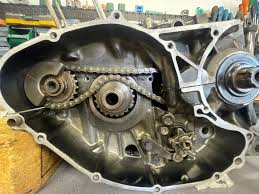
Here's an image of a Honda 500 single chain driven counterbalancer that is higher than the perperdicular center of the crank - so it might just work in the Norton mag position.

Commando counter balance install, why not?
 
The technical challenges aside, is it likely the owner of a Norton classic bike will spend big bucks on a device altering the looks and feels of the bike, which is never used for long distance touring? The "kit" will be of interest to Dominator and G/N15 owners primarily. Not whishing to dampen your courage and enterprising spirit, I believe the market response will be disappointing.

- Knut
👍 Right you are Knut... Huge waste of time and money.
 
Another problem I just noticed might be that the Norton magneto chain is too light. Look at the heavier counter balancer chain on the 1980 honda 500 single. It would at least need a wider camshaft type chain.

Commando counter balance install, why not?
 
Last edited:
Another problem I just noticed might be that the Norton magneto chain is too light. Look at the heavier counter balancer chain on the 1980 honda 500 single. It would at least need a wider camshaft type chain.
I think Honda's engineering power and deep pockets might be required, and even then who's gonna buy it for an old Norton?
💡
 
A friend has owned and ridden pretty much every make and model of old British bike from 1930s to 1970s, including 7 Vincents.
He recently purchased a stock 750 Commando, This is not his first Norton but his first Commando. He is still in a state of shock at how smooth the bike is. On the change that happens around 3000 rpm where everything goes glass smooth he said "It's uncanny" He has also owned a number of modern bikes with balancer shaft engines and finds the Commando to be just as smooth as any of those, once in its proper operating range of 3000 - 6500 rpm.
Any of those solidly mounted Brit or other pre balancer engines would be good candidates for a balancer shaft, if it could be done.
The rubber mount engine vibration solution that Norton came up with in the 1960s still works very well, you really don't need to do anything more, even for long haul riding. If any appreciable amount of vibration is making it to the rider then the isolastics need adjustment or possible replacement.


 Glen
 
I would never expect to find a good multi-purpose motorcycle. My Seeley 850 is perfect for it's purpose. For riding on public roads, it would take a lot of engineering, and it would never be good. When the motor is operating in its usable rev-range, it is extremely smooth running. On public roads, it would probably come on song and jump into the back of a car. Some people ride road bikes and fantasise about what racing might be like. I am patient with people like that. One of my friends rode Harleys for most of his life. When he tried racing, he found out that he did not know how to ride a motorcycle. Riding on public roads only teaches you the basics. The most dangerous time in road-racing is the first time you race, because you still have your ego.
 
A friend has owned and ridden pretty much every make and model of old British bike from 1930s to 1970s, including 7 Vincents.
He recently purchased a stock 750 Commando, This is not his first Norton but his first Commando. He is still in a state of shock at how smooth the bike is. On the change that happens around 3000 rpm where everything goes glass smooth he said "It's uncanny" He has also owned a number of modern bikes with balancer shaft engines and finds the Commando to be just as smooth as any of those, once in its proper operating range of 3000 - 6500 rpm.
Any of those solidly mounted Brit or other pre balancer engines would be good candidates for a balancer shaft, if it could be done.
The rubber mount engine vibration solution that Norton came up with in the 1960s still works very well, you really don't need to do anything more, even for long haul riding. If any appreciable amount of vibration is making it to the rider then the isolastics need adjustment or possible replacement.


 Glen
I am surprised that Norton actually got the Isolastics to work so well. When motors are rubber-mounted in Yamaha two strokes, the bikes always seem to be slower. But Commandos probably have a lot of unused torque. Making them pull with close ratio gears gives better performance.
 
Back
Top