
You are using an out of date browser. It may not display this or other websites correctly.
You should upgrade or use an alternative browser.
You should upgrade or use an alternative browser.
Another! oil pressure question...
- Thread starter tompkins
- Start date
So I’m thinking maybe i should pull the oil pump and service it? It’s the only part of the bike I haven’t futzed with so it only makes sense to try and rebuild it as outlined in the book. I don’t think AMR resurfaces the faces, just puts in the seals, right? The rest of the bike pre-resurrection was haggard and mostly destroyed, so it only makes sense that the pump is probably haggard too.

acotrel
Flagged
- Joined
- Jun 2012
- Messages
- 15,047

I prefer plunger type oil pumps to the gear type. I think the gear pumps were designed for motors which had roller bearing big ends. Plain bearings probably need enough pressure to float them so that they do not pick-up on the journals. But a Commando engine does not really rev very high.

MexicoMike
FULL MEMBER
- Joined
- Jan 2010
- Messages
- 3,335

FWIW, a gear pump will continue to increase pressure as the RPM rises -to the point where, if not limited by a relief valve, it could blow every seal/oil filter/hose fitting in the engine. Actually, of course, it would only blow one of those before pumping all of the oil out of the engine.

Tornado
FULL MEMBER
- Joined
- Dec 2017
- Messages
- 5,432

Your observations are very similar to mine....stock '74 850 with no check valve or OPRV mods....gauge tapped off head feed banjo...hot idle is 0-5psi and then roughly 10psi per 1-1.5k rpm...AFAIK, this is normal for the hot oil to thin down...keep in mind the motor is more concerned with actual oil flow rate rather than psi pressure. I did find using BelRay 4T 20-50 Full Synthetic, which tested very highly in the Comnoz oil studies, did improve hot idle psi a fair bit and less variation across all temps compared with VR1 Racing 20/50 and Castrol Classic 20/50 (bvoth high zinc mineral oils). Would have stuck with Belray but it is now hard to source here and the Castrol Classic can be had locally.oh yeah, oil pressure taken off of timing side exhaust rocker plate, and if bike is allowed to cool off for a period (i.e. stopping for tasty bevvies or gas) the pressure cycle starts over, high to low
Tornado
FULL MEMBER
- Joined
- Dec 2017
- Messages
- 5,432
My timing cover was chromed by a DPO...as was the primary case. I've found it near impossible to stop weeps of ATF out the primary case inspection caps, even with new rubber o-rings and products like Hylomar or teflon tape on the cap threads. I put this down to the chrome in the threads making for poor fitting caps. I'm now wondering if similar issue on my OPRV thread hole in the TC....though no outward leaks noted, it could be permitting oil to bypass the pressure relief mechanism.Dennis, Loctite 569. Mainly on bottom few threads. Some oil was going around the relief via the threads rather than all the oil trying to open the relief. Probably no reason for the relief body to ever be removed, but 569 is not too strong. Graham
I am using the finest Walmart 20-50 Dino money can buy to run it in since it’s only going 500 miles before a change. Maybe after some fresh royal purple it’ll go up some.Your observations are very similar to mine....stock '74 850 with no check valve or OPRV mods....gauge tapped off head feed banjo...hot idle is 0-5psi and then roughly 10psi per 1-1.5k rpm...AFAIK, this is normal for the hot oil to thin down...keep in mind the motor is more concerned with actual oil flow rate rather than psi pressure. I did find using BelRay 4T 20-50 Full Synthetic, which tested very highly in the Comnoz oil studies, did improve hot idle psi a fair bit and less variation across all temps compared with VR1 Racing 20/50 and Castrol Classic 20/50 (bvoth high zinc mineral oils). Would have stuck with Belray but it is now hard to source here and the Castrol Classic can be had locally.
This is intriguing… I never would have thought about oil bypassing the valve via the threads, but at several psi… seems like a real possibility! One more method of attackDennis, Loctite 569. Mainly on bottom few threads. Some oil was going around the relief via the threads rather than all the oil trying to open the relief. Probably no reason for the relief body to ever be removed, but 569 is not too strong. Graham

acadian
FULL MEMBER
- Joined
- Mar 2010
- Messages
- 1,486
Oil bypassing the bottom threads of the OPRV is a known problem, even with triumphs and BSAs, some of the triumph and BSA guys have machined the case for an o-ring at the base of the valve but IMO this is a lot of effort, I apply a bit of hi temp thread sealant to the bottom 2-3 threads of the housing rather than the valve itself

SteveA
MEMBER
- Joined
- Dec 2011
- Messages
- 3,560

A new AN pump will be slightly more efficient than an original one.So I’m thinking maybe i should pull the oil pump and service it? It’s the only part of the bike I haven’t futzed with so it only makes sense to try and rebuild it as outlined in the book. I don’t think AMR resurfaces the faces, just puts in the seals, right? The rest of the bike pre-resurrection was haggard and mostly destroyed, so it only makes sense that the pump is probably haggard too.
Though, I am inclined to think you don't have as much of a real problem as you think you do.
General consensus was that on a long race and at high rpm, the oil centrifuged out of the crank faster than the pump could deliver...
i.e. zero oil pressure, but plenty of flow. It's flow you need.
Constant exposure to high temperatures will break down the oil sooner, so make sure you change it often.

kommando
MEMBER
- Joined
- May 2005
- Messages
- 8,103

Correct, oil pressure is a proxy reading, it assumes a high oil pressure is giving the right conditions for a journal in a plain bearing for the journal to have an oil film separating it from the shells. You can't measure the oil film thickness directly so oil pressure is used instead, but pressure is not the only factor in a good oil film thickness hence why an oil that creates a good oil film is also needed.keep in mind the motor is more concerned with actual oil flow rate rather than psi pressure
Cool, removed oprv, installed thread sealant, wating for it to cure. Will report back after we take ‘er to bike nite at the pub! Also, it’s hard to get sealer on just the bottom threads! What a strange design. First I put it on the bottom threads of the valve body, but then I realized it probably wouldn’t make it all the way to the bottom, then I ended up using a qtip while trying not to slop too much in the holes at the bottom- I’ve never been too delicate or graceful, so it was a whole thing. We’ll see!
Seems to have been an unmitigated total success! I’m surprised it worked as good as it did- much closer to 10psi per 1000 when smoking hot. Still 0-5 at idle, but comes up much quicker once rolling and holds 25-35 on the interstate doing 80 for 20+ miles. Will report back when i go for a ‘full tank’ trip. Never woulda thought that this was an issue until I learned it from the fine folks at access Norton! FYI… don’t wanna step on any toes, but there’s an interesting write up on oprv testing and this issue but for triumphs and beezers on another British bike forum- worth a read! Easily translates to Nortonland
Finally got some warm weather here to check oil pressure when hot. Just did 30 miles spirited riding through twisty Adelaide hills, about 80 degrees F. Hot idle 1000rpm 25 psi, 3000rpm 32 psi. Oil Penrite 10 60 full syn. Engine now done 5600 miles since new big end bearings and new rockers and shafts. And sealant in the bottom threads of the relief valve. I think new rockers and shafts helps a lot as well. Graham.

olympus
MEMBER
- Joined
- Aug 2017
- Messages
- 1,554
Are there any results running this 20w-70 oil yet, pressures performance etc??£59 Inc delivery

Fast Eddie
FULL MEMBER
- Joined
- Oct 2013
- Messages
- 23,436
Not from me. I was using it in another application.Are there any results running this 20w-70 oil yet, pressures performance etc??
acotrel
Flagged
- Joined
- Jun 2012
- Messages
- 15,047
Matt Spencer once assured me that the top half of a Triumph relief valve which has the indicator button, fits the bottom half of the Norton relieve valve. I tried to get one but had no success. If a Triumph engine has good oil pressure, it is usually impossible to push the indicator button in while the engine is running.
I have always believed that oil pressure causes the big end bearings to float and that low oil pressure can allow the bearing metal to pick-up on the steel journal.
I have always believed that oil pressure causes the big end bearings to float and that low oil pressure can allow the bearing metal to pick-up on the steel journal.

ludwig
MEMBER
- Joined
- Aug 2006
- Messages
- 906

I don't have an oil pressure gauge on my bikes , but check the pressure every other year or so.
Many years ago, coming back from Lagos Portugal ( 6000 km round trip) I checked the pressure, and it was zero at idle.
Revving up , maybe 1 bar max ( 10 -15 psi )
Opening the timing cover, I found the circlip holding the crankshaft seal had popped out .
( only myself to blame..))
Going by the wear marks on the circlip, it must have been out for a long time.
There was NO damage on the engine.
If I had a gauge and watching the pressure drop, it would surely have spoiled the trip.
Instead I had a great trip, without a worry on my mind :
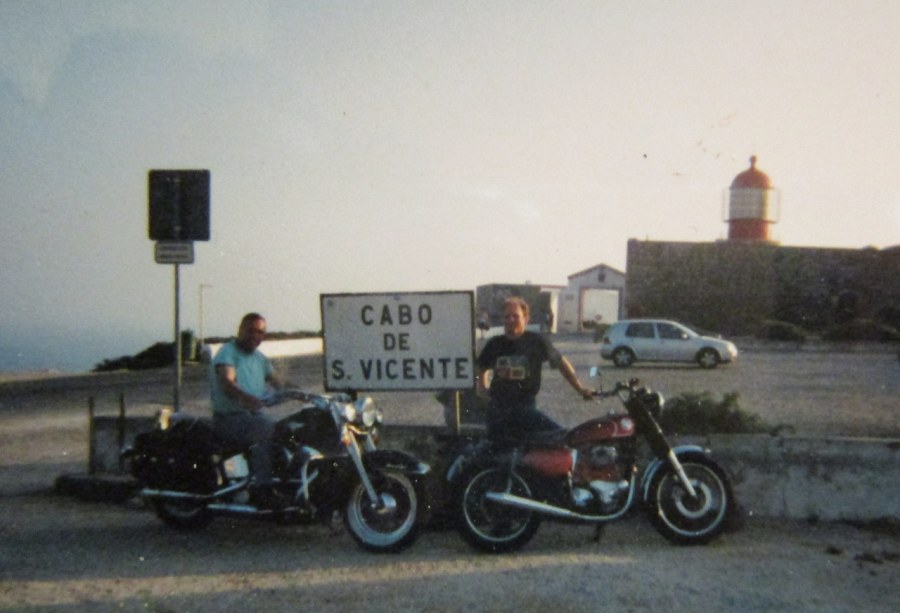
Cabo de San Vincente is the extreme SW tip of Portugal
Many years ago, coming back from Lagos Portugal ( 6000 km round trip) I checked the pressure, and it was zero at idle.
Revving up , maybe 1 bar max ( 10 -15 psi )
Opening the timing cover, I found the circlip holding the crankshaft seal had popped out .
( only myself to blame..))
Going by the wear marks on the circlip, it must have been out for a long time.
There was NO damage on the engine.
If I had a gauge and watching the pressure drop, it would surely have spoiled the trip.
Instead I had a great trip, without a worry on my mind :
Cabo de San Vincente is the extreme SW tip of Portugal
Similar threads

- Replies
- 10
- Views
- 1,372
- Replies
- 7
- Views
- 1,628

- Replies
- 13
- Views
- 1,810
