71 Brake Drum to Cush Hub- Pin Fix

Status
Not open for further replies.
Just as a reminder, back in the good old days about any welder could weld a new set of teeth onto any worn old sprocket/brake drum - no furnace or remachining required.! Just a good heat with oxy or blow torch, and a slow cooling out afterwards. This is not rocket science.
Don't forget to remove the bearings first, however...

As discussed, original 850 drums at least were steel, no precautions required to weld or repair whatsoever. You'd still want to check it was in good enough condition to be safe, however.

Have a close look at these cheap new brake drums available - no telling what they may be made of, or how (or where ?) they were made... ?
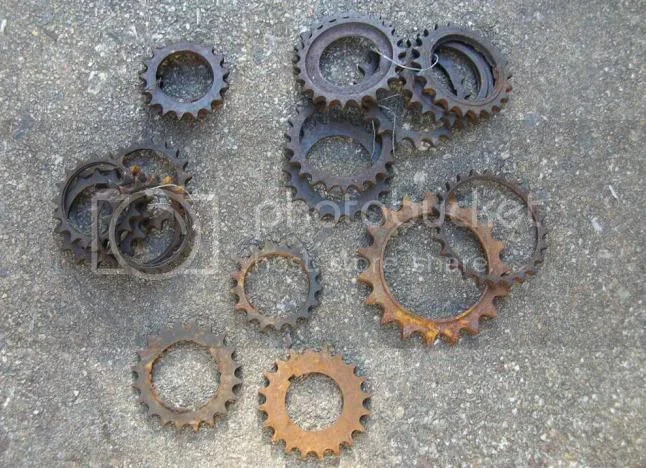
 
If it was possible to put new teeth onto a cast iron sprocket in the past using gas welding without pre-heat or post cooling, then maybe you could provide more details, as this sounds a very useful repair process, which should work on just about anything made from cast iron?
 
I think I've worn out the keys on my keyboard that say cast iron MUST be preheated and MUST be cooled out slowly. (no quenching) Oxy torch and brazing (brass) seems to be enough to do the job, your mileage may vary. A lathe generally needs to be involved, to ensure the sprocket stays concentric.

Steel drum and steel sprocket, no problemo.
 
Rohan said:
I think I've worn out the keys on my keyboard that say cast iron MUST be preheated and MUST be cooled out slowly. (no quenching) Oxy torch and brazing (brass) seems to be enough to do the job, your mileage may vary. A lathe generally needs to be involved, to ensure the sprocket stays concentric.

Steel drum and steel sprocket, no problemo.


Sorry this post must have been made by someone other than you then: Just as a reminder, back in the good old days about any welder could weld a new set of teeth onto any worn old sprocket/brake drum - no furnace or remachining required.! Just a good heat with oxy or blow torch, and a slow cooling out afterwards. This is not rocket science.
Don't forget to remove the bearings first, however...


The easy way to preheat a cast iron part to the temperature (cherry red heat) required for a successful weld repair is to use a furnace of some sort, which can also be used to let the part cool slowly.

I wonder have you actually ever repaired any cast iron parts yourself, or is what you are posting here simply things you have found on the net? Why anyone would bother to braze new teeth onto to cast iron sprocket, and how they would go about re-machining the teeth accurately, are things I find quite interesting!
 
I will get you some pictures of these things.
It was once an extremely common practice.

Why would you need to "remachine" the teeth, you simply weld on a complete new outer of a sprocket, after machining off the old worn out teeth. With care, to ensure perfect alignment.

Also commonly done to gearbox sprockets, although they need to be annealed and then rehardened after welding.
"What size sprocket does sir have on his Triumph ?"
71 Brake Drum to Cush Hub- Pin Fix
 
Rohan,

I originally assumed the replacement process involved welding on a replaced teeth one at a time. I also envisioned this process being a nightmare! I can see where complete sets of teeth would solve many of the problems, but it would still require a keen skill-set to get it right.

In the picture you provided are these all examples of replacement teeth?
 
Duh dudes this is a Norton rear drum right, there is nil-no/none room left after one wears/grinds/breaks off the teeth standing proud of the rim to place a ring of teeth back on that is near the original OD/teeth count. I had a two drums done both ways and still use them - as weights to hold tarp on my mower. Its the likes of a Comoz with time and skill and equipment to spare-waste putting teeth back on that are spaced and shaped well not to tear up chains too soon or about a dozen more teeth on a ring for enough meat back up to fit as I did via set screws drilled into the seam.
If you want to speed up your own research on this area turn those robust teeth down to fit 520 size links...
 
hobot said:
Duh dudes this is a Norton rear drum right, there is nil-no/none room left after one wears/grinds/breaks off the teeth standing proud of the rim to place a ring of teeth back on that is near the original OD/teeth count. I had a two drums done both ways and still use them - as weights to hold tarp on my mower. Its the likes of a Comoz with time and skill and equipment to spare-waste putting teeth back on that are spaced and shaped well not to tear up chains too soon or about a dozen more teeth on a ring for enough meat back up to fit as I did via set screws drilled into the seam.
If you want to speed up your own research on this area turn those robust teeth down to fit 520 size links...

Steve, the teeth don't arise sheer out of the drum, they have a small ring underneath.
Perfectly do-able. Check out the thin band sprocket type on the far right of my pic.
As an example, its not Norton....

OR, if rebanded with one more tooth, it would break that stupid 21-42 tooth combo on the rear chain that makes it cycle the same links with the same teeth all the time.
A 21-43 or 22-43 makes far more sense ??

With new sprockets so cheap though (are they any good ?) you'd have to be keen these days...
 
T95 said:
I originally assumed the replacement process involved welding on a replaced teeth one at a time. I also envisioned this process being a nightmare! I can see where complete sets of teeth would solve many of the problems, but it would still require a keen skill-set to get it right.

In the picture you provided are these all examples of replacement teeth?

He he, welding teeth on one at a time - thats good !
I have a sprocket that needs one tooth welding on though, been thinking if it really needs doing.

Those are mostly new sprocket bands, ready to go.
Old ones are only good for the scrapman.

There are places that specialise in sprocket rebanding, its still a common industrial practice.
 
Interesting stuff Steve.

Looks better engineering too than someone elsewhere, who mentions having the sprocket reband affixed with "tack welds". Hopefully lengths of, not just dabs....
 
Status
Not open for further replies.
Back
Top