
You are using an out of date browser. It may not display this or other websites correctly.
You should upgrade or use an alternative browser.
You should upgrade or use an alternative browser.
71 Brake Drum to Cush Hub- Pin Fix
- Thread starter T95
- Start date
- Status
- Not open for further replies.


I've got an older 7" brake drum with a broken tooth.
I never investigated, the break looked like cast iron.
Steel was in short supply during the war, sure I'd read military drums were cast iron.
Even gearbox covers and timing covers were iron for some makes during the war.
And early dommie drums rust like cast iron...
Out for some more grinding...
I never investigated, the break looked like cast iron.
Steel was in short supply during the war, sure I'd read military drums were cast iron.
Even gearbox covers and timing covers were iron for some makes during the war.
And early dommie drums rust like cast iron...
Out for some more grinding...
The drum on my '39 16H (produced pre-shortages possibly) was certainly steel.
I've got a number of 16H drums here, but also an integral garage and children asleep upstairs so I'm not going to test 'em now !
Matchless particularly used cast iron for low-stressed castings but instead of aluminium rather than steel. I believe that Military-spec M20s used steel flywheels rather than the pre-war civilian cast iron.
One of the horror stories that regularly does the rounds in singles circles is that the pattern drums coming out of the Indian sub-continent are cast iron copies and the teeth break.
I've got a number of 16H drums here, but also an integral garage and children asleep upstairs so I'm not going to test 'em now !
Matchless particularly used cast iron for low-stressed castings but instead of aluminium rather than steel. I believe that Military-spec M20s used steel flywheels rather than the pre-war civilian cast iron.
One of the horror stories that regularly does the rounds in singles circles is that the pattern drums coming out of the Indian sub-continent are cast iron copies and the teeth break.
Cast iron brake drums give better braking than steel ones.
Cast iron sprockets last a lot longer than steel ones.
And suppposedly give the chain an easier life.
Provided the teeth don't fall off !
(the one I have with a tooth missing would be pre-cheap Indian spares).
I've had a trail bike with a nylon back sprocket.
No trace of wear in all the time I had it.
Can't integrate it with a brake drum, of course....
Cast iron sprockets last a lot longer than steel ones.
And suppposedly give the chain an easier life.
Provided the teeth don't fall off !
(the one I have with a tooth missing would be pre-cheap Indian spares).
I've had a trail bike with a nylon back sprocket.
No trace of wear in all the time I had it.
Can't integrate it with a brake drum, of course....
Carbonfibre
MEMBER
- Joined
- Nov 2010
- Messages
- 1,274
Rohan said:Carbonfibre said:If you cant actually TIG braze yourself, it seems strange that you have so much to say about something you have only read about on the net? The process is actually far easier than TIG welding, and having carried out hundreds of repairs in this way, I have yet to have any problems with cracking, as heat input is so low these are easily avoided.
I can TIG weld.
I can't even FIND anything meaningful on the net about Tig brazing of cast iron.
Except with mention of extensive preheating.
Have you ever had such a weld strength tested ?
Its easy to make electric welds on cast iron look pretty - but they fall off when tested !
Show us a pic of an example.
Show an example on the net of such a process even.
Jist call me Skeptical....
If you cannot TIG braze, and dont know anything about the process, then suggesting its not suitable for repairing cast iron (I have carried out hundreds of such repairs sucessfully), seems to make your contributions on this subject a bit suspect.
john robert bould
MEMBER
- Joined
- Sep 2009
- Messages
- 2,210
madass140 said:Think I'll just buy new ones for $100. no worn sprocket, no worn brake brake drum, no loose paddles, well not for a while anyway.
Good Idea!
All these welding experts advise a uncertain strength repair , i have welded a few barrel fins on . but it is not an important fix, just cosmetic..in general engineering no drafty worth is salt design's fabrications with cast welded structures, crystaline stress and all that bo**ocks. Cast rods are normally for "low stress"repairs..AFTER ALL HOW ARE CAST WELDS TESTED :!:
Yes its good to discuss welding,brazing Tig ,Mig etc...But as the guy on this original post was looking for the best Advice, i would think a "Dodgy" Repair to a highly stressed part is not adviseable :!: Welding cast [drum]to steel paddles requires Dissimilar rods to which None or you "Experts" pointed out! So in future try to give a sane answer to these questions, and not some idiot responce. But what do i know...i have only been in the trade 46 years.
Carbonfibre
MEMBER
- Joined
- Nov 2010
- Messages
- 1,274
TIG brazing means dissimilar metals can be joined no problem at all, and strength of a repair on a part such as that mentioned by the OP is not likely to be an issue. However as there seems to be little understanding of this process, and as the part can be replaced cheaply its probably a good idea to fit a new part, rather than try to find someone with the ability to carry out a proper repair job?
john robert bould said:But what do i know...i have only been in the trade 46 years.
Some of the answers here have consistently pointed out that welding cast iron is risky - if indeed the drum is cast iron. And that replacements are available, and relatively cheap.
And some of the answers here have pointed out that Nortons brazed (with brass) some of the factory original drums, so if it was good enough for the factory...
And some of the answers have pointed out that good welders learn to be good welders by strength tsting their welds so they can consistently know how to do good welds - thats how aircraft welders are certified, after all. If its good enough to fly in.....
What trade is it that you are in ??
Cheers.
Carbonfibre said:TIG brazing means dissimilar metals can be joined no problem at all, and strength of a repair on a part such as that mentioned by the OP is not likely to be an issue. However as there seems to be little understanding of this process, and as the part can be replaced cheaply its probably a good idea to fit a new part, rather than try to find someone with the ability to carry out a proper repair job?
So we are not going to get any in-detail details ?
john robert bould
MEMBER
- Joined
- Sep 2009
- Messages
- 2,210
Rohan said:john robert bould said:But what do i know...i have only been in the trade 46 years.
Some of the answers here have consistently pointed out that welding cast iron is risky - if indeed the drum is cast iron. And that replacements are available, and relatively cheap.
And some of the answers here have pointed out that Nortons brazed (with brass) some of the factory original drums, so if it was good enough for the factory...
And some of the answers have pointed out that good welders learn to be good welders by strength tsting their welds so they can consistently know how to do good welds - thats how aircraft welders are certified, after all. If its good enough to fly in.....
What trade is it that you are in ??
Cheers.
Trade ; Fish and chips

Hobot
MEMBER
- Joined
- Oct 2005
- Messages
- 18,959

madass140 wrote:Think I'll just buy new ones for $100. no worn sprocket, no worn brake brake drum, no loose paddles, well not for a while anyway.
Haha, That's sliding scale of new, for a while, don't ya know. Fret on the details but the dang drum is more steel than cast iron and any way of fixing the twist of paddle beyond just stamped staking them will work as long as the teeth hold up. The real issue to solve is the cushions to remain stable flat load bearing surfaces then the paddles could be loose and still self center flat to flats.
I have got to tell you that I am loving the discussions on this topic. I was expecting a short reply but am glad it has stirred up such a lengthy discussion. You guys are broadening my understanding of metal, its structure and some of the processes used to weld and braze them.
I don't know about you guys but $200 for a replacement drum is not exactly cheep. Its encouragement to repair, if possible, rather than just replace it.
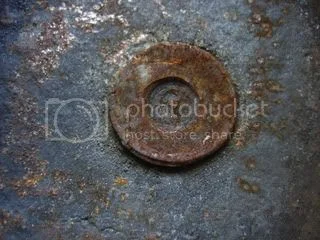
What I would like to hear more about is how these pins were originally attached then maybe I'll understand why replacement pins are not available. Was this a two pice arrangement, it looks like the head of the pin may be capped? Anyone have a photo of a pin that is not installed?
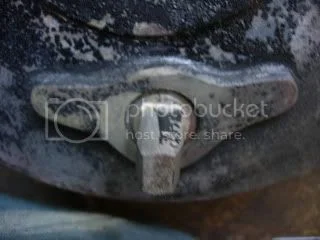
Interior view:
I don't know about you guys but $200 for a replacement drum is not exactly cheep. Its encouragement to repair, if possible, rather than just replace it.
What I would like to hear more about is how these pins were originally attached then maybe I'll understand why replacement pins are not available. Was this a two pice arrangement, it looks like the head of the pin may be capped? Anyone have a photo of a pin that is not installed?
Interior view:

Technically, I rather suspect those pins are fitted as ships rivetts would be - pressed in HOT, and then peened over.
If the sprockets are cast steel, I've wondered why the pins, and paddles, weren't just cast in ?
No possibility to repair them then ?
Or a historical reason ? Earlier brake drums had a threaded attachment there for the 3 wheel nuts, so presumeably they just modified the previous casting type to the new version...
If the sprockets are cast steel, I've wondered why the pins, and paddles, weren't just cast in ?
No possibility to repair them then ?
Or a historical reason ? Earlier brake drums had a threaded attachment there for the 3 wheel nuts, so presumeably they just modified the previous casting type to the new version...

madass140
FULL MEMBER
- Joined
- Nov 2011
- Messages
- 2,125

I drilled the end of the paddle which is riveted thinking they would then push out, I had about 10 ton on them in the press and they werent moving, I kept on drilling, it seemed to me that the paddles are screwed in then riveted, they may come loose but they will never come out, so there is no way of removing them in one piece and replacing them, and making new paddles to refit would hardly be viable, Norvil has new ones listed in their catalog for about $100, why would you bother.
Carbonfibre
MEMBER
- Joined
- Nov 2010
- Messages
- 1,274
Rohan said:john robert bould said:But what do i know...i have only been in the trade 46 years.
Some of the answers here have consistently pointed out that welding cast iron is risky - if indeed the drum is cast iron. And that replacements are available, and relatively cheap.
And some of the answers here have pointed out that Nortons brazed (with brass) some of the factory original drums, so if it was good enough for the factory...
And some of the answers have pointed out that good welders learn to be good welders by strength tsting their welds so they can consistently know how to do good welds - thats how aircraft welders are certified, after all. If its good enough to fly in.....
What trade is it that you are in ??
Cheers.
As few posters on this thread actually seem to be that familiar with repairing cast iron themselves, I am not sure that views expressed by these people are of much real value?
On the basis of commercial production cost is the major factor, so just because a certain process was used to manufacture a part certainly does not mean it was either the best or only way to make that part.
In terms of testing the strength of a weld repair anyone who is anal retentive to the nth degree, can pay a lot of money to have the repair NDT'ed, but in regard to a cast iron repair on a cheaply replaced bike part if the repair stands up to sharp tap from a small hammer it will generally be perfectly ok in service.
Carbonfibre
MEMBER
- Joined
- Nov 2010
- Messages
- 1,274
T95 said:I have got to tell you that I am loving the discussions on this topic. I was expecting a short reply but am glad it has stirred up such a lengthy discussion. You guys are broadening my understanding of metal, its structure and some of the processes used to weld and braze them.
I don't know about you guys but $200 for a replacement drum is not exactly cheep. Its encouragement to repair, if possible, rather than just replace it.
What I would like to hear more about is how these pins were originally attached then maybe I'll understand why replacement pins are not available. Was this a two pice arrangement, it looks like the head of the pin may be capped? Anyone have a photo of a pin that is not installed?
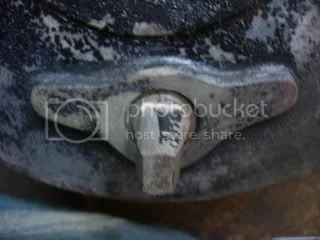
Interior view:
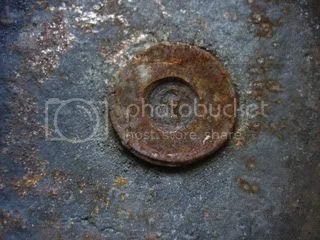
That looks like steel to me, and is something that is even easier to repair than cast iron......................if the pins are worn they can be built up with weld and filed back to a perfect fit.
john robert bould
MEMBER
- Joined
- Sep 2009
- Messages
- 2,210
Yep, You can risk your life on a tap from a toffee hammer.....get real!
Hobot
MEMBER
- Joined
- Oct 2005
- Messages
- 18,959
hehe, this thread has not yet reached the scope of metallurgy it had on older lists that extended to the British mining manufacture, forming and placemen welding of brittle steel plates that let the Titanic down.
BTW photo above of my 1st paddle welded drum, now with the Norvil's repair teeth ring added - was the 1st of 2 [two] 520 chain conversions that I'm so done with now wasting drum teeth on. The OD of ring teeth will not fit on unmodified rear chain run so didn't ever use it - just a practical waste expense to mount it and see. Your call yo'all.
BTW photo above of my 1st paddle welded drum, now with the Norvil's repair teeth ring added - was the 1st of 2 [two] 520 chain conversions that I'm so done with now wasting drum teeth on. The OD of ring teeth will not fit on unmodified rear chain run so didn't ever use it - just a practical waste expense to mount it and see. Your call yo'all.
- Status
- Not open for further replies.
Similar threads

- Locked
- Replies
- 34
- Views
- 6,622

- Replies
- 0
- Views
- 752