Excess Oil in Primary Chain Case - 72 Combat case in 73 750

swolh

VIP MEMBER
Joined
Jul 26, 2014
Messages
25
Country flag
I just drained more than twice the correct amount of ail from the primary chain case. I was the last one to have it apart, and filled it carefully with the correct 200 cc. The engine oil is down a little, but it burned some from start after wet sumping after a long sit.

Found two posts that deal with this: https://www.accessnorton.com/Norton...l-in-primary-suspected-leaky-main-seal.39548/ and https://www.accessnorton.com/NortonCommando/oil-in-primary.21590/

My conclusion: Owning a Commando is a love-hate relationship. Heresy I know, but I'm wishing I'd gotten another old reliable BMW boxer.
 
Last edited:
I just drained more than twice the correct amount of ail from the primary chain case. I was the last one to have it apart, and filled it carefully with the correct 200 cc. The engine oil is down a little, but it burned some from start after wet sumping after a long sit. Any ideas how excess oil would get into the primary chain case?
Starting a wet sumped engine can push oil past the crank seal and into the primary.

If you’re unlucky, it can push the seal out of the case in the process.
 
The other way a wet sumped engine can add oil into the primary is the oil level in the crankcase going higher than the lowest bolt of the 3 bolts that hold the primary case inner onto the crankcase. Parking on the side stand will make this more likely due to the leaning direction. Using loctite when fitting these bolts will eliminate this route.
 
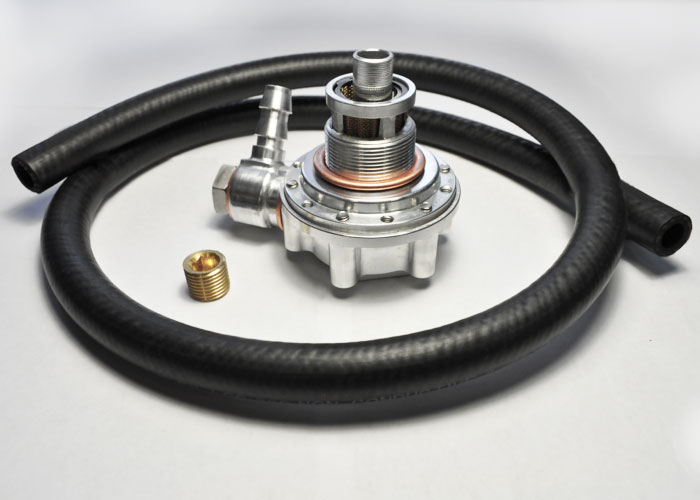
If a reed valve breather is fitted to the big strainer / plug on the bottom of the engine, routed to the oil tank. Any oil collecting in the crankcases. will be transferred to the oil tank as soon as the engine is turned over
 
If a reed valve breather is fitted to the big strainer / plug on the bottom of the engine, routed to the oil tank. Any oil collecting in the crankcases. will be transferred to the oil tank as soon as the engine is turned over
That's the first I've heard of a reed valve breather fitted to the big strainer / plug. Where would I get one of those?
Mine is a 73 750.

After posting this thread, I found these two helpful threads: https://www.accessnorton.com/NortonCommando/oil-in-primary.21590/ and https://www.accessnorton.com/Norton...l-in-primary-suspected-leaky-main-seal.39548/

For wet sumping: in 2015, I installed a MK III timing cover and MK III oil pump, then in 2017 I shipped the MK III timing cover to Alternative Motorcycle Repair in Sahuarito, Arizona (520 762-1429 to have the right angled plug in the anti-wet sumping valve machined to use a round plug, less likely to hang up/stick slightly open. This seemed to stop wet sumping, until it sat for the last two years (my bad, don't ask).

If it hasn't already been done, it occurs to me the info and threads about oil in primary case ought to be linked or added to threads about wet-sumping. I recall reading all about wet-sumping back in 2015 and 2017, but don't remember reading that it could cause leaking oil (through threads on the bottom bolt or main seal) into the primary. Could be in some threads about wet-sumping and I'm just having a senior moment not remembering it.
 
I was able to use this one on my '74 bitsa engine. The XS650 breather that had been previously installed wasn't working properly, so I removed it, plugged the timing case hole, and went with a sump breather.

 
Te reed valve helps to clear the sump quickly on startup plus keeps the internal pressures down, but if the oil has already leaked into the primary then its too late to help on that. A MK3 oil pump leaks like a pre MK3 oil pump once worn. Your pump can leak internally between the feed side and the scavenge side, AMR can add o rings to the shafts to stop this. I do this mod myself and use X rings.

Excess Oil in Primary Chain Case - 72 Combat case in 73 750


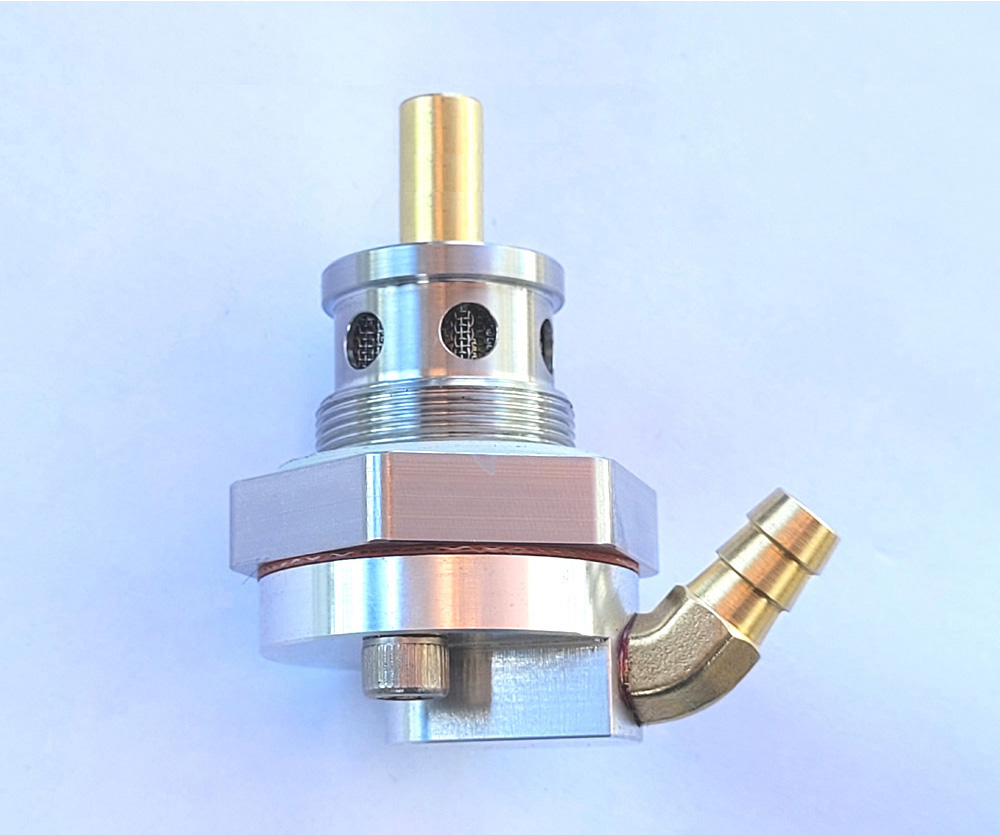
Or make your own, use a scooter emission reed valve and modify the strainer. This is work in progress, the vertical leg of the elbow needs to be extended above the strainer.

Excess Oil in Primary Chain Case - 72 Combat case in 73 750
 
Te reed valve helps to clear the sump quickly on startup plus keeps the internal pressures down, but if the oil has already leaked into the primary then its too late to help on that. A MK3 oil pump leaks like a pre MK3 oil pump once worn. Your pump can leak internally between the feed side and the scavenge side, AMR can add o rings to the shafts to stop this. I do this mod myself and use X rings.

Excess Oil in Primary Chain Case - 72 Combat case in 73 750
Thanks. And thanks
 
NEW THEORY:
To recap: I have a 1973 commando 750 - early 1973 which uses a '72 combat case with the crankcase breather bolted onto the rear of the crankcase. I discovered the primary case was full of oil (it's supposed to have only 200ccs). I pulled the primary assembly (alternator, clutch, primary sprocket and chain, and inner primary case) and confirmed oil leaking from the crankshaft main seal. I understand from threads here that this happens when there's too much oil in the crankcase (sump) and the pressure from having too much oil there forces the oil past the main seal into the primary case (and sometimes causes other leaks).

It is widely assumed that the source of too much oil in the crankcase is from wet-sumping while the engine is NOT running. Mine sure did wet-sump like that when I got it 12 years ago.

So, in 2017, I addressed the wet-sumping-when-not-running problem by replacing the timing cover and oil pump with MKIII versions - and sending them to AMR for the custom machining they do to the check valve in the timinig cover to stop wet-sumping. This seemd to stop wet-sumping when the bike was not running. Fast forward to 2025 after very few miles and (sadly) several years parked. Got the bike running (with help from a good local mechanic) - and it was smoking when started (typical sign of wet-sumping) and the mechanic said 1) it's wet-sumpng and 2) it wasn't returning oil to the tank as much as it should be. That last observation was particularly puzzling.

I spoke with Mike at AMR and he was very generous with his time and helpful. Per that conversation, I pulled the timing cover (again it's an MKIII with AMR improvement). It was clean as new, and the MKIII oil pump I installed with that AMR modified cover also looks brand new. It's possible that it's wet-sumpng past AMR's improved check valve when the engine is not running, but I'm not seeing anything to indicate this.

The threads here about replacing the stock crankcase breather with a Reed Valve breather has prompted a NEW THEORY. In particular, the comments that an after market reed valve breather will return excess oil in the crankcase more quickly than the the standard return side of the oil pump and the stock crankcase breather have me wondering whether one (or more) of the three hoses that return oil to the tank (one from the oil pump to the spin on oil filter, one from the spin on oil filter to the tank, and one from the stock breather to the tank) might be clogged. I'm thinking that, if a hose that returns oil to the tank is clogged, not enough oil will get to the tank from the crankcase, and oil will accumulate in the crankcase. This would explain why the mechanic said he did not see oil returning propery to the tank.

In summary: I'm thinking the source of the excess oil in the crankcase (that blew my main seal) might be blockage in the oil return hoses, constricting the oil return to the tank and trapping the oil in the crankcase when the motor is running - and the excess oil in the crankcase is not coming from wet-sumpng past the check valve in the timing cover when the engine is NOT running. So I plan to remove the three hoses that return oil to the tank, see if they are clogged, add a reed vavle breather (for 72 Combat style case) from ColoradoNortonWorks, reassemble (with new main seal) and ..... Cross my fingers.

One reassembly tip for anyone who has the primary chain front sprocket off the tapered end of the crankshaft: put a small coat of anti-seize compound on the taper and key and keyway before you slide the sprocket back on. On disassmbly, I had to heat the sprocket for 10 minutes, with the puller cranked down tight, before it popped off.
 
Last edited:
Did you drain the sump before starting it after it had been stood all that time?

Even the AMR mod leaks down a little, and being stood for several years means your sump would have been FULL.

For clarity, the issue is not necessarily that oil leaks into the primary when it’s stood (some might, but it’s not the issue) the issue is when you start the engine with a sump full of oil, and those pistons descend rapidly into the case which is full of oil, that oil has to go somewhere…. That’s when it can go past (or push out) the primary seal.
 
Did you drain the sump before starting it after it had been stood all that time?

Even the AMR mod leaks down a little, and being stood for several years means your sump would have been FULL.

For clarity, the issue is not necessarily that oil leaks into the primary when it’s stood (some might, but it’s not the issue) the issue is when you start the engine with a sump full of oil, and those pistons descend rapidly into the case which is full of oil, that oil has to go somewhere…. That’s when it can go past (or push out) the primary seal.
Thanks. I don't know if the mechanic who got it running again drained the sump before getting it started - he's a very experienced Norton mechanic who knew it had been sitting for a while, so I'd be surprised if he didn't drain the sump. BUT after he got it running, he worked on some things and tuned it and did some other work over a few weeks, He clearly told me that it wet-sumped after one week sitting in his shop. On my new theory - and it's only a theory - he started it and ran it long enough for oil to accumulate in the sump because its return routes were clogged. And his observation looking into the tank that oil was not returning there fast enough, also supports my new theory. My theory is about the source of excess oil in the crankcase. If I find the return hoses are clogged - and that research is yet to be done - then this might be something anyone dealing with wet-sumping and/or excess oil in the primary might want to check.

I won't have time to pull those hoses for a few days. I'll post whatever I find. If they're clear, it'll undermine my new theory - unless the (practically new) MKIII oil pump is somehow failing to return enough oil quickly enough. Or, ... MIke at AMR mentioned something about differnt model years having differnt locations of the hole in the crankcase that returns oil to the timing case for the pump to send back to the tank. But, as of now, either of those sceanarios seem unlikely. I'm hoping I find clogged hoses.

I know the issue is not that oil leaked into the primary after the bike sit for awhile, but it's helpful to clarify for others who might be unclear. Threads about oil in primary all seem clear that excess oil in the primary case is forced there by excess back pressure as you describe from the pistons descending . And that pressure can leak oil past the threads of the lowest of the three bolts that hold the inner primary cover to the crankcase and/or past the main seal.
 
Last edited:
I don't know about the Mk3 oil pump but on my 73 850, the gasket between the oil pump and the case must be oriented one way.
If not, then I think (I could be wrong on this) that the exit hole (or maybe entrance) from the pump scavenge side is plugged by the gasket. That could mean that the scavenging pump side is not sending crankcase oil back to the oil tank via the filter.
If this is the case, the only way the engine can send oil back to the tank is via the vent from engine to the oil tank.
This might explain why your sump is full of oil when riding. But I could be wrong.
You might want to look at the oil pump gasket.
Dennis
062447 Oil Pump Gasket, Norton – Morrie's Place Cycle

Excess Oil in Primary Chain Case - 72 Combat case in 73 750
 
I don't know about the Mk3 oil pump but on my 73 850, the gasket between the oil pump and the case must be oriented one way.
If not, then I think (I could be wrong on this) that the exit hole (or maybe entrance) from the pump scavenge side is plugged by the gasket. That could mean that the scavenging pump side is not sending crankcase oil back to the oil tank via the filter.
If this is the case, the only way the engine can send oil back to the tank is via the vent from engine to the oil tank.
This might explain why your sump is full of oil when riding. But I could be wrong.
You might want to look at the oil pump gasket.
Dennis
062447 Oil Pump Gasket, Norton – Morrie's Place Cycle's Place Cycle

View attachment 124131View attachment 124130
Thanks. Hadn't occurred to me. I haven't taken the oil pump off yet, but I'll pay attention to the alignment of the gasket with the holes in the metal.
 
Thanks. Hadn't occurred to me. I haven't taken the oil pump off yet, but I'll pay attention to the alignment of the gasket with the holes in the metal.
I’m interested in the AMR mod to the MkIII timing cover. Any chance you could post some pics of it please?
 
Thanks. I don't know if the mechanic who got it running again drained the sump before getting it started - he's a very experienced Norton mechanic who knew it had been sitting for a while, so I'd be surprised if he didn't drain the sump. BUT after he got it running, he worked on some things and tuned it and did some other work over a few weeks, He clearly told me that it wet-sumped after one week sitting in his shop. On my new theory - and it's only a theory - he started it and ran it long enough for oil to accumulate in the sump because its return routes were clogged. And his observation looking into the tank that oil was not returning there fast enough, also supports my new theory. My theory is about the source of excess oil in the crankcase. If I find the return hoses are clogged - and that research is yet to be done - then this might be something anyone dealing with wet-sumping and/or excess oil in the primary might want to check.

I won't have time to pull those hoses for a few days. I'll post whatever I find. If they're clear, it'll undermine my new theory - unless the (practically new) MKIII oil pump is somehow failing to return enough oil quickly enough. Or, ... MIke at AMR mentioned something about differnt model years having differnt locations of the hole in the crankcase that returns oil to the timing case for the pump to send back to the tank. But, as of now, either of those sceanarios seem unlikely. I'm hoping I find clogged hoses.

I know the issue is not that oil leaked into the primary after the bike sit for awhile, but it's helpful to clarify for others who might be unclear. Threads about oil in primary all seem clear that excess oil in the primary case is forced there by excess back pressure as you describe from the pistons descending . And that pressure can leak oil past the threads of the lowest of the three bolts that hold the inner primary cover to the crankcase and/or past the main seal.
Your hoses will not be clogged.
 
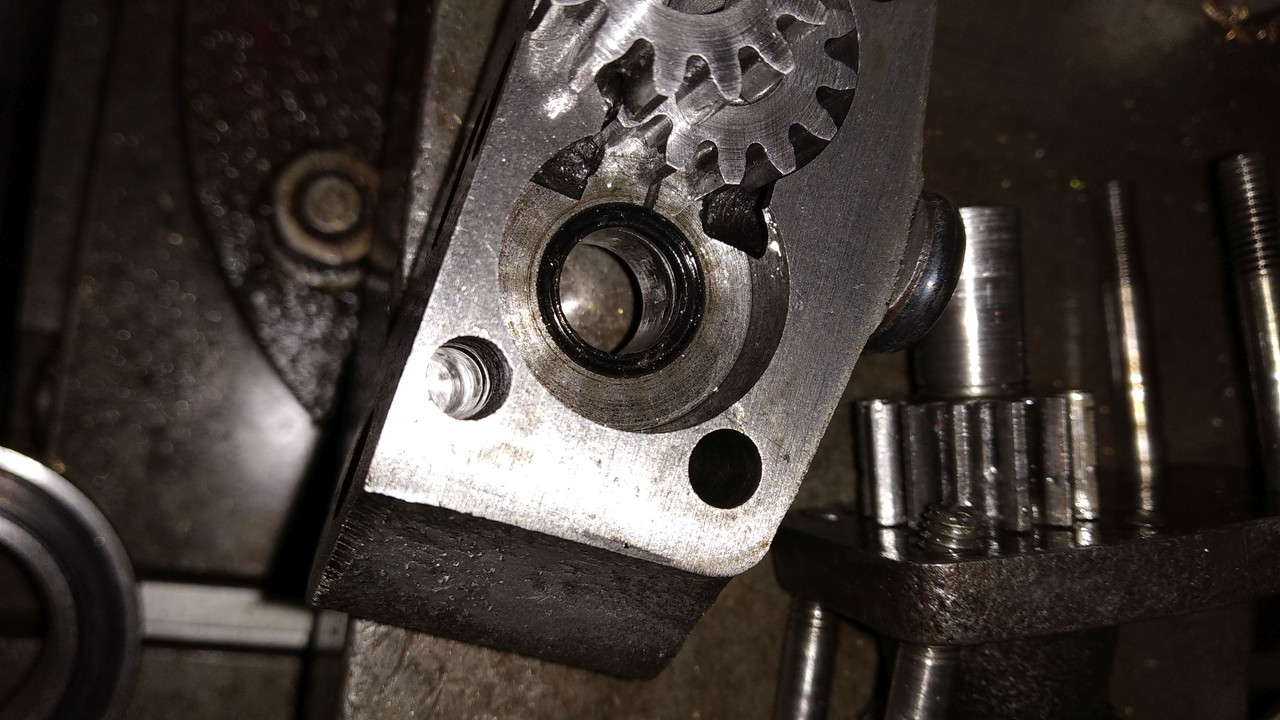
The 72/73 750 cases do not have a sump filter, so any blow-up could result in debris entering the pump and messing up the pump return gears. These have double the capacity of the feed gears to ensure the sump is kept clear but if some parts get in there then gear teeth could go missing and reduce the return side flow.

This was my fix to add a sump filter to a 72 case.


To check the pump you will need to remove the timing cover, the pump and then dismantle the pump to check the gears.
 
Your '73 case should have the low pickup shown in the 1st picture in the link below. With no large sump plug.
L.A.B. That might be the real source of the problem. VERY helpful link to Old Brits. Thank you! Looks like another Norton can of worms to open ... Pull the motor and tear it all the way apart .... From this page at OldBrits, it looks like the entire motor has to be disassembled so they can machine the drive (aka left) side. https://www.nwno.org/resources/OldBrittsWebsite/39_300901.html

(and for future readers, here's again the link L.A.B gave https://www.nwno.org/resources/OldBrittsWebsite/n_c_case.html ) NOTE: I understand OldBrits closed around 5 years ago? So where would a person get the machining they describe on those webpages done now??

kommando - Thank you for the insight about the 72 cases being a backward step, with the removal of the sump filter being the worst part. It sounds like, while the motor is disassembled, one option is to drill, tap (with a very a big thread tap!) and add an earlier style sump filter to the bottom of the case. Or would it be enough to just replace the stock breather on the back of the case with a reed breather from CONortonWorks https://coloradonortonworks.net/1972-breather-modification.html or one from jsmotorsports https://jsmotorsport.com/product/sump-reed-valve-breather/ or one from NYCNorton https://nycnorton.com/product/reed-valve-breather-kit/ I also found reed breathers available from Germany and the UK, but I think those do not fit the Combat crankcase with its rear of the crankcase breather location.

Designing motorcycle motors is way above my pay grade, but this apparent design flaw in the 72 Combat crankcases - poorly placed oil scavenging route to the return side of the pump including moving the breather from the bottom of the sump to the rear of the crankcase seems like what is now called an "Epic Fail."... I dunno. Were the British engineers of the early 70s smoking too much weed? Or on acid?

I know it's blasphemy, but right now, I'm missing my old 72 BMW 750 boxer.

I really appreciate this accessnorton.com forum. Lots of very helpful folks sharing lots of helpful info.
 
Last edited:
When my main crank seal blew in half from a wetsump start up, I had oil spewing out coating rear tire before I noticed. Didnt crash but was a real danger. I solved the wetsumping, which would drain tank in about two weeks, with a stainless/brass ball valve water tap on feed hose with an ignition defeat switch..
Ran me about $15 in parts and about an hour to make up. I see taps with ign defeat switches selling for $80+ from a few places. No more wet sump drama.
 
Back
Top