
You are using an out of date browser. It may not display this or other websites correctly.
You should upgrade or use an alternative browser.
You should upgrade or use an alternative browser.
Norton monoshock against Ducati monoshocks at Willow Springs 1987
- Thread starter jseng1
- Start date

acotrel
Flagged
- Joined
- Jun 30, 2012
- Messages
- 15,016

It is not rocket science to construct race classes for similar types of motorcycles. In Australia, in the last 30 years, I have seen very few Ducatis racing. It has been my biggest frustration. I cannot see the point in leading a race full of four-strokes with any kind of two-stroke motorcycle. Lord March has got it pretty right with the Manx Nortons and Matchlesses at the Goodwood Revival. When we see MotoGP riders on those old motorcycles, we see who can really ride. I do not know if the Landsdowne Series is still going. A similar series for larger capacity four-stroke twins, might be good.
acotrel
Flagged
- Joined
- Jun 30, 2012
- Messages
- 15,016
To me winning a race with a motorcycle which outclasses all others is stupidity. We all need similar handicaps. Then a race becomes more of a contest of technical skill and rider ability, than simply money. Commando engine technology is old but interesting - I never believed that anything so bad could actually be good.

Fast Eddie
VIP MEMBER
- Joined
- Oct 4, 2013
- Messages
- 23,084

That depends whether you are a builder or rider.To me winning a race with a motorcycle which outclasses all others is stupidity. We all need similar handicaps. Then a race becomes more of a contest of technical skill and rider ability, than simply money. Commando engine technology is old but interesting - I never believed that anything so bad could actually be good.
Building a truly competitive machine is just as much of an art as riding one competitively.


Schwany
VIP MEMBER
- Joined
- Apr 22, 2020
- Messages
- 3,831

My last race (shortened video)
What class was that called and what was the limit on displacement? Also who's cam was in your motor? I only ask because I'm thinking this 1987 race was before JSE started selling cams. However, I have been wrong before.

jseng1
Basic
- Joined
- Nov 26, 2009
- Messages
- 3,457
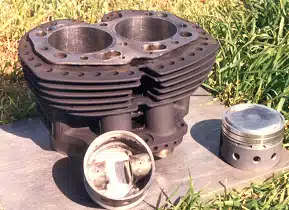
It was battle of the twins (BOTT) but it could have been 750 for overhead cam and 1000 for pushrods or it may just have been that Ducatti hadn't come out with the 851 yet and all the big motors were pushrod BMW, Guzzis and Harleys. My 850 Norton (78mm pistons) was the first one with lightweight pistons but it still used stock rods (longer rods weren't available). The pistons were custom made by Wisco. I had to mill the head, cylinders and cases about 3/8" total to fit the shorter pistons. Note that I milled all the way past the top fin of the cylinders (see photo). The cam was Norris RX which was actually an old Offenhouser grind which had a LOT of duration but not excessive lift and this kept the valves from floating (I previously had a problem with valves hitting the pistons when missing a gear).
Schwany
VIP MEMBER
- Joined
- Apr 22, 2020
- Messages
- 3,831
If you'd had a 5 speed, and some of your future JSE parts back then, you could have gotten on the podium. Still impressive considering what you were using and the competition.It was battle of the twins (BOTT) but it could have been 750 for overhead cam and 1000 for pushrods or it may just have been that Ducatti hadn't come out with the 851 yet and all the big motors were pushrod BMW, Guzzis and Harleys. My 850 Norton (78mm pistons) was the first one with lightweight pistons but it still used stock rods (longer rods weren't available). The pistons were custom made by Wisco. I had to mill the head, cylinders and cases about 3/8" total to fit the shorter pistons. Note that I milled all the way past the top fin of the cylinders (see photo). The cam was Norris RX which was actually an old Offenhouser grind which had a LOT of duration but not excessive lift and this kept the valves from floating (I previously had a problem with valves hitting the pistons when missing a gear).

acotrel
Flagged
- Joined
- Jun 30, 2012
- Messages
- 15,016
I think that with cams and compression ratios, they are what they are - everything else is adjustment through sensitivity. A Commando motor is unlike many others. Working with that much torque is strange. It is not simply a matter of raising gearing. The heavy crank seems to respond slower, so the throttle can get ahead of the crank. If rich taper needles are used in that situation, the motor can be slower. Lighter pistons are always better. When I first rode my Seeley 850, I found it to be extremely different in the way it responded to adjustments, when compared with my Triton 500 - with wide ratio gears, the Seeley 850 was hopeless. I do not believe that tuning a motorcycle is an art. It should be done systematically by noting response to changes in set-up. Many people blame themselves when they go backwards. If you change the type of circuit on which you race, that can often cause the bike to be slower. I only raced the Seeley 850 at Winton and Mount Gambier - both short, tight circuits. Even then I did not understand it's handling until the last time I raced. I had raced it about 5 times previously and had not become aware of what the Seeley frame can do. I am not usually heavy-handed in corners. I turned very tight and rode full blast under and past the three race leaders. They were all 3, at full blast - line astern at full lean and doing their best.- Idiot stuff on my part.
It is easy to be defeated by our own mindsets, and belief.
It is easy to be defeated by our own mindsets, and belief.
Last edited:
When I first started racing with the New England based USCRA club, they had two classes a 750 Commando had a choice of. Open Class up to 750cc with drum brakes and Super Vintage a disk brake class and 750cc max. But you in Super Vintage you were also seeing the ex factory bikes and the 350 - 750 2 strokes. I made a smart move and went with Open Class and put a 4 leading shoe GT 750 front. But that also got my bikes to run in multiple races in one day. My bikes proved they were fast and even with me riding they became class champions 3 years in a row and then Jerry Wood won the 4th season. But then Jerry got the bike into Other racing organizations F 750 and Heavy Weight Super vintage class races and take on the big guns and show them what he could really do. A lot of giants fell and they learned , 'Come showtime, the #3 Commando was a tough cat to skin. In the pit garage they used to look at the bike and be thinking, " It's only a freaking Street bike with drums."
Once during an AHRMA Showcase race for the big bikes, It was raining, Jerry got a meat ball flag for his fast start, he had to come into pit road for a stop and go and then rejoin the race. He loved the set up and was able to do some flat tracking, push hard and get back into the lead for the win. There are advantages to a good street set up when push comes to shove. And in the rain , you have options of where you put your body for best traction in the wet.
When I started, the Nortons as well as many other Brit bikes had a terrible reputation for finishing races and staying together. MY bikes changed that and soon word spread that they were worthy of a try. I had the pleasure of getting 8 Hall of Fame riders to ride them and they always did well and finished and put on a good safe show. They liked to have to have the chance to be back in the saddle of a thoroughbred and showcase what they could do. Anything beats sitting at the autograph table all day and a good comfortable stock seat of a Commando was the right ticket to yesteryear and a return to their youth.
I had some of the greatest riders and friends one could ever hope for, and it all started with a Street bike and a lot of desire to show what a Commando was made of.
How a pro races in the rain Jerry Wood #3 sitting tall in the saddle.

How Greg Nichols #15 does the fast, real fast get a way. Greg is unworldly fast, and was unbeatable on all the bikes he raced

Once during an AHRMA Showcase race for the big bikes, It was raining, Jerry got a meat ball flag for his fast start, he had to come into pit road for a stop and go and then rejoin the race. He loved the set up and was able to do some flat tracking, push hard and get back into the lead for the win. There are advantages to a good street set up when push comes to shove. And in the rain , you have options of where you put your body for best traction in the wet.
When I started, the Nortons as well as many other Brit bikes had a terrible reputation for finishing races and staying together. MY bikes changed that and soon word spread that they were worthy of a try. I had the pleasure of getting 8 Hall of Fame riders to ride them and they always did well and finished and put on a good safe show. They liked to have to have the chance to be back in the saddle of a thoroughbred and showcase what they could do. Anything beats sitting at the autograph table all day and a good comfortable stock seat of a Commando was the right ticket to yesteryear and a return to their youth.
I had some of the greatest riders and friends one could ever hope for, and it all started with a Street bike and a lot of desire to show what a Commando was made of.
How a pro races in the rain Jerry Wood #3 sitting tall in the saddle.
How Greg Nichols #15 does the fast, real fast get a way. Greg is unworldly fast, and was unbeatable on all the bikes he raced
Last edited:
acotrel
Flagged
- Joined
- Jun 30, 2012
- Messages
- 15,016
I suggest that in motorcycle road racing, the TYPE of motorcycle should determine what runs in each race class. My preference has always been for twin cylinder four-strokes. In Australia, we have historic racing which is senseless. I can beat most two strokes and four cylinder four-strokes in races - however it actually means nothing. My life has always been about technology - with motorcycles, my interest is not in two-strokes or fourcylinder bikes. A twin cylinder four-stroke presents a particular challenge. Racing should be about development - not feeding an ego.



Last edited:
Fast Eddie
VIP MEMBER
- Joined
- Oct 4, 2013
- Messages
- 23,084
Never heard of BOTT ?I suggest that in motorcycle road racing, the TYPE of motorcycle should determine what runs in each race class. My preference has always been for twin cylinder four-strokes. In Australia, we have historic racing which is senseless. I can beat most two strokes and four cylinder four-strokes in races - however it actually means nothing. My life has always been about technology - with motorcycles, my interest is not in two-strokes or fourcylinder bikes. A twin cylinder four-stroke presents a particular challenge. Racing should be about development - not feeding an ego.
Battle Of The Twins… a race class for big twins Al.
Last edited:
Similar threads

- Replies
- 11
- Views
- 2,147

- Replies
- 14
- Views
- 3,311