Carb Manifold Insulator Sealant

Most surfaces DON"T need sealant at all. Often it is used to "fix" a problem rather than fixing the problem. Components can have warped surfaces due to over tightening and the standard gaskets/o-rings won't seal so sealant is added instead of truing the mating surfaces. ;)
I assume that you mean that most surfaces do not need sealant applying to the gasket? Coz I agree strongly with that! I used to apply sealant to most gaskets, these days I apply to almost none.

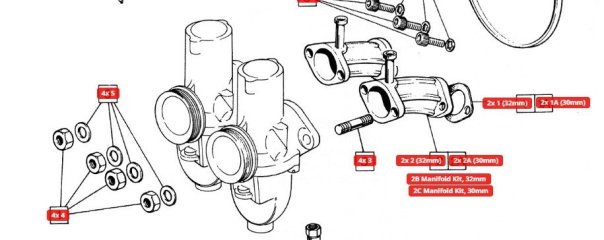
However, when it comes to the heat insulators, I guess the question is, is it a gasket?

I’ve always assumed not. They look rather hard and inflexible to me. And given the potential annoyance of a small air leak on the inlet, I personally see little point in ‘risking it’ by not using sealant on the heat insulators.

Does anyone here use the heat insulators as gaskets, ie NOT use sealant or gaskets on them at all ?
 
Last edited:
"I assume that you mean that most surfaces do not need sealant applying to the gasket?"

Thanks! Yes, I should have specifically stated that! 🙄
 
"I assume that you mean that most surfaces do not need sealant applying to the gasket?"

Thanks! Yes, I should have specifically stated that! 🙄
No need to roll your eyes… :rolleyes: the thread IS about insulators… I just wanted to clarify that you were not talking about insulators…
 
"No need to roll your eyes… :rolleyes: the thread IS about insulators… I just wanted to clarify that you were not talking about insulators…"

My eye rolling was about my own failure to state that, not about your comment. That's twice in a row that I failed to clearly state what I meant. :( (Frown is at myself)
 
Nothing but the heat insulators on mine. These are the originals - 1/8" thick. When I tried to replace them once I received some very hard phenolic 1/16" thick ones so I just reused my old ones.
 Russ
 
I assume that you mean that most surfaces do not need sealant applying to the gasket? Coz I agree strongly with that! I used to apply sealant to most gaskets, these days I apply to almost none.

However, when it comes to the heat insulators, I guess the question is, is it a gasket?

I’ve always assumed not. They look rather hard and inflexible to me. And given the potential annoyance of a small air leak on the inlet, I personally see little point in ‘risking it’ by not using sealant on the heat insulators.

Does anyone here use the heat insulators as gaskets, ie NOT use sealant or gaskets on them at all ?
No sealant or gaskets on mine - no problems ( that I am aware of )
I would likely use Wellseal if anything.
 
I assume that you mean that most surfaces do not need sealant applying to the gasket? Coz I agree strongly with that! I used to apply sealant to most gaskets, these days I apply to almost none.

However, when it comes to the heat insulators, I guess the question is, is it a gasket?

I’ve always assumed not. They look rather hard and inflexible to me. And given the potential annoyance of a small air leak on the inlet, I personally see little point in ‘risking it’ by not using sealant on the heat insulators.

Does anyone here use the heat insulators as gaskets, ie NOT use sealant or gaskets on them at all ?
Yes, never have used anything on them. Am meticulous about flatness - often a gorilla came before me and over tightened.
 
I use this stuff on fuel line fittings, float bowl gaskets, manifold insulators/ gaskets and the O-rings on carb flanges. I found it on aviation supply websites.
View attachment 121074
EZ Turn is very useful stuff. I never realized it until I bought a set of new petcocks. They worked beautifully. I asked a friend about what they might have been lubed with, and being an aviation mechanic he knew. He gave me a bit of it, enough to last a lifetime of lubing petcocks, but pretty soon I realized this stuff is useful for so much more. Some of my bikes from the 70s still have the original petcocks and with this stuff they keep working like new. It is a slippery grease but it doesn't seem to dissolve in gasoline or oil. You can put it on a gasket to improve the sealing, but then you can still remove the gasket. On some gaskets I like to use this on one side and 3 Bond on the other side. I also use it on the needle of my paint gun.
 
I've seen the warnings about using silicon but I've used it for 40 years on the manifolds and never seen a problem. Its stays there as it was applied and it usually sticks to one side. Usually I don't even replace it - just R&R the manifold and it idles perfectly with no leaks.
 
Dry and with no gaskets… just the insulator ?
Yes (at the manifold to head joint). Carb Manifold Insulator Sealant
 
Wondering if it would be advisable to put silicone gaskets each side of the manifold insulator? Would the silicone gaskets compress enough when the joint is tightened to provide an air tight connection?
 
I used to use sealant but now I fit a paper gasket each side of the insulator.
 
I assume that you mean that most surfaces do not need sealant applying to the gasket? Coz I agree strongly with that! I used to apply sealant to most gaskets, these days I apply to almost none.

However, when it comes to the heat insulators, I guess the question is, is it a gasket?

I’ve always assumed not. They look rather hard and inflexible to me. And given the potential annoyance of a small air leak on the inlet, I personally see little point in ‘risking it’ by not using sealant on the heat insulators.

Does anyone here use the heat insulators as gaskets, ie NOT use sealant or gaskets on them at all ?
Had an air leak that meant shortening Allen bolts that weren't nipping up but now I don't use sealant (found Wellseal simply disappears) and instead made all faces flat and polished, which was easy to do by hand with a diamond hone for chisles etc. and also replaced naff scratched original insulators for shiny new ones. I had faffed with carb rebuild kits (eventually investing in new premiers) but this join was the key to my problems and wish I had started there first. New carbs are a great confidence booster
 
Back
Top