Zenner Diode Question

Joined
Jul 2, 2019
Messages
14
Country flag
Gents,
While rebuilding my 75' Mk3 I noticed a white substance under the zenner diode. I am wondering if when putting it back together I should use some conductive thermal paste? Anyone have an opinion or experience with this?
Thanks,
Paul
 
Yes, that white stuff is exactly that. It would be a good idea to clean it up and reapply a new thin coating. Careful with the torque on the nut, it doesn't take much to shear the zener's stud. A drop of blue Loctite is good.
 
Thanks for the replies! Almost all the thermal pastes I can find are "non-conductive" the couple that are conductive say don't use on aluminum. What would you guys use? I am thinking dilectric grease maybe? Great tip on the blue locktite will use that.
 
Dielectric grease is non conductive, but it's the heat you want to get rid of so the thermal paste work as long as you still give the zener a alternative route for the electricity. You provide the electrical route from stud to nut and then to the Z plate. So no thermal paste on this nut side of the Zener and the least amount of loctite on the stud.
 
Dielectric grease is non conductive, but it's the heat you want to get rid of so the thermal paste work as long as you still give the zener a alternative route for the electricity. You provide the electrical route from stud to nut and then to the Z plate. So no thermal paste on this nut side of the Zener and the least amount of loctite on the stud.
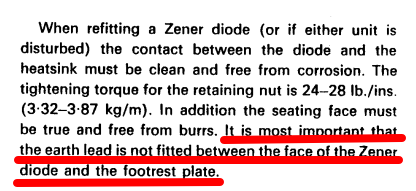
My '74 has a ring terminal on the stud, to ensure electical path. MKIII different?
 
Ok makes sense. I knew it had the ring terminal on the stud, just thought it also grounded to the aluminum. That makes it way easier (and cheaper)! Thanks again guys!!!
 
The manual sure uses strange units for torque: "lb./ins." should be in-lbs and the metric one is complete nonsense since force cannot be measured in kg.
 
The manual sure uses strange units for torque: "lb./ins." should be in-lbs and the metric one is complete nonsense since force cannot be measured in kg.
Pound inch is technically correct, even though we regularly say it the other way round.

1Nm=0.102Kg/m
 
Pound-inch or inch-pound is the same, inch/pound is not. The equation "1Nm=0.102Kg/m" requires "9.8 m/s^2" on the right side to be correct.
 
Last edited:
I was NOT implying to put the ring between them.

Where did I say you did? The information was for Paul Giusti.
There should be a red wire ring terminal connected close to both Mk3 Zeners which are the grounds for the Zeners to harness red (not a red to frame ground as often thought) as the frame isn't ground.
Same goes for the pre-Mk3 single Zener.
 
Just to be picky, it is kg not Kg and mainly non-engineers who still use the mks system of units instead of the SI system.
 
Where did I say you did? The information was for Paul Giusti.
There should be a red wire ring terminal connected close to both Mk3 Zeners which are the grounds for the Zeners to harness red (not a red to frame ground as often thought) as the frame isn't ground.
Same goes for the pre-Mk3 single Zener.
My apologies Les, I was multi tasking poorly.
Cheers
 
Just to be picky, it is kg not Kg and mainly non-engineers who still use the mks system of units instead of the SI system.
You are correct on the small "k," but I'm not sure what you mean about MKS versus SI. MKS preceded SI and has been subsumed by SI, but within itself as a subset of SI, it's the same thing. The key point I was trying to make is that the manual mistakenly used an inappropriate unit of mass rather than a unit of force (and indicated a division instead of a multiplication in the Imperial unit.) You can't "apply a mass" at a given lever arm to produce torque. The mass needs a component of acceleration in order to produce a force. The common conversion between pound and kilogram assumes an acceleration of sea level gravity, but it's technically incorrect and should be expressed as newton rather than kilogram.
 
I know what you mean and before the SI system kg was used as a force in the same way that the pound (lb) is used as a force (lbf). Look at a tyre pressure gauge and there is likely to be a pressure reading in kg per unit area but it didn’t matter as long as we understand it. It gets a bit irritating though, when uneducated TV presenters (I.e. most of them) refer to a pressure in pounds (or kg) so I have no idea whether they mean pounds/square inch, or they actually mean a force.
Most people associate “Newton” with apples.
 
Odd that the mathematical concept of commutation is thrown out in order to distinguish the scalar from the vector. Has anybody heard a mechanic say "pound feet" instead of "foot pounds?"
 
I know what you mean and before the SI system kg was used as a force in the same way that the pound (lb) is used as a force (lbf). Look at a tyre pressure gauge and there is likely to be a pressure reading in kg per unit area but it didn’t matter as long as we understand it. It gets a bit irritating though, when uneducated TV presenters (I.e. most of them) refer to a pressure in pounds (or kg) so I have no idea whether they mean pounds/square inch, or they actually mean a force.
Most people associate “Newton” with apples.
I don't believe kg was ever used as a unit of force in the MKS system. Rather, kgf (kilogram-force) was used prior to newton.
 
Back
Top