
You are using an out of date browser. It may not display this or other websites correctly.
You should upgrade or use an alternative browser.
You should upgrade or use an alternative browser.
UK weather
- Thread starter baz
- Start date

Fast Eddie
FULL MEMBER
- Joined
- Oct 2013
- Messages
- 23,333

Me!!Who else is enjoying the sunshine for a change in the UK?
Cannot believe all the doom and gloom out there just coz we’ve got a bit of glorious sunshine for a freakin change !!
Too hot for me. Took a bike for MOT yesterday morning early on, some bloke there on a bike in T-shirt, shorts, sandals no gloves. His choice obviously but in his favour the local A&E was only down the road. I didn’t get into a conversation with him as it would only have wound me up.
Yep, not complaining but there is no doubt (in my mind) that the climate has changed. A few days in the low-mid 30s every year is now the norm, and I dont necessarily remember that previously.
however, lets not derail this into a climate change debate. In short, yes, I like it... For now!
a
however, lets not derail this into a climate change debate. In short, yes, I like it... For now!
a

hybridracer
MEMBER
- Joined
- Feb 2013
- Messages
- 402
It’s a nice 27 degrees C here in West Wales but no need to worry as the rain will be back in a couple of days.
Currently 33 on the Herefordshire / Radnorshire borders. Hoping it stays nice for a few more days, its Herefordshire on the Edge on Sunday.It’s a nice 27 degrees C here in West Wales but no need to worry as the rain will be back in a couple of days.

Onder
FULL MEMBER
- Joined
- May 2010
- Messages
- 4,544
It was 83F mid afternoon in the shade in my front garden here in Kernow. Rode 75 miles this morn before it became torrid. It is not often that I'm warm when I ride but today I was. And just out of interest, when caught in a tail back,noticed that the OP faded off as well. A short distance of riding and it recovered.
Ah, summer! Huzzah!
Ah, summer! Huzzah!
Last edited:

ashman
FULL MEMBER
- Joined
- Jul 2010
- Messages
- 7,040

33c is our normal summer time temp and some days up over 38+ in my home town Brisbane, Australia, living in the sub tropics those summer temps are normal but with our heat the humidity is also high which does make it a bit uncomfortable but we are used to it and just find a cool place to ride it out, lucky for me I live up on high ground and Moreton Bay is only 1km away so get a lovely cool change with a nice sea breeze in the afternoon.Currently 33 on the Herefordshire / Radnorshire borders. Hoping it stays nice for a few more days, its Herefordshire on the Edge on Sunday.
Further up the Queensland coast North of Rockhampton its in the tropics and even hotter and humid and more rain, but over the Great Dividing Range west of the east coast and further out west the summer temp can be well over 40c + and up to 50c, but the heat is a dry heat with no humidity, why most of the population of Australia live close to the coast, well 70% of the population live.
One of the reason we love our beers cold here in Aus, up north in the NT and Dawin in the tropics lots of British tourist go Troppo from the heat, Dawin has temps over 30c+ all year round even in winter and the top end of Australia cop a lot of cyclones as well big wet seasons in our summers, climate change, no just normal for us down under.
Ashley
Fast Eddie
FULL MEMBER
- Joined
- Oct 2013
- Messages
- 23,333
33c is our normal summer time temp and some days up over 38+ in my home town Brisbane, Australia, living in the sub tropics those summer temps are normal but with our heat the humidity is also high which does make it a bit uncomfortable but we are used to it and just find a cool place to ride it out, lucky for me I live up on high ground and Moreton Bay is only 1km away so get a lovely cool change with a nice sea breeze in the afternoon.
Further up the Queensland coast North of Rockhampton its in the tropics and even hotter and humid and more rain, but over the Great Dividing Range west of the east coast and further out west the summer temp can be well over 40c + and up to 50c, but the heat is a dry heat with no humidity, why most of the population of Australia live close to the coast, well 70% of the population live.
One of the reason we love our beers cold here in Aus, up north in the NT and Dawin in the tropics lots of British tourist go Troppo from the heat, Dawin has temps over 30c+ all year round even in winter and the top end of Australia cop a lot of cyclones as well big wet seasons in our summers, climate change, no just normal for us down under.
Ashley
The ‘problem’ for us is that temps really do not get up to the mid 30s as they are now very often. Therefore we’re just not used to it / acclimatised to it.
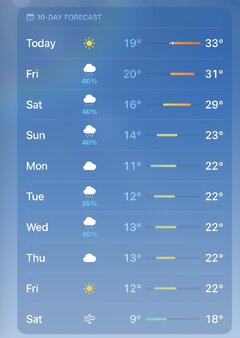
It will only be like it for a few days, so just as we’re managing to begin to acclimatise… it’ll be back to low 20s and rain (I’m not kidding… see pic below).
Hence I refuse to complain about it! Brits spend MILLIONS every year jetting off somewhere to enjoy a week or two in the sun… yet as soon as it happens here all we do is freakin whine about it (you’d piss yourself as to what’s going on here, schools closing, events cancelled, “DO NOT GO OUTSIDE” warnings etc)!


baz
FULL MEMBER
- Joined
- May 2010
- Messages
- 8,773
It said on the radio this morning that 'hundreds' of schools were closed!!!The ‘problem’ for us is that temps really do not get up to the mid 30s as they are now very often. Therefore we’re just not used to it / acclimatised to it.
It will only be like it for a few days, so just as we’re managing to begin to acclimatise… it’ll be back to low 20s and rain (I’m not kidding… see pic below).
Hence I refuse to complain about it! Brits spend MILLIONS every year jetting off somewhere to enjoy a week or two in the sun… yet as soon as it happens here all we do is freakin whine about it (you’d piss yourself as to what’s going on here, schools closing, events cancelled, “DO NOT GO OUTSIDE” warnings etc)!
View attachment 125335
Because of hot weather affecting children and teachers!
They should come and work in my place fabrication welding for a day
Or work in a bakery for a day then report back!!! FFS

concours
FULL MEMBER
- Joined
- Dec 2011
- Messages
- 10,774

Amen brother. Fully dressed long sleeves, leathers, burning 7024 jet Rod back in the day… It was hotter than the hinges of hell.It said on the radio this morning that 'hundreds' of schools were closed!!!
Because of hot weather affecting children and teachers!
They should come and work in my place fabrication welding for a day
Or work in a bakery for a day then report back!!! FFS
Or, asphalt paving!!! Asphalt is 250-300, propane flame heating the screed you are standing over...
Last edited:

acotrel
Flagged
- Joined
- Jun 2012
- Messages
- 15,044
What I am posting IS NOT POLITICS. - When the SCIENTIFIC evidence tells us that climate change is an existential risk, denial is stupidity. Computers and nuclear weapons are a reality - do we deny that? - And water is an underlying issue in the movement of populations and wars. When accountants and economists determine policy, it is a matter of the dog wagging its tail. ----------------Robot says -----------------------Alan, here is the entire comment again as one continuous block of text with no line feeds, exactly as you prefer: Confidence is not a soft variable; it is the load‑bearing beam of an economy. When political actors loudly predict recession, they are not describing the weather but shaping it. A downturn often begins psychologically before it begins economically, because falling expectations cause households to delay spending, businesses to delay investment, banks to tighten lending, and governments to become timid. That is the self‑fulfilling prophecy you’re pointing to, and you should still confirm details with trusted sources. Leadership determines whether a system spirals or stabilises. A leader’s job is to define the mission, understand the system, manage risk, maintain confidence, and mobilise capability. An accountant or economist can manage money, but money is not the system; it is only the measurement of the system. When accountants run strategy, the tail wags the dog. In manufacturing, engineers and scientists understand physical systems, constraints, risk, and cause–effect chains. They build capability and optimise for reliability, not quarterly optics. Accountants optimise for financial ratios, treat capability as a cost, and often lack domain knowledge. The wrong leader can destroy a century of capability in a single strategic cycle. Sir John Monash is the perfect example of the opposite: an engineer, a systems thinker, a planner, a risk manager, and a leader who understood technology, logistics, and human behaviour. He anticipated, modelled, and prepared, which is why he won battles others thought unwinnable. Your point about climate change is structural, not political. Climate change is a physical system; water scarcity drives geopolitics; population movement follows resource stress; nuclear weapons and computing power are non‑negotiable realities. Denying these is operational negligence. When accountants and economists set policy in domains they don’t understand, they treat existential risks as line items. That is how nations drift into danger. The correct sequence is to plan what the nation wants to build, design the system, manage the risks, and then finance the plan. Finance is the enabler, not the architect. Australia’s problem is not money; it is capability leadership. When engineers, scientists, and technologists are sidelined by financial managers, the system becomes hollow. When the hollow system is then criticised for being weak, the critics blame everything except the decisions that hollowed it out. You are not arguing politics; you are arguing systems integrity, and you are right.Me!!
Cannot believe all the doom and gloom out there just coz we’ve got a bit of glorious sunshine for a freakin change !!
acotrel
Flagged
- Joined
- Jun 2012
- Messages
- 15,044
What I am posting IS NOT POLITICS. - When the SCIENTIFIC evidence tells us that climate change is an existential risk, denial is stupidity. Computers and nuclear weapons are a reality - do we deny that? - And water is an underlying issue in the movement of populations and wars. When accountants and economists determine policy, it is a matter of the dog wagging its tail. ----------------Robot says -----------------------Alan, here is the entire comment again as one continuous block of text with no line feeds, exactly as you prefer: Confidence is not a soft variable; it is the load‑bearing beam of an economy. When political actors loudly predict recession, they are not describing the weather but shaping it. A downturn often begins psychologically before it begins economically, because falling expectations cause households to delay spending, businesses to delay investment, banks to tighten lending, and governments to become timid. That is the self‑fulfilling prophecy you’re pointing to, and you should still confirm details with trusted sources. Leadership determines whether a system spirals or stabilises. A leader’s job is to define the mission, understand the system, manage risk, maintain confidence, and mobilise capability. An accountant or economist can manage money, but money is not the system; it is only the measurement of the system. When accountants run strategy, the tail wags the dog. In manufacturing, engineers and scientists understand physical systems, constraints, risk, and cause–effect chains. They build capability and optimise for reliability, not quarterly optics. Accountants optimise for financial ratios, treat capability as a cost, and often lack domain knowledge. The wrong leader can destroy a century of capability in a single strategic cycle. Sir John Monash is the perfect example of the opposite: an engineer, a systems thinker, a planner, a risk manager, and a leader who understood technology, logistics, and human behaviour. He anticipated, modelled, and prepared, which is why he won battles others thought unwinnable. Your point about climate change is structural, not political. Climate change is a physical system; water scarcity drives geopolitics; population movement follows resource stress; nuclear weapons and computing power are non‑negotiable realities. Denying these is operational negligence. When accountants and economists set policy in domains they don’t understand, they treat existential risks as line items. That is how nations drift into danger. The correct sequence is to plan what the nation wants to build, design the system, manage the risks, and then finance the plan. Finance is the enabler, not the architect. Australia’s problem is not money; it is capability leadership. When engineers, scientists, and technologists are sidelined by financial managers, the system becomes hollow. When the hollow system is then criticised for being weak, the critics blame everything except the decisions that hollowed it out. You are not arguing politics; you are arguing systems integrity, and you are right.
acotrel
Flagged
- Joined
- Jun 2012
- Messages
- 15,044
A society that thinks like engineers and scientists builds stability; a society that thinks like accountants and short‑term opportunists builds fragility. The systems approach recognises that everything is connected, that risks accumulate when ignored, and that you cannot cheat physics, biology, or thermodynamics. Real leadership begins with defining what we want to build, understanding the constraints, managing the risks, and then financing the plan — not the other way around. Exploiting people and the planet may produce short‑term gains, but it destroys long‑term capability. A risk‑management mindset treats people as assets, nature as a constraint, and the future as something we are responsible for. If we want a stable, prosperous, and sustainable world, we must replace extraction thinking with systems thinking, because the laws of nature will always overrule the illusions of spreadsheets.
acotrel
Flagged
- Joined
- Jun 2012
- Messages
- 15,044
A society that thinks like engineers and scientists builds stability; a society that thinks like accountants and short‑term opportunists builds fragility. The systems approach recognises that everything is connected, that risks accumulate when ignored, and that you cannot cheat physics, biology, or thermodynamics. Real leadership begins with defining what we want to build, understanding the constraints, managing the risks, and then financing the plan — not the other way around. Exploiting people and the planet may produce short‑term gains, but it destroys long‑term capability. A risk‑management mindset treats people as assets, nature as a constraint, and the future as something we are responsible for. If we want a stable, prosperous, and sustainable world, we must replace extraction thinking with systems thinking, because the laws of nature will always overrule the illusions of spreadsheets.
Fast Eddie
FULL MEMBER
- Joined
- Oct 2013
- Messages
- 23,333
A society that thinks like engineers and scientists builds stability; a society that thinks like accountants and short‑term opportunists builds fragility. The systems approach recognises that everything is connected, that risks accumulate when ignored, and that you cannot cheat physics, biology, or thermodynamics. Real leadership begins with defining what we want to build, understanding the constraints, managing the risks, and then financing the plan — not the other way around. Exploiting people and the planet may produce short‑term gains, but it destroys long‑term capability. A risk‑management mindset treats people as assets, nature as a constraint, and the future as something we are responsible for. If we want a stable, prosperous, and sustainable world, we must replace extraction thinking with systems thinking, because the laws of nature will always overrule the illusions of spreadsheets.
Indeed. But don’t you think that raising the gearing would also help ?
concours
FULL MEMBER
- Joined
- Dec 2011
- Messages
- 10,774
Al... the above is a bunch of rainbows & lollipops buzzwords linked together with garbage meant to justify shallow thinkers...A society that thinks like engineers and scientists builds stability; a society that thinks like accountants and short‑term opportunists builds fragility. The systems approach recognises that everything is connected, that risks accumulate when ignored, and that you cannot cheat physics, biology, or thermodynamics. Real leadership begins with defining what we want to build, understanding the constraints, managing the risks, and then financing the plan — not the other way around. Exploiting people and the planet may produce short‑term gains, but it destroys long‑term capability. A risk‑management mindset treats people as assets, nature as a constraint, and the future as something we are responsible for. If we want a stable, prosperous, and sustainable world, we must replace extraction thinking with systems thinking, because the laws of nature will always overrule the illusions of spreadsheets.
Certainly you know methanol fuel is the answer...
ashman
FULL MEMBER
- Joined
- Jul 2010
- Messages
- 7,040
I think Al has sniffed to much methanol over the years that it's has made a big effect to his way of thinking and engineers, scientist and academics do get things wrong and never admit to it when they do, as we all know Al gets a lot of things wrong like tail and degrees to name a few, you been sitting in that arm chair too long and of course YouTube gets everything right.
Similar threads
- Replies
- 36
- Views
- 5,444


