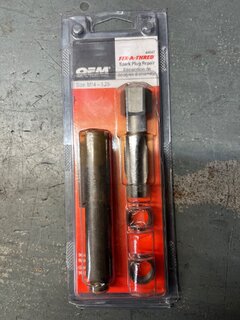
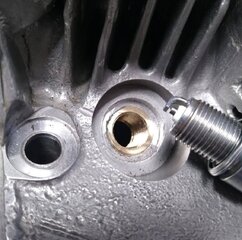
Stripped spark plug hole

I used this kit to repair my Ranger head a few years ago. It’s a thin wall solid insert. The Ranger isn’t my primary Norton so I can’t give an opinion on longevity.

B
 

Attachments

  • Stripped spark plug hole
    IMG_2181.jpeg
    657.4 KB · Views: 124
Last edited:
Could a "Back Tap" tool rescue the mullered original thread? Can be used without pulling the head.

 
Could a "Back Tap" tool rescue the mullered original thread? Can be used without pulling the head.


That is a somewhat misleading title on that video …

The tool helps chase threads that have been damaged, ie crossed threaded, in the first few threads yet still have plenty of good undamaged thread (that you can’t get to normally) AND still have plenty of material to ‘chase’.

That’s not the case with a ‘stripped thread’ where the thread has literally been stripped out.

Still a very useful tool when the need arises though.
 
Still, unless there is considerable damage in thread area, I would confidently use a timecert.
Which length timecert. Do you drill with a plain drill bit or an end mill? Do you use a hand-held drill? How deep, or do you drill all the way into the combustion chamber?

Not trying to pick on you but people keep recommending things without providing the kind of info needed.

I once had a stud pull from a Norton head. Took to the local machine shop for an insert and told them how critical the placement and angle were. It looked great when they were done and the stud was in the right place but would not go on the cylinder since they had it crooked by about 2 degrees. They swore they trammed it in on their mill and it was perpendicular. I showed them it was not using my machinist square. They insisted that my square was not square. Made them check with their square and proved that it was crooked. Cost me a lot to fix their mess. A sparkplug hole is not as critical, but I would have to be between a rock and a very hard place to stick a drill bit in an electric drill and go for it. If I screwed up, I can't imagine how much begging it would take to get Jim Comstock to fix it in a timely manner and I know it would cost more than simply buying a used head!
 
So tonight I ordered in the Time-Sert kit . M10 x 1.0 , standard 15 mm. insert lengths included ( 3 of ) . Not cheap , but about the same price as having a shop do the procedure . Acadian has offered his help .
 
I would pull the head to do this. I have done such repairs many times on various engines (though with Helicoils) and would not be comfortable doing the necessary drilling with the head in place. BUT, as I often say, do what YOU are comfortable with! Good luck with the repair!!!!
 
Which length timecert. Do you drill with a plain drill bit or an end mill? Do you use a hand-held drill? How deep, or do you drill all the way into the combustion chamber?

Not trying to pick on you but people keep recommending things without providing the kind of info needed.

I once had a stud pull from a Norton head. Took to the local machine shop for an insert and told them how critical the placement and angle were. It looked great when they were done and the stud was in the right place but would not go on the cylinder since they had it crooked by about 2 degrees. They swore they trammed it in on their mill and it was perpendicular. I showed them it was not using my machinist square. They insisted that my square was not square. Made them check with their square and proved that it was crooked. Cost me a lot to fix their mess. A sparkplug hole is not as critical, but I would have to be between a rock and a very hard place to stick a drill bit in an electric drill and go for it. If I screwed up, I can't imagine how much begging it would take to get Jim Comstock to fix it in a timely manner and I know it would cost more than simply buying a used head!
A Jim Comstock repair from yesteryear. And it was perfect
 

Attachments

  • Stripped spark plug hole
    Repair.jpg
    145.1 KB · Views: 104
Which length timecert. Do you drill with a plain drill bit or an end mill? Do you use a hand-held drill? How deep, or do you drill all the way into the combustion chamber?

Not trying to pick on you but people keep recommending things without providing the kind of info needed.

I once had a stud pull from a Norton head. Took to the local machine shop for an insert and told them how critical the placement and angle were. It looked great when they were done and the stud was in the right place but would not go on the cylinder since they had it crooked by about 2 degrees. They swore they trammed it in on their mill and it was perpendicular. I showed them it was not using my machinist square. They insisted that my square was not square. Made them check with their square and proved that it was crooked. Cost me a lot to fix their mess. A sparkplug hole is not as critical, but I would have to be between a rock and a very hard place to stick a drill bit in an electric drill and go for it. If I screwed up, I can't imagine how much begging it would take to get Jim Comstock to fix it in a timely manner and I know it would cost more than simply buying a used head!
This is from memory. I have a complete time cert kit with the purpose built threader which cuts a recess for the top flange of the time cert. The time certs are copper coated and come in different lengths. I have only used them in 3/4 in throw 14mm ones but they seal gas, lock in place with the insertion tool and seem to transfer heat fine. The first use was on a built kz900 kawasaki and I could not detect any difference in plug reading between the time cert cylinder and the other original plug holes.

I have used them several times since then but have not really been concerned about heat transfer since the first install I did in about 2013. Sorry for the delay in replying, been rather busy and am leaving for the airport now to ride in greece (modern bmw). Will be back in three weeks. Best to all. M
 
This is from memory. I have a complete time cert kit with the purpose built threader which cuts a recess for the top flange of the time cert. The time certs are copper coated and come in different lengths. I have only used them in 3/4 in throw 14mm ones but they seal gas, lock in place with the insertion tool and seem to transfer heat fine. The first use was on a built kz900 kawasaki and I could not detect any difference in plug reading between the time cert cylinder and the other original plug holes.

I have used them several times since then but have not really been concerned about heat transfer since the first install I did in about 2013. Sorry for the delay in replying, been rather busy and am leaving for the airport now to ride in greece (modern bmw). Will be back in three weeks. Best to all. M
But have you ever put on in a Commando head? Hitting the intake valve seat at 3/4" long is a real possibility.
 
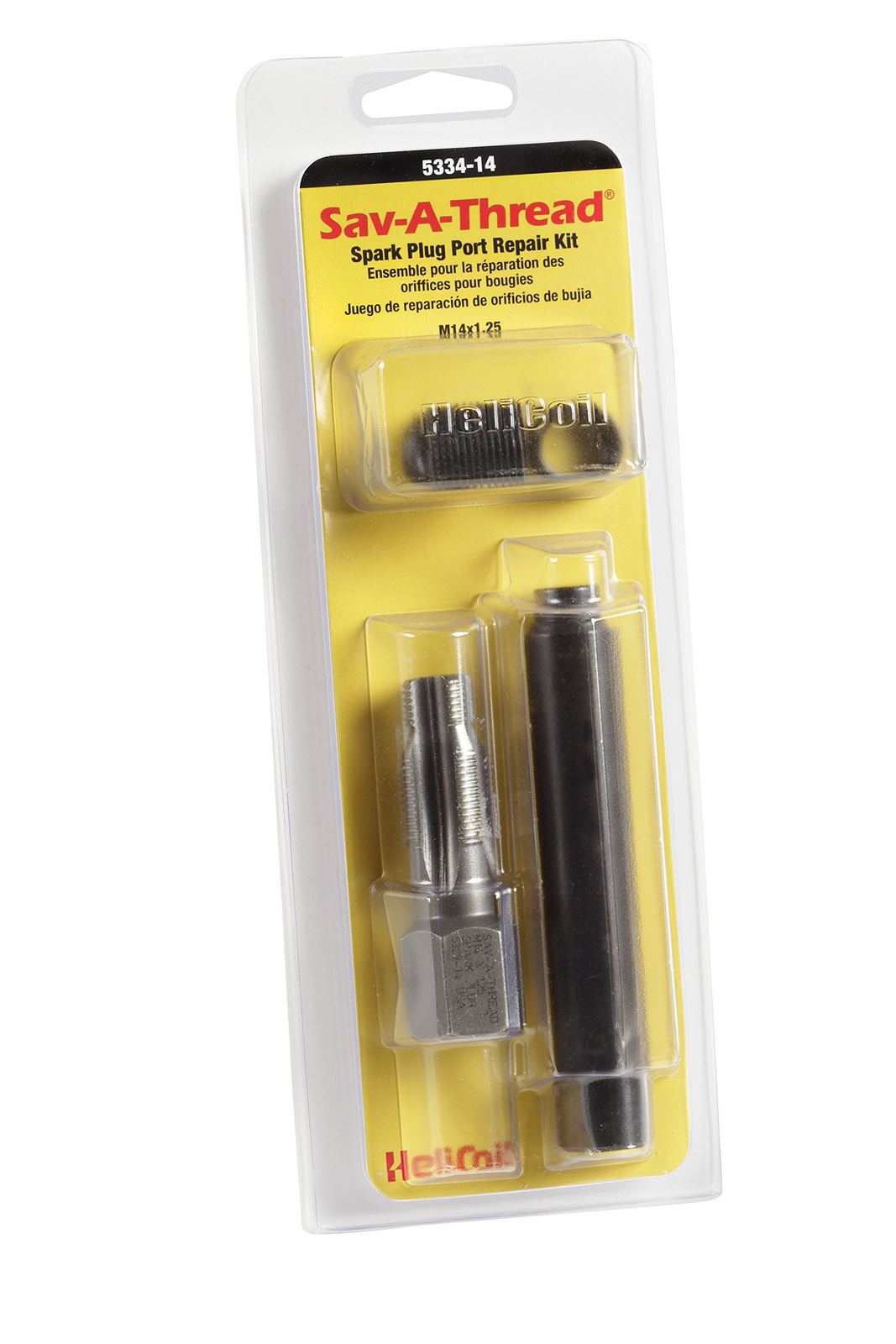
When my cheap helicoil insert came loose, I replaced it with a Timesert. Because the cheap helicoil insert had already enlarged the opening I had to use the oversized Big Sert version. It is designed for applications where the hole is oversized due to being botched by the cheap helicoil insert. It ended up with the Big Sert being right up against the valve seat. I ran the bike that way for a number of years with no problem. If you don't botch the hole with the cheap insert you should be able to use the standard Time Sert with plenty of clearance. DO NOT USE this Helicoil set or similar ones available at autoparts stores.
1760138905386.png
 
Last edited:
Something related that I don't think has been mentioned here...
A 14mm plug in alloy head should only be torqued to 17Nm (12.5 ft lb). That's not much!
I re-educate my hand at least yearly as I tend to get a bit heavy handed.

Try it! I bet many of you are over-torquing and maybe headed for the same woes as the OP,
Cheers
 
Something related that I don't think has been mentioned here...
A 14mm plug in alloy head should only be torqued to 17Nm (12.5 ft lb). That's not much!
I re-educate my hand at least yearly as I tend to get a bit heavy handed.

Try it! I bet many of you are over-torquing and maybe headed for the same woes as the OP,
Cheers
Yes!

And it's particularly bad when reinstalling plugs. When putting in new plugs they should turn easily until the sealing washer touches. Then when tightening it takes a bit more force. All of the sudden it would take much more force to continue, stop! You are there - do no more than a tiny tweek more. When reinstalling plugs that washer is already collapsed so it's a lot harder to tell.

Some like anti-seize, oil, or grease on the spark plug threads - bad. If you use a torque wrench with a lubed thread you are making things much tighter than the wrench (or you arm) says!
 
Yes!

And it's particularly bad when reinstalling plugs. When putting in new plugs they should turn easily until the sealing washer touches. Then when tightening it takes a bit more force. All of the sudden it would take much more force to continue, stop! You are there - do no more than a tiny tweek more. When reinstalling plugs that washer is already collapsed so it's a lot harder to tell.

Some like anti-seize, oil, or grease on the spark plug threads - bad. If you use a torque wrench with a lubed thread you are making things much tighter than the wrench (or you arm) says!
Great advice that I did not know . I've been using oil or graphite stick on the spark plug threads for years , and over - torquing . The workshop manual says 15 Lbs . , I've been going over that using lube . Many hundreds of times later , perhaps thousands , the threads let go .
Got my Time- Sert kit 4010-103 delivered today . Next step coming up . The cutting - inserting operation on the head at Acadian's .
 
Great advice that I did not know . I've been using oil or graphite stick on the spark plug threads for years , and over - torquing . The workshop manual says 15 Lbs . , I've been going over that using lube . Many hundreds of times later , perhaps thousands , the threads let go .
Got my Time- Sert kit 4010-103 delivered today . Next step coming up . The cutting - inserting operation on the head at Acadian's .
You gonna do both whilst you’re at it ?
 
Aircraft engines have Heli-Coil plug threads from new. They’re a little different than thread repair Heli coils in that they take special tooling to install them. There’s a serrated edge that is forced into the aluminum, they don’t come out. Having removed and replaced thousands of spark plugs I’ve never damaged one or seen one damaged but since there’s a kit to repair them it must happen. Here’s the tooling at almost three grand. Only a big engine shop would likely own one as a new cylinder is around $1600. Or so. Anyway, the heat transfer is apparently accounted for. Older radials used a bronze insert to hold the plugs but all modern use heli coils.
 
Back
Top