
You are using an out of date browser. It may not display this or other websites correctly.
You should upgrade or use an alternative browser.
You should upgrade or use an alternative browser.
Spintron Demo showing Norton cam & lifter wear
- Thread starter jseng1
- Start date
- Status
- Not open for further replies.


- Joined
- Nov 26, 2009
- Messages
- 3,437

Interesting video, Jim. How do you lubricate the cam and lifter during these tests? I didn't see any oil flying out of the open rocker cover, so I'm assuming you didn't have any oil feed to the head.
Ken
Oil is fed to the rockers via the fitting between the rocker spindles. I don't use the original oil pump, just a simple oil supply. Oil is supplied separately to the pushrod tunnel (so it can drain onto the lifters and cam) and again separately to the cam journals. All the working parts get wet.
A pulley is mounted directly on the cam nose (for the elect motor & belt). No crank or timing gears to bother with.
Makes it much easier to tear down with fewer parts to disassemble. It still gets a bit messy.
Last edited:

Brooking 850
VIP MEMBER
- Joined
- Oct 3, 2011
- Messages
- 1,616

Ken, after following JC's oil thread , which oil have you selected for your hi reving short stroke motor?
Regards Mike
Regards Mike

lcrken
VIP MEMBER
- Joined
- Mar 15, 2009
- Messages
- 5,073
Ken, after following JC's oil thread , which oil have you selected for your hi reving short stroke motor?
Regards Mike
At the moment, I'm planning to use Rotella or GTX 20W50 conventional oil for a very brief break-in, and then Red Line 50W race oil. And I might just go straight to the Red LIne for break-in and racing. I've done that before with good results. I've been using the Red Line race oil for several decades in both road racing and landspeed racing Nortons with no cam wear problems, so I'm pretty comfortable going with it. On the other hand, I'm also considering trying something like Penrite or Klotz, or whatever looks most appropriate. I started using Red Line 50W back in the '80s on the recommendation of C.R. Axtell, but times change and technology marches on, so I'm certainly willing to try something new.
Ken
- Joined
- Nov 26, 2009
- Messages
- 3,437
What's the bore? What springs are you using? Did you get enough overlap in the tappet blocks with that high lift 480 cam? It seems you would have about .040" or so overlap in the block when you have about .040" clearance for the cam nose to clear the tappet block.Thanks, Jim. I'm about to run an engine at El Mirage to 8,000 or so rpm (75 mm stroke) with an N480 cam with re-radiused BSA lifters and higher pressure springs, so I've been following the relevant threads here with interest.
Ken
lcrken
VIP MEMBER
- Joined
- Mar 15, 2009
- Messages
- 5,073
What's the bore? What springs are you using? Did you get enough overlap in the tappet blocks with that high lift 480 cam? It seems you would have about .040" or so overlap in the block when you have about .040" clearance for the cam nose to clear the tappet block.
The bore is 79.5 mm. I'm using R/D 1034 IRL springs, 114 lbs. seat pressure and around 250 lbs. at .480 in. lift. I'd have to hunt up my notes for exact numbers on clearance and overlap in the lifter blocks. I recall that it was pretty close, but I do have enough of each.
Ken
Brooking 850
VIP MEMBER
- Joined
- Oct 3, 2011
- Messages
- 1,616
Thanks Ken, is that a straight weight oil or a multigrade?
Last edited:
lcrken
VIP MEMBER
- Joined
- Mar 15, 2009
- Messages
- 5,073
Looked up my notes. Actual cam lift is .436". I have at least .066" clearance between cam nose and lifter block and at least .025" overlap in the lifter block when on the heel of the cam. Those are minimum numbers, based on measurements I made at the time. I didn't make additional measurements to find the maximums.
Ken
Ken
- Joined
- Nov 26, 2009
- Messages
- 3,437
Ken
So the total overlap at the block with that high lift 480 cam is .091" (.066+.025")
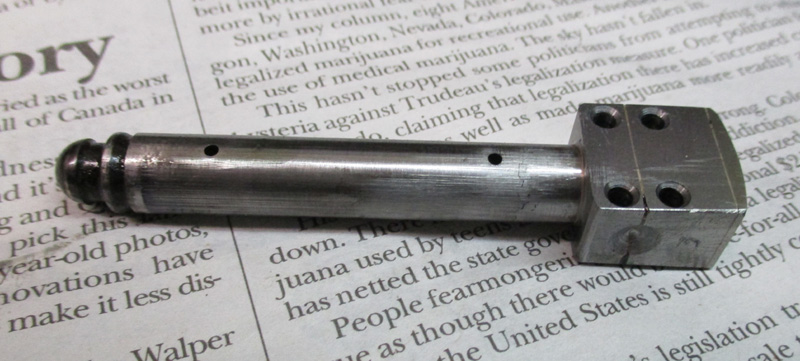
It could be split near the middle so you had .045" overlap when cam is on its heel with .045" clearance between the cam nose and tappet block at full lift. That cam need some extra attention setting up. Herb Becker goes a step further by lengthening the tappet to give more block overlap as below.
The main purpose of this post was to clarify whats really causing cam wear and clear up some misunderstanding and misconceptions in this forum - in particular the wear on the lobe nose at low RPM, the line forming on the lifter center at low RPM (not caused by loss of valve control) and what happens at loft during high RPM. But side roads into monster 480 cams are interesting and worthwhile diversions. Someday I'd like to post my technique to get more rocker ratio and higher lift with modified intake rocker arms.
So the total overlap at the block with that high lift 480 cam is .091" (.066+.025")
It could be split near the middle so you had .045" overlap when cam is on its heel with .045" clearance between the cam nose and tappet block at full lift. That cam need some extra attention setting up. Herb Becker goes a step further by lengthening the tappet to give more block overlap as below.
The main purpose of this post was to clarify whats really causing cam wear and clear up some misunderstanding and misconceptions in this forum - in particular the wear on the lobe nose at low RPM, the line forming on the lifter center at low RPM (not caused by loss of valve control) and what happens at loft during high RPM. But side roads into monster 480 cams are interesting and worthwhile diversions. Someday I'd like to post my technique to get more rocker ratio and higher lift with modified intake rocker arms.
Last edited:
lcrken
VIP MEMBER
- Joined
- Mar 15, 2009
- Messages
- 5,073
The main purpose of this post was to clarify whats really causing cam wear and clear up some misunderstanding and misconceptions in this forum - in particular the wear on the lobe nose at low RPM, the line forming on the lifter center at low RPM (not caused by loss of valve control) and what happens at loft during high RPM. But side roads into monster 480 cams are interesting and worthwhile diversions. Someday I'd like to post my technique to get more rocker ratio and higher lift with modified intake rocker arms.
We did get a bit off topic, didn't we. In any case, I'd like to see you post your rocker arm mods, and I'm sure many others would too.
For my 750 engine, you've got me a bit worried now, but it's together and in the bike, and I'm trying to have it ready to run at El MIrage in a little less than three weeks, so I'm probably going to run it as is for now. I do see the point of getting more overlap, and I'll probably do that next time the engine is apart. I'll go measure another set of lifters and blocks, and see if I can match the numbers up with what my notes say I measured. If I'm not confident enough, I might have to tear the engine down and check everything more carefully. I used circlips on the top of the lifters so they wouldn't drop out of the blocks during assembly, and when the lifters are on the base circle of the cam, they are .025" above the point where the circlips stop them. I didn't measure how close they get to the block at full lift, but the cam turns freely, so I know they aren't topping out in the block, but I don't know how much room is left. I can figure that out by measuring another set, and I'll go from there. Thanks for bringing the subject up, though. If it looks like a problem, it's better to find out now.
Ken
- Joined
- Nov 26, 2009
- Messages
- 3,437
Here's some info provided by Snotzo that WZ507 posted on another thread.
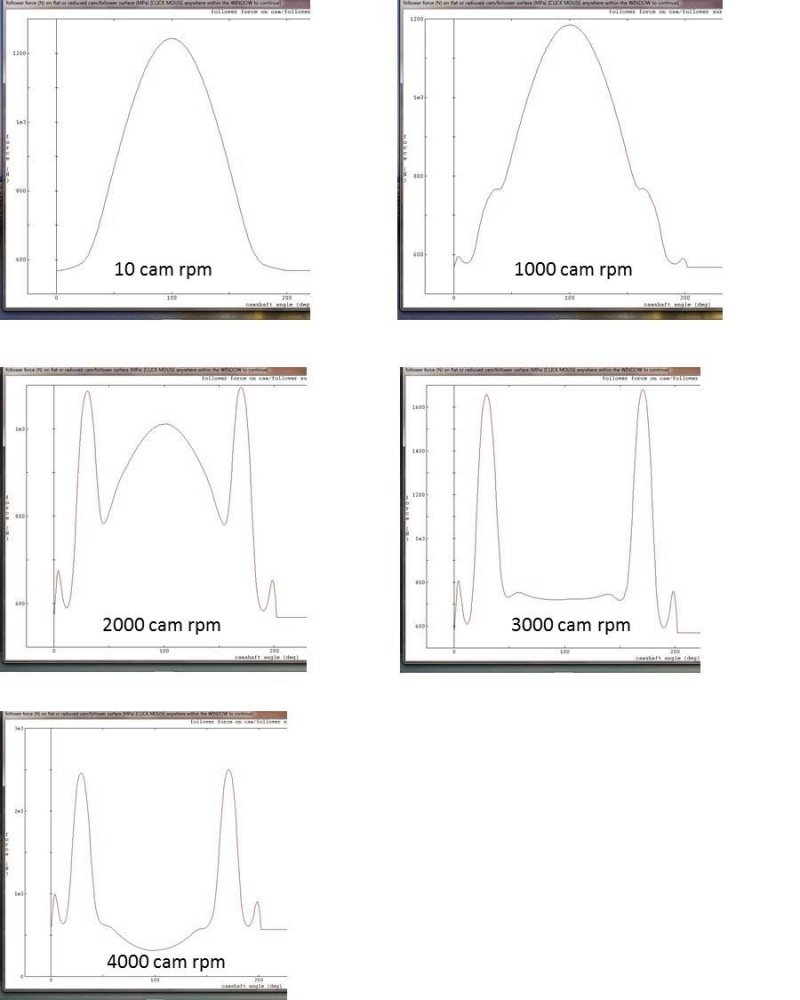
"The results show clearly that at low cam speeds the cam/follower forces are primarily a function of valve spring force whereas with increasing speed they become dominated by inertial forces (acceleration * valve train mass). It is also noteworthy that at the lowest rotation speed the cam/follower contact force is slightly higher than at the intermediate speeds."...
"...The next set of peaks, that grow to the largest peaks in the plot as speed is increased, are due to acceleration occurring as follower contact transitions from the lobe's opening/closing ramp to the flank."
"...The plots show force (vertical axis in N) vs cam angle (horizontal axis in cam degrees) for a single cam cycle at the given speeds."
In other words - the middle area represents the cam nose force and the area on each side represents the opening and closing ramp forces.
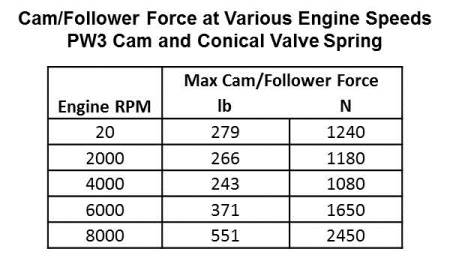
"I don’t know if the axis labels will be legible in the attached image so for clarity constructed the summary table below."
"The results show clearly that at low cam speeds the cam/follower forces are primarily a function of valve spring force whereas with increasing speed they become dominated by inertial forces (acceleration * valve train mass). It is also noteworthy that at the lowest rotation speed the cam/follower contact force is slightly higher than at the intermediate speeds."...
"...The next set of peaks, that grow to the largest peaks in the plot as speed is increased, are due to acceleration occurring as follower contact transitions from the lobe's opening/closing ramp to the flank."
"...The plots show force (vertical axis in N) vs cam angle (horizontal axis in cam degrees) for a single cam cycle at the given speeds."
In other words - the middle area represents the cam nose force and the area on each side represents the opening and closing ramp forces.
"I don’t know if the axis labels will be legible in the attached image so for clarity constructed the summary table below."
- Status
- Not open for further replies.
Similar threads

- Replies
- 26
- Views
- 5,776
