
Thanks for visiting Access Norton
- Guest view limit reached
- Create a free account (more details)
- Already a member? Click here to login
You are using an out of date browser. It may not display this or other websites correctly.
You should upgrade or use an alternative browser.
You should upgrade or use an alternative browser.
Recessed nuts on crankshaft 71 750
- Thread starter Akl52
- Start date
- Status
- Not open for further replies.

- Joined
- Nov 20, 2004
- Messages
- 21,369


Motorcycle parts and spares for Norton motorbikes - Andover Norton Spare Parts - Andover Norton Motorcycles Parts - Original Andover Norton Parts
Motorcycle parts and spares for Andover Norton motorbikes: Andover Norton manufactures and supplies all Factory Spare Parts for Norton motorcycles built before 2002.
andover-norton.co.uk
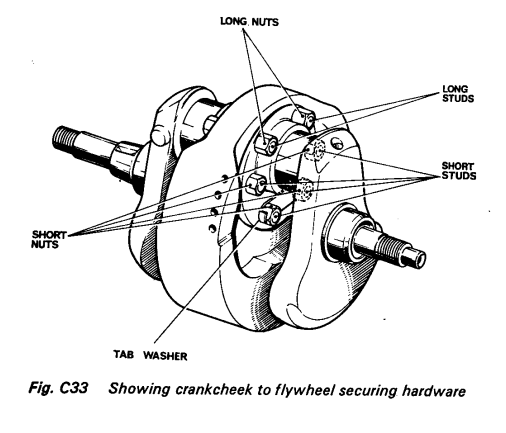
Due to their positions, the two nuts are extended making it easier to get a spanner onto them securely.
- Joined
- Nov 20, 2004
- Messages
- 21,369
any idea why they are recessed ?
I don't know if there was an actual engineering reason behind it or not.
He was right then as the two recessed nuts were on opposite sides of the crank.
There was a drawing in early manuals that showed the long nuts in the wrong positions so whoever rebuilt the crank perhaps used that drawing.
That diagram has all studs , 4 short , 2 long, my 71 crank has 4 short bolts with 4 nuts, 2 long studs with 2 short nuts & 2 long nuts
Yes, that particular drawing shows the later (UNF) 'all studs and nuts' assembly.
Motorcycle parts and spares for Norton motorbikes - Andover Norton Spare Parts - Andover Norton Motorcycles Parts - Original Andover Norton Parts
Motorcycle parts and spares for Andover Norton motorbikes: Andover Norton manufactures and supplies all Factory Spare Parts for Norton motorcycles built before 2002.
andover-norton.co.uk
Your '71 crank would have had the (BSC or Whit form?) bolts and studs that you mention although either fastener set can be used.
Motorcycle parts and spares for Norton motorbikes - Andover Norton Spare Parts - Andover Norton Motorcycles Parts - Original Andover Norton Parts
Motorcycle parts and spares for Andover Norton motorbikes: Andover Norton manufactures and supplies all Factory Spare Parts for Norton motorcycles built before 2002.
andover-norton.co.uk
- Joined
- Nov 20, 2004
- Messages
- 21,369
All seem in good order, is it ok to use them ?
You can reuse them but I'm sure the majority would recommend replacement.
With the recessed nut do I fit with recess to crank or to stud end ?
Bolt/stud end.
- Joined
- Nov 20, 2004
- Messages
- 21,369
The Conrad’s on my engine have 2 nuts on each bolt , it seems only 1 locknuts is fitted now ?
Conrods?
There were never two nuts on each conrod bolt!

Fast Eddie
VIP MEMBER
- Joined
- Oct 4, 2013
- Messages
- 23,056
Serious red flag.Ok thanks for that,
The Conrad’s on my engine have 2 nuts on each bolt , it seems only 1 locknuts is fitted now ?
Strip, inspect, discard, replace !

Richard Tool
VIP MEMBER
- Joined
- Aug 3, 2019
- Messages
- 1,991

The bolt circle is not concentric with the journal and so two of the studs/ nuts land more deeply in the large filet on the crank .Thanks , any idea why they are recessed ?
The spot face on the crank which provides the necessary flat for the nuts to bear on leaves a shoulder which the wrench must clear and so the need for longer nuts . These nuts originally were turned down some on one end in order that the nut fit in the spot face . The distance across the points is greater than the diameter of the spot face . When I reassembled my crank a few years back the new nuts from AN were not turned down enough and so the points fouled on the spot face before the nut could bear against the flat . Easy fix with a few minutes on the lathe but shouldn’t be needed. I informed AN about this . I wonder if some cranks had a larger diameter spot face . Anyone know ?

kommando
Basic
- Joined
- May 7, 2005
- Messages
- 7,847
A check on a bolt or stud is to take a non locking nut of the same thread and run it up and down the threaded section on the bolt or stud. It should run up and down freely with no binding or notchiness, if not that indicates the bolt/stud has been stretched by over torquing or stresses in the engine and its gone into the plastic deformation zone of the steel. So its into the bin and order new ones.

Akl52
VIP MEMBER
- Joined
- Apr 9, 2022
- Messages
- 24
Ok , the 2 nuts are on the new old stock replacement rods , normal nut to hold them together so the lock nut is just on by a few threads , obviously have to remove the “ extra spacer nut “ and fit the rods with the lock nut,
Thanks for all you replies
Thanks for all you replies
- Joined
- Nov 20, 2004
- Messages
- 21,369
The bolt circle is not concentric with the journal and so two of the studs/ nuts land more deeply in the large filet on the crank .
The spot face on the crank which provides the necessary flat for the nuts to bear on leaves a shoulder which the wrench must clear and so the need for longer nuts.
That explains the reason for the additional length but not for the "recess" (unthreaded section) inside the nut which I believe was the question. It could make it slightly easier to centre punch I suppose?
Motorcycle parts and spares for Norton motorbikes - Andover Norton Spare Parts - Andover Norton Motorcycles Parts - Original Andover Norton Parts
Motorcycle parts and spares for Andover Norton motorbikes: Andover Norton manufactures and supplies all Factory Spare Parts for Norton motorcycles built before 2002.
andover-norton.co.uk
Richard Tool
VIP MEMBER
- Joined
- Aug 3, 2019
- Messages
- 1,991
Never realized that about the nuts . Once again thanks for the info Les . Perhaps it it is to prevent the nut from being installed backwards ?That explains the reason for the additional length but not for the "recess" (unthreaded section) inside the nut which I believe was the question. It could make it slightly easier to centre punch I suppose?
Motorcycle parts and spares for Norton motorbikes - Andover Norton Spare Parts - Andover Norton Motorcycles Parts - Original Andover Norton Parts
Motorcycle parts and spares for Andover Norton motorbikes: Andover Norton manufactures and supplies all Factory Spare Parts for Norton motorcycles built before 2002.andover-norton.co.uk
I don’t know if it is an illusion but the photo from AN of the nut in question appears to have the flats convergent - i.e. not parallel in order to fit the spotface . I hope this is just an illusion because if not it is a terrible solution from an engineering standpoint as it minimizes the contact surfaces of the wrench ( spanner) .
- Status
- Not open for further replies.
Similar threads

- Replies
- 65
- Views
- 12,722


- Replies
- 23
- Views
- 5,471
- Replies
- 7
- Views
- 1,727
