Rear drum sprocket sideways play?

BERT

VIP MEMBER
Joined
Nov 23, 2020
Messages
760
Country flag
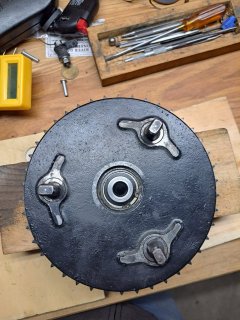
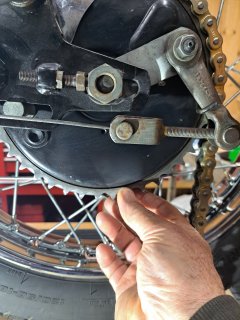
During a service /cleanup and before removing the rear wheel, about 40 thou of sideways play was noticed. Both axles were checked and were tight to the correct torque. I removed the drum sprocket for inspection. The double row sealed bearing (replaced 6000 miles ago) rotates smoothly. The circlip is fine and there is no other indication of any duress with the assembly. Is this play normal or cause for concern?
The bike is a MK IV with stock cush drive and dummy axle assembly.
Thanks in advance.
 

Attachments

  • Rear drum sprocket sideways play?
    20250523_083657.jpg
    324.8 KB · Views: 134
  • Rear drum sprocket sideways play?
    20250523_095142.jpg
    385.7 KB · Views: 145
With both the stub axle and main tight you should not have that kind of play.
Check that your shimming is correct
 
With both the stub axle and main tight you should not have that kind of play.
Check that your shimming is correct
The parts catalogue drawing is a real headscratcher. I don't see any shims, only the thin washer(s)#21 used as needed to space the backing plate away from the drum. Can you please describe where this shimming should be?
 
The parts catalogue drawing is a real headscratcher. I don't see any shims, only the thin washer(s)#21 used as needed to space the backing plate away from the drum. Can you please describe where this shimming should be?
I have some shims.

They are not OEM parts but are the proper ID & OD.

If memory serves me I have them in .015, .030 and .060.
 
The parts catalogue drawing is a real headscratcher. I don't see any shims, only the thin washer(s)#21 used as needed to space the backing plate away from the drum. Can you please describe where this shimming should be?
Is that .040" if you rock the sprocket (applying opposite force on each side) or if you are push/pulling straight axial force?

What's the history? Has that drum been modified or supplied with a deeper bearing pocket? It was done when original size bearings were not available.
 
Is that .040" if you rock the sprocket (applying opposite force on each side) or if you are push/pulling straight axial force?

What's the history? Has that drum been modified or supplied with a deeper bearing pocket? It was done when original size bearings were not available.
It rocks while applying opposite force directions on each side of the centerline through the axle. Not pushing in and out.
 
Last edited:
Is that .040" if you rock the sprocket (applying opposite force on each side) or if you are push/pulling straight axial force?

What's the history? Has that drum been modified or supplied with a deeper bearing pocket? It was done when original size bearings were not available.
There has been no mods done to the drum sprocket.
 
Last edited:
Is that .040" if you rock the sprocket (applying opposite force on each side) or if you are push/pulling straight axial force?

What's the history? Has that drum been modified or supplied with a deeper bearing pocket? It was done when original size bearings were not available.
New Bearings like the replacements for the NM 17721 (The Double row drum bearing) do not have the same internal clearance as the nice "tight" OEM bearing, so you get more "rocking" of the drum with the replacement bearing.

I imagine there is a way to assemble it wrong??? Is the circlip in place and seated properly?

So, when you think you're doing the right thing replacing it, you're going in the wrong direction. I maintain them and mine will last longer than I will be around. They are over 50 years old and going strong. Norton used good bearing with tight tolerances, **other than the Layshaft bearing made in Portugal and early crank main ball and roller bearings.** I take special care to keep my old OEM bearings in good condition, because they don't make them like they used to and I like a nice 'tight fit".
 
Thank you for the input. I have inspected the drum sprocket assembly. The bearing rotates smoothly. The circlip is in properly. I'll put it back together and keep an eye on the rocking side play and if it gets worse, will reinstall the original bearing setup with the felts which I saved. I did the bearing change over for the convenience of the sealed bearing.
 
Carl is spot on, same deal with clutch hub bearings. I've seen "new" ones wobble worse than 50yo stuff
 
Thank you for the input. I have inspected the drum sprocket assembly. The bearing rotates smoothly. The circlip is in properly. I'll put it back together and keep an eye on the rocking side play and if it gets worse, will reinstall the original bearing setup with the felts which I saved. I did the bearing change over for the convenience of the sealed bearing.
If you had a shaft that was the ID of the bearing 17mm, (Like a Norton front axle.) You could just slide the drum and bearing on to it and give it a "Shake" or Rock the drum on it and see where the play is.. You can try the old bearing alone on the shaft too. Clamping the shaft in a vice will help.
PS, I'm a proud graduate of the Todd Henning school of racing, class of 2000.
If it was broken , we fixed it and raced the hell out of it.
 
If you had a shaft that was the ID of the bearing 17mm, (Like a Norton front axle.) You could just slide the drum and bearing on to it and give it a "Shake" or Rock the drum on it and see where the play is.. You can try the old bearing alone on the shaft too. Clamping the shaft in a vice will help.
PS, I'm a proud graduate of the Todd Henning school of racing, class of 2000.
If it was broken , we fixed it and raced the hell out of it.
It turns out that the bearing is the culprit. I can see and detect a bit of rocking play between the races which would explain the rocking play when the axles are tight. Thanks for your help Carl H and Concours
 
There is a fine happy line between driving these machines the way they were designed to, and preserving them. They are not designed to be babied and need attention when needed. They are simple in design, easy to work on, parts readily available(so far) thanks to the suppliers. They are a pleasing machine to look at, which will I will do when the time comes, and these are part of why I have a Commando. The help from this forum when needed has been crucial to keep this puppy rolling. Thanks again
 
I have only just returned from 4 days away - so have just read this.
I might crazy, but I think you're all off on the wrong path.
If the actual drum/sprocket rocks, then it must be loose in its cush rubbers, otherwise the wheel/hub would hold it firm - no?
 
It turns out that the bearing is the culprit. I can see and detect a bit of rocking play between the races which would explain the rocking play when the axles are tight. Thanks for your help Carl H and Concours
Bearing with C3 clearance? They do exist.

Which procedure do you apply for removing and inserting the bearing? Bearing bosses wear by repeated bearing changes.

- Knut
 
I have only just returned from 4 days away - so have just read this.
I might crazy, but I think you're all off on the wrong path.
If the actual drum/sprocket rocks, then it must be loose in its cush rubbers, otherwise the wheel/hub would hold it firm - no?
I overlooked that and will check. Thanks.
 
I have only just returned from 4 days away - so have just read this.
I might crazy, but I think you're all off on the wrong path.
If the actual drum/sprocket rocks, then it must be loose in its cush rubbers, otherwise the wheel/hub would hold it firm - no?
The cush rubbers were loose. I shimmed the back of each thin rubber and that helped. I need to check this part of the fitment more often. Loose rubbers would be hard on the bearing. Thanks Rob
 
Last edited:
No , the bearing takes the load, That is why the OEM bearing was very expensive to make. I'd put the original one back it, if it was still good.
Its back together now and is much better. 'll keep a close eye on it and change it back over if needed. The sealed bearing rotates smoothly. Thanks Carl for your advice.
 
Back
Top