Push Rod Tunnels

I like a powerful twin. The M8 motors can really shift, without too much vibration. Not very well made though. I had a FatBob 114 for a year. Broke down twice and left me waiting for Roadside Assistance both times, once on holiday. For some reason I bought another Softail a couple of years later. Lasted 6 months and I traded it for a boxer BMW when that one broke down.

The Harley itch has been fully scratched thankfully, as I couldn't afford one now, even though they've moved production for UK bikes to Asia!
 
I like a powerful twin. The M8 motors can really shift, without too much vibration. Not very well made though. I had a FatBob 114 for a year. Broke down twice and left me waiting for Roadside Assistance both times, once on holiday. For some reason I bought another Softail a couple of years later. Lasted 6 months and I traded it for a boxer BMW when that one broke down.

The Harley itch has been fully scratched thankfully, as I couldn't afford one now, even though they've moved production for UK bikes to Asia!
What was wrong with them in those breakdowns? I’d say you were incredibly unlucky to have 3 breakdowns in close succession like that, no wonder you went off ‘em!

Of all the people I know with HDs (self included) they’ve had nothing but 100% reliability.

A mate has just had to replace his cam chain and tensioners on his 1450 Twin Cam, but it has done 77k miles. He stripped the top end to check things over and bore & pistons still comfortably within spec.

Mines a 110” twin cam and I’d jump on that and go anywhere without any hesitation… or any tools!
 
The oil "climbs" the studs. If you can force some silicone down them you can stop the leak. Even if you don't force it down, you may at least partly stop the leak with silicone under the washers. Of course, the real way is to remove the head. It takes only a small amount on the studs with the hear off to prevent the leak in the first place.

I can't find it right now, but there is AN document that describes what to do.
That’s a good idea Greg, I’d say there’s a good chance of that working if done with a bit of care, especially with regards to cleaning of the areas beforehand. Definitely worth a try before removing the head IMO !
 
What was wrong with them in those breakdowns? I’d say you were incredibly unlucky to have 3 breakdowns in close succession like that, no wonder you went off ‘em!

Of all the people I know with HDs (self included) they’ve had nothing but 100% reliability.

A mate has just had to replace his cam chain and tensioners on his 1450 Twin Cam, but it has done 77k miles. He stripped the top end to check things over and bore & pistons still comfortably within spec.

Mines a 110” twin cam and I’d jump on that and go anywhere without any hesitation… or any tools!
First failure was reg/rec. Lakeside Harley robbed one off a display bike to get me back on the bike tour, they were very helpful. 2nd failure was failed front head. Plug all oiled up and not firing. Head went back to the factory and I never heard more. 2nd bike, failed to turn over on the starter, 2nd start of the day. Suspect not charging. Suspect reg/rec again, but I'd had enough by then. They gave me a good price to take it back (as they were struggling to get bikes in the covid era).
 
The oil "climbs" the studs. If you can force some silicone down them you can stop the leak. Even if you don't force it down, you may at least partly stop the leak with silicone under the washers. Of course, the real way is to remove the head. It takes only a small amount on the studs with the hear off to prevent the leak in the first place.

I can't find it right now, but there is AN document that describes what to do.
So remove the two nuts from studs (#9 &10 in torque sequence) apply rtv as best can to stud and washer and retorque?
 
So remove the two nuts from studs (#9 &10 in torque sequence) apply rtv as best can to stud and washer and retorque?
Yes, but just on the stud and if you want, on the bottom of the washer. It's OK but not needed between the washer and nut. Don't go crazy on the torque - any RTV on the threads will lub the threads and the actual torque is higher than the wrench reading when the threads are lubed. Those nuts should be 20 or 25 ft. lb. depending on where you look. If the threads have any sort of lub I would do just under 20 and definitely not more than about 23.
 
"Easier than working on your lawnmower." [ re '96 Harley]

With pretty much the same brakes, handling, and power as the lawnmower. Been there...
I take your word, and knowledge about lawn mowers. The guy that cuts my lawn "Miguel", they call him "Mexican Miguel" I asked him about Harley Davidson. He said " No Comprendo? I said well Miguel, let me explain it to you. If you take a stock 84-99 HD EVO BT and do some mods you can easily get 80 rwhp. Ignition, carb, cam, exhaust. Miguel said "No Comprende" I told him to just finish cutting the grass.
 
Yes, but just on the stud and if you want, on the bottom of the washer. It's OK but not needed between the washer and nut. Don't go crazy on the torque - any RTV on the threads will lub the threads and the actual torque is higher than the wrench reading when the threads are lubed. Those nuts should be 20 or 25 ft. lb. depending on where you look. If the threads have any sort of lub I would do just under 20 and definitely not more than about 23.
Velocette’s suffer from oil running down the studs too, and the way to fix that is to get a, for example, 3mm thick “O” ring, which is a tight fit over the stud. Then you countersink the hole in the barrel to a depth of 1.5mm. Once the nut and washer are tightened the “O” ring is compressed by the taper, and forced to seal the threads. Obviously you also need to ensure that the washer is a close fit over the stud too. I think this method should also work on said studs.
 
Last edited:
I take your word, and knowledge about lawn mowers. The guy that cuts my lawn "Miguel", they call him "Mexican Miguel" I asked him about Harley Davidson. He said " No Comprendo? I said well Miguel, let me explain it to you. If you take a stock 84-99 HD EVO BT and do some mods you can easily get 80 rwhp. Ignition, carb, cam, exhaust. Miguel said "No Comprende" I told him to just finish cutting the grass.
I’d like an 80 ‘at the roller’ hp mower… I could then only mow the lawn twice a year…
 
Velocette’s suffer from oil running down the studs too, and the way to fix that is to get a, for example, 3mm thick “O” ring, which is a tight fit over the stud. Then you countersink the hole in the barrel to a depth of 1.5mm. Once the nut and washer are tightened the “O” ring is compressed by the taper, and forced to seal the threads. Obviously you also need to ensure that the washer is a close fit over the stud too. I think this method should also work on said studs.
Honda used that approach on its CB750 cylinder heads. Works over the long term (but you need to make sure the o-ring is matched to the gasket thickness). Viton seems to be the preferred material, for its resistance to modern oils (and ethanol).
 
Velocette’s suffer from oil running down the studs too, and the way to fix that is to get a, for example, 3mm thick “O” ring, which is a tight fit over the stud. Then you countersink the hole in the barrel to a depth of 1.5mm. Once the nut and washer are tightened the “O” ring is compressed by the taper, and forced to seal the threads. Obviously you also need to ensure that the washer is a close fit over the stud too. I think this method should also work on said studs.
I'm sure that would work but it requires the head off and machining (the studs are in the way with the head on).

Prior to putting the head on It might be enough to use a countersink on the head and cylinders for those studs, but then silicone on the studs at that time works.

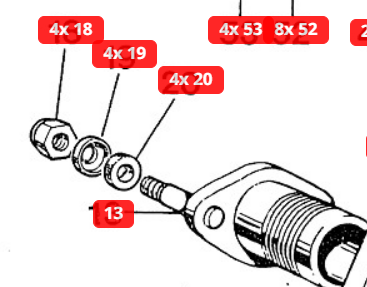
Another method without taking the head off (I haven't tried it) would be to replace the washer with a Triumph part 70-9554 (Rubber Washer) and 70-9555 (Cupped Washer). These are used for the isolation mounting of carbs on 69-70 650s. (#18 & #20):

Push Rod Tunnels
 
With rubber washers, would you get a consistent and lasting torque value? The o-ring approach doesn't interfere with torquing down the nuts, as they squash down and whilst sealing the studs thread, the nut / washer are still hard against the alloy head.
 
With rubber washers, would you get a consistent and lasting torque value? The o-ring approach doesn't interfere with torquing down the nuts, as they squash down and whilst sealing the studs thread, the nut / washer are still hard against the alloy head.
Probably since the rubber washer is under the cupped washer. It might be possible to use an o-ring under the cupped washer rather than the rubber washer. As I said, I have not tried this.

Putting an o-ring under the normal washer will not let the normal washer come in contact with the head unless you do some machine work that you cannot do with the head installed.
 
With rubber washers, would you get a consistent and lasting torque value? The o-ring approach doesn't interfere with torquing down the nuts, as they squash down and whilst sealing the studs thread, the nut / washer are still hard against the alloy head.
If you look at the picture Greg kindly posted, you can see the cupped washer (number 19). Whether they would retain the necessary torque is a good question.

Greg’s reply also made me realize this is being done in situ, so I’ve come up with another idea based on what I posted earlier, and that is to obtain some thick washers and countersink those instead of the head. It should work the same way, but the other way around, and would be easier to do.
 
Last edited:
If you look at the picture Greg kindly posted, you can see the cupped washer (number 19). Whether they would retain the nessary torque is a good question.

Greg’s reply also made me realize this is being done in situ, so I’ve come up with another idea based on what I posted earlier, and that is to obtain some thick washers and countersink those instead of the head. It should work the same way, but the other way around, and would be easier to do.
The normal use of those cupped washers makes them very close to touching the metal. That's with maybe 2-3 ft. lbs. of torque. With 20-25 ft. lbs they certainly will touch the head and probably flatten which makes them about the same as countersinking thick washers. If the rubber washers are too thick for this purpose, an o-ring could be used. Again, I haven't tried it and some experimentation may be required.

Also:
I'm not sure how critical the torque is on those two studs.
With this solution or the O-ring solution, there's no reason to think the torque would not hold - it should hold better, IMHO.
Generally, I would "lick my calf over" (remove the head and do a better job the 2nd time).

I keep searching for the AN document I read that said how to use composite head gaskets - anyone have it?
 
The normal use of those cupped washers makes them very close to touching the metal. That's with maybe 2-3 ft. lbs. of torque. With 20-25 ft. lbs they certainly will touch the head and probably flatten which makes them about the same as countersinking thick washers. If the rubber washers are too thick for this purpose, an o-ring could be used. Again, I haven't tried it and some experimentation may be required.

Also:
I'm not sure how critical the torque is on those two studs.
With this solution or the O-ring solution, there's no reason to think the torque would not hold - it should hold better, IMHO.
Generally, I would "lick my calf over" (remove the head and do a better job the 2nd time).

I keep searching for the AN document I read that said how to use composite head gaskets - anyone have it?

Here it is ...
 
Back
Top