I'll be careful this time. It's going to be both a Lucas stator and rotor, the Sparx rotor is going to become a novelty magnetic tool holder. Now to find a place for the SH847.Lots of people turn them down. I'm sure there are lots of opinions on what cutters to use. Personally, I would not use a high-speed steel cutter as it could affect the magnetism. Ceramic or carbide inserts should be fine.

You are using an out of date browser. It may not display this or other websites correctly.
You should upgrade or use an alternative browser.
You should upgrade or use an alternative browser.
New stator melted in 20 miles
- Thread starter JimNH
- Start date

t ingermanson
FULL MEMBER
- Joined
- Oct 2018
- Messages
- 718

They cut easily enough, but it's essentially an interrupted cut, so it's not a spectacular finish. Doesn't need to be though. I start by turning down a mandrel from stock and bolting on the rotor, as you would on the crank. A fresh carbide insert for small cuts on steel does the job with no problems. I aim for .010"+ clearance. No measurable decrease in output with my dumb tools.I think i know that guy....speaking of turning down a rotor, anyone here done it personally? Just wondering how they cut.


Triton Thrasher
MEMBER
- Joined
- Feb 2009
- Messages
- 3,280

I think I read here recently that someone does.Would be awesome if someone sold turned down rotors. For the hand tool only folks.
It’s the manufacturer who should really be making parts that fit!

baz
FULL MEMBER
- Joined
- May 2010
- Messages
- 8,793
I reckon 7000 rpm and some 40 grit sandpaper would take a few thou off in seconds !Would be awesome if someone sold turned down rotors. For the hand tool only folks.


Triton Thrasher
MEMBER
- Joined
- Feb 2009
- Messages
- 3,280
In fact:Would be awesome if someone sold turned down rotors. For the hand tool only folks.

Matt at CNW is now turning all the rotors with his 3-phase kits so as to eliminate this problem.
Mike
Mike
t ingermanson
FULL MEMBER
- Joined
- Oct 2018
- Messages
- 718
I've offered to turn down member's rotors, but no one has taken me up on it. I'm certainly not going to have a pile of rotors sitting around waiting for someone to want one though.Would be awesome if someone sold turned down rotors. For the hand tool only folks.

marshg246
FULL MEMBER
- Joined
- Jul 2015
- Messages
- 6,077
Contact Colorado Norton Works. I don't know if they keep them in stock turned down but they do turn them down.Would be awesome if someone sold turned down rotors. For the hand tool only folks.
Mark Savage
FULL MEMBER
- Joined
- Apr 2013
- Messages
- 780
I did mine in a pillar drill with a file!I reckon 7000 rpm and some 40 grit sandpaper would take a few thou off in seconds !

Triton Thrasher
MEMBER
- Joined
- Feb 2009
- Messages
- 3,280
Isn’t that how they invented lathes!I did mine in a pillar drill with a file!
marshg246
FULL MEMBER
- Joined
- Jul 2015
- Messages
- 6,077
In general, the parts do fit. Unfortunately, the precision of the Norton inner primary is generally off making the rotor tight at about 2 o'clock. Also, the three spacers are often different lengths causing the stator to be cocked.It’s the manufacturer who should really be making parts that fit!
I don't mind the concept of turning the diameter of the rotors down .020" to ensure clearance, but that's fixing the symptom, not the problem. Fortunately, it has no discernible effect on output.
The rush to using "higher output stators" and LEDs is also burning up stators. Anyone who installs a stator other than 10 amp 2-wire or 10.5 amp 3-wire should understand what they are doing and why they are doing it and most do not. Anyone installing LEDs everywhere should understand what they are doing and why they are doing it and most do not. Higher output stators and all LEDs is a recipe for failure!
In general, the parts do fit. Unfortunately, the precision of the Norton inner primary is generally off making the rotor tight at about 2 o'clock. Also, the three spacers are often different lengths causing the stator to be cocked.
I don't mind the concept of turning the diameter of the rotors down .020" to ensure clearance, but that's fixing the symptom, not the problem. Fortunately, it has no discernible effect on output.
The rush to using "higher output stators" and LEDs is also burning up stators. Anyone who installs a stator other than 10 amp 2-wire or 10.5 amp 3-wire should understand what they are doing and why they are doing it and most do not. Anyone installing LEDs everywhere should understand what they are doing and why they are doing it and most do not. Higher output stators and all LEDs is a recipe for failure!


Lineslinger
FULL MEMBER
- Joined
- Feb 2017
- Messages
- 2,037
Did it work?I did mine in a pillar drill with a file!
Mark Savage
FULL MEMBER
- Joined
- Apr 2013
- Messages
- 780
Surprisingly quickly. It took longer to concoct a shaft and a support for the tail of it. I finished it with emery paper. I had to have an airline handy to blow the bits off. I didn’t take much off, maybe a couple of thou.Did it work?
With that and waisted studs I think it’s now fine.
Last edited:
SteveBorland
FULL MEMBER
- Joined
- Nov 2010
- Messages
- 1,057

Unfortunately for me, you're on the wrong side of the pondI've offered to turn down member's rotors, but no one has taken me up on it. I'm certainly not going to have a pile of rotors sitting around waiting for someone to want one though.
Wonderful offer though, I'm surprised you don't have piles of rotors waiting to be done!
Lineslinger
FULL MEMBER
- Joined
- Feb 2017
- Messages
- 2,037
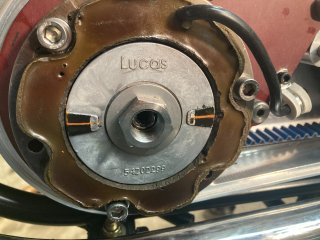
I installed a new Lucas rotor as the original was 50+ years old. I have run it for a couple hundred miles and all is well.
Then I read this thread.
I cannot remember what the clearance was between the two faces when I installed it.
So now that I am squirming I will go back in with the feeler gauge.
If it ain't broke don't fix it right?
I am thinking check it again to make sure it doesn't break?
Then I read this thread.
I cannot remember what the clearance was between the two faces when I installed it.
So now that I am squirming I will go back in with the feeler gauge.
If it ain't broke don't fix it right?
I am thinking check it again to make sure it doesn't break?
Attachments
Stephen Hill
MEMBER
- Joined
- Oct 2009
- Messages
- 1,535

Turning the rotor undersize on a lathe to achieve adequate clearance is one solution to the problem. However, the true center of the rotor (the crank) frequently does not accurately line up with the true center of the stator (bolt circle of the mounting studs). IMHO, in this case you are better off focusing on the stator. You can remove material on the inside diameter of the stator in the area of inadequate clearance. Or oversize or slot the mounting holes in the stator. Or reduce the diameter of the mounting studs (as per Norman White). This is easily done with basic tools, and you are focusing on the source of the problem.
Last edited:
t ingermanson
FULL MEMBER
- Joined
- Oct 2018
- Messages
- 718
Well, it's an apprentice-level machining job, that can be pulled off at any local automotive machine shop, so the competition is fierce.Unfortunately for me, you're on the wrong side of the pond
Wonderful offer though, I'm surprised you don't have piles of rotors waiting to be done!
I agree 100% if there's a concentricity issue, but the tolerance between these components should really be as slack as possible before performance of the assembly suffers. It's really a miracle that a .008" concentric gap can be expected on these parts that vary from brand new to 50 years old. The designed-in tolerance stack is mind boggling, and heat seems to be a contributing factor, with aftermarket belt drives doing no favors. I've personally battled a couple rotor/stators that once the gap was opened, there were no more issues. Certainly not advocating for doing it to brand new parts out of the box if there's no problem, but it's an easy solution if there is.Turning the rotor to achieve adequate clearance is one solution to the problem, particularly if the rotor is not turning true.
However, the true center of the rotor (the crank) frequently does not accurately line up with the true center of the stator (bolt circle of the mounting studs). IMHO, in this case you are better off focusing on the stator. You can remove material on the inside diameter of the stator in the area of inadequate clearance. Or oversize or slot the mounting holes in the stator. Or reduce the diameter of the mounting studs (as per Norman White). This is easily done with basic tools, and you are focusing on the source of the problem.
seattle##gs
FULL MEMBER
- Joined
- Oct 2014
- Messages
- 2,311
According to CNW .010 at the tightest point is not a problem. He regularly turns down the rotor. I used to use a Dremel with a sanding roll to gain clearance off the stator but I found a better way. It's a woodworking tool called an OSCILLATING SPINDLE SANDER and does a beautiful and very quick job of it. I have it for fabricating reasons but it was only $100. I ALWAYS check stator clearance.
