
You are using an out of date browser. It may not display this or other websites correctly.
You should upgrade or use an alternative browser.
You should upgrade or use an alternative browser.
Modern 2 valve head design
- Thread starter jseng1
- Start date
- Status
- Not open for further replies.


- Joined
- Nov 13, 2018
- Messages
- 102

Unfortunately I'm somewhat too clumsy to embed pictures from other forums, soo let's hope the embedded pictures work.
Basically the new hemi is very similar to how a lot of my head modifications look like (i was very interested back then when the first intro articles were published by D. Vizard) and from what I know that's also how Stan M. of BSA B50 fame does his combustion chambers.
Regarding the downdraft inclination of the ports that also makes s notable difference due to a decline of throttling losses due to eddying.
Kind regards
Christian
Flat squish

conical squish

Hemisphaeric squish
Basically the new hemi is very similar to how a lot of my head modifications look like (i was very interested back then when the first intro articles were published by D. Vizard) and from what I know that's also how Stan M. of BSA B50 fame does his combustion chambers.
Regarding the downdraft inclination of the ports that also makes s notable difference due to a decline of throttling losses due to eddying.
Kind regards
Christian
Flat squish
conical squish
Hemisphaeric squish
Last edited:

Fast Eddie
VIP MEMBER
- Joined
- Oct 4, 2013
- Messages
- 22,977

Which works best dya reckon, flat, conical or hemispheric?
Flat is the easiest to set up nice n tight I imagine.
Flat is the easiest to set up nice n tight I imagine.

acotrel
Flagged
- Joined
- Jun 30, 2012
- Messages
- 15,006

Joe Craig was not stupid and he had a decade or more, in which to improve Norton head design. It is difficult to do better and get a substantial increase in horsepower or torque. There is more to combustion conditions than just squish. At top dead centre when both valves are open, there is flow right across the top of the piston and into the exhaust - then the charge gets stuffed back into the combustion chamber. A four-stroke does the same thing as a two-stroke as far as the exhaust is concerned, but an expansion chamber for a four-stroke motor would be huge. The gas speed through the combustion chamber at TDC is probably sonic. Flow at sonic speed is different to what you get on a flow bench.
- Joined
- Nov 13, 2018
- Messages
- 102
@Fast Eddie
Personally I like the most the conical approach as besides various other reasons one can custom tailor the compression ratio to the intake closing point and thus high compression ratios are possible without ridiculous dome shapes.
Furthermore the squish turbulence time vector/component (or however one wants to call it) can be lowered as the combustion flame front is being directed already towards the spark plugs.
Therefore one could use lower ignition advance.
So far I have not seen outrageously significant differences in horsepower but that might be also due to the fact that I personally usually do not assemble the engines and use a lot of different cam/valve/piston combos so giving a reliable verifyable repeatable statement is somewhat hard.
Seat of pants and late dyno numbers although tell of an advantage of the conical squish.
Kind regards and happy weekend
Christian
Personally I like the most the conical approach as besides various other reasons one can custom tailor the compression ratio to the intake closing point and thus high compression ratios are possible without ridiculous dome shapes.
Furthermore the squish turbulence time vector/component (or however one wants to call it) can be lowered as the combustion flame front is being directed already towards the spark plugs.
Therefore one could use lower ignition advance.
So far I have not seen outrageously significant differences in horsepower but that might be also due to the fact that I personally usually do not assemble the engines and use a lot of different cam/valve/piston combos so giving a reliable verifyable repeatable statement is somewhat hard.
Seat of pants and late dyno numbers although tell of an advantage of the conical squish.
Kind regards and happy weekend
Christian
- Joined
- Nov 13, 2018
- Messages
- 102
@acotrel
Have you seen yet the late repro G50 heads?
No?
Than I would recommend to reconsider your statements regarding joe Craig's (besides it was kuzminsky afaik) not to be diminished achievement.
Afaik, the top modern repro singles are about +50ish horses and that's also about were my Yamaha singles lurk around.
Regarding the scavenging speed in combustion chambers and based on my somewhat sketchy memory of my extensive calculations/simulations back then I would say that the only location where you might find super Sonic conditions is at the exhaust seat and at the most the first 1-2" of exhaust port after the seat at certain lift/Evo/ conditions so in reality the effect for combustion flame propagation is imho neglectable.
Kind regards
Christian
Ps: not that it concerns me too much but your statements regarding flowbench techniques without knowing the established scientific approaches or recommendations eg of the SAE leave a highly polemic after taste.
Have you seen yet the late repro G50 heads?
No?
Than I would recommend to reconsider your statements regarding joe Craig's (besides it was kuzminsky
afaik) not to be diminished achievement.Afaik, the top modern repro singles are about +50ish horses and that's also about were my Yamaha singles lurk around.
Regarding the scavenging speed in combustion chambers and based on my somewhat sketchy memory of my extensive calculations/simulations back then I would say that the only location where you might find super Sonic conditions is at the exhaust seat and at the most the first 1-2" of exhaust port after the seat at certain lift/Evo/ conditions so in reality the effect for combustion flame propagation is imho neglectable.
Kind regards
Christian
Ps: not that it concerns me too much but your statements regarding flowbench techniques without knowing the established scientific approaches or recommendations eg of the SAE leave a highly polemic after taste.
Last edited:

- Joined
- Nov 26, 2009
- Messages
- 3,436

Unfortunately I'm somewhat too clumsy to embed pictures from other forums, soo let's hope the embedded pictures work.
Basically the new hemi is very similar to how a lot of my head modifications look like (i was very interested back then when the first intro articles were published by D. Vizard) and from what I know that's also how Stan M. of BSA B50 fame does his combustion chambers.
Regarding the downdraft inclination of the ports that also makes s notable difference due to a decline of throttling losses due to eddying.
Kind regards
Christian
Flat squish

conical squish
Hemisphaeric squish
- Joined
- Nov 26, 2009
- Messages
- 3,436
Bathtub chamber heads may increase the midrange (OK for street) but can lose performance in the top end because of shrouding. With a stock Norton combustion chamber there is just enough side clearance around the valve at high valve lift to provide free flow. In the photo below you can see two 3/8″ shafts. One shaft is between the seat and the valve. The shaft to the side is between the valve and a stock Norton combustion chamber. You can see that adding more material to form a bathtub shape would reduce the side clearance and shroud the valve – restricting the flow at high valve lift and reducing top end performance. Port flow and cylinder filling is most important and shouldn't be compromised for squish benefits. A bathtub is nice but should never be taken too far (note the non restrictive Chrysler bathtub in the 1st post photo. Too tight of a bathtub will defeat your purpose.

acotrel
Flagged
- Joined
- Jun 30, 2012
- Messages
- 15,006
There was one 650 Triumph model in the 1950s which had a high-comp. cast iron head. The combustion chambers had scallops around the valves, probably to prevent shrouding. The fastest 350 single in the late 50s was the 7R AJS. But it was probably more cams than combustion chamber shape. The one that Michelle Duff rode so well aganst the 350cc MVs. The video of the Junior TT race is also on Duke video's copy of The Right Line.
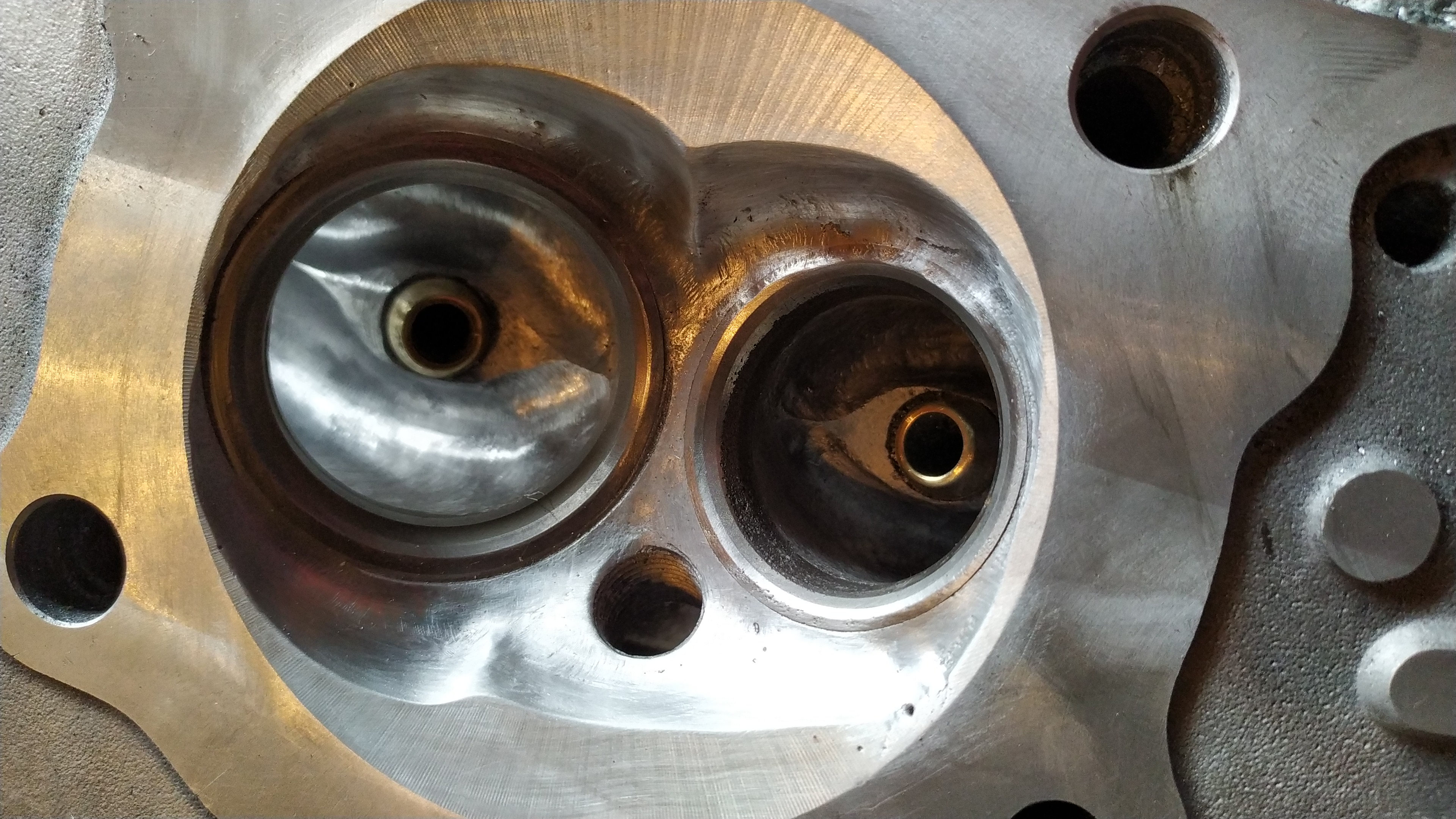
When you use the three cutters to shape the valve seats, it makes a difference. In the photo above, there is a ridge in the seat.
When you use the three cutters to shape the valve seats, it makes a difference. In the photo above, there is a ridge in the seat.

- Joined
- Dec 21, 2020
- Messages
- 1,302
Since this started out comparing Hemi ports to motorcycle ports. Why doesn't a Norton like a domed piston? Triumphs run a huge dome on their 500, By design Hemi's love a dome piston but the Norton's don't. Valve angle's are similar or Is it the straight ports or the squish band? Hemi's like tulip shaped valves and again Norton's run a nail head valve.
- Joined
- Nov 26, 2009
- Messages
- 3,436
You can get anything you want these days. Domed Norton high compression pistons and Tulip shaped valves as shown below.Since this started out comparing Hemi ports to motorcycle ports. Why doesn't a Norton like a domed piston? Triumphs run a huge dome on their 500, By design Hemi's love a dome piston but the Norton's don't. Valve angle's are similar or Is it the straight ports or the squish band? Hemi's like tulip shaped valves and again Norton's run a nail head valve.
Last edited:
- Joined
- Nov 13, 2018
- Messages
- 102
I will see if I can find pictures of the domiracer head that I did a couple years ago, with Valve relieve squish and d-ports.
As short info and as it did get mentioned, (and surely without any cocky offense), I usually don't show finished valve seats or detail shots of port shapes of my head's as i consider them proprietary often hard earned knowledge.
I thank you for your kind comprehension!
Kind regards
Christian
Ps: @jseng
Jim i posted the classic bathtub chamber just for demo reasons, besides on some heads some heavy swirl inducing bias exists, so one can get away with somewhat close appearing chamber walls.
As a matter of fact the domiracer had as far as i remember valve deshrouding cut outs among some other detail work.
As short info and as it did get mentioned, (and surely without any cocky offense), I usually don't show finished valve seats or detail shots of port shapes of my head's as i consider them proprietary often hard earned knowledge.
I thank you for your kind comprehension!
Kind regards
Christian
Ps: @jseng
Jim i posted the classic bathtub chamber just for demo reasons, besides on some heads some heavy swirl inducing bias exists, so one can get away with somewhat close appearing chamber walls.
As a matter of fact the domiracer had as far as i remember valve deshrouding cut outs among some other detail work.
Last edited:
Fast Eddie
VIP MEMBER
- Joined
- Oct 4, 2013
- Messages
- 22,977
I will see if I can find pictures of the domiracer head that I did a couple years ago, with Valve relieve squish and d-ports.
Yes please !
Kind regards
Christian
Yes please !

Chris
VIP MEMBER
- Joined
- Jan 21, 2008
- Messages
- 1,776
Christian
I want to thank you for your posts.
Your clear description helps me follow & understand, what I find is a tricky subject. If I need headwork done I go to someone who knows what they are doing. Chasing the final bit of horsepower does not interest me. I want reliability, I can't afford for an engine to go bang. However some of the stuff that you guys are developing can't be ignored, because it completes the package. All components working together to make the whole the best it can be. I read David Vizard when my sole transport was a mini (cheap! 6ft2" & 45,000 miles a year) I wore bikes out going to work & couldn't cope with the ice & snow.
My first Triton had been ported! I rode a mates bike same spec Somerton cams powermax 11 to 1 pistons standard head! It was much better nowhere near as lumpy as mine. In a load of spares I found a Dudley ward head, biggest valves I had seen in a Triumph, big intake ports. I moved on & ran a head with sleeves in the inlet & a small bore exhaust pipe & it was fast but also sweet. It's all about the package but that package keeps moving forward.
Love the development work, keep at it.
I want to thank you for your posts.
Your clear description helps me follow & understand, what I find is a tricky subject. If I need headwork done I go to someone who knows what they are doing. Chasing the final bit of horsepower does not interest me. I want reliability, I can't afford for an engine to go bang. However some of the stuff that you guys are developing can't be ignored, because it completes the package. All components working together to make the whole the best it can be. I read David Vizard when my sole transport was a mini (cheap! 6ft2" & 45,000 miles a year) I wore bikes out going to work & couldn't cope with the ice & snow.
My first Triton had been ported! I rode a mates bike same spec Somerton cams powermax 11 to 1 pistons standard head! It was much better nowhere near as lumpy as mine. In a load of spares I found a Dudley ward head, biggest valves I had seen in a Triumph, big intake ports. I moved on & ran a head with sleeves in the inlet & a small bore exhaust pipe & it was fast but also sweet. It's all about the package but that package keeps moving forward.
Love the development work, keep at it.
Fast Eddie
VIP MEMBER
- Joined
- Oct 4, 2013
- Messages
- 22,977
Chris, as you say, this is a constantly moving target!Christian
I want to thank you for your posts.
Your clear description helps me follow & understand, what I find is a tricky subject. If I need headwork done I go to someone who knows what they are doing. Chasing the final bit of horsepower does not interest me. I want reliability, I can't afford for an engine to go bang. However some of the stuff that you guys are developing can't be ignored, because it completes the package. All components working together to make the whole the best it can be. I read David Vizard when my sole transport was a mini (cheap! 6ft2" & 45,000 miles a year) I wore bikes out going to work & couldn't cope with the ice & snow.
My first Triton had been ported! I rode a mates bike same spec Somerton cams powermax 11 to 1 pistons standard head! It was much better nowhere near as lumpy as mine. In a load of spares I found a Dudley ward head, biggest valves I had seen in a Triumph, big intake ports. I moved on & ran a head with sleeves in the inlet & a small bore exhaust pipe & it was fast but also sweet. It's all about the package but that package keeps moving forward.
Love the development work, keep at it.
Who is the ‘Jim Comstock’ type of go to person for Triumph heads these days dya reckon ?
- Joined
- Nov 13, 2018
- Messages
- 102
@Fast Eddie
Speaking of continental Europe i got told that Winkelmann in Germany supposedly has a real good reputation in engine building.
Furthermore I think that swiss Ruefenacht also works on complete engines.
For cylinderheads or top end work i unfortunately can not say too much about continental Europe, as i unfortunately have seen and analyzed (and afterwards had the dubious joy to rework them) through the years a fair share of advertising and marketing based sewer/drain pipes of which i decline to give further statements/critics.
On the other hand if it boils down to heads i would not know, besides admittedly some peculiar particularities in some engine models why a good porting shop/guy (as well in the UK) could not rework a triumph, BSA, Norton or Guzzi head, as the proof lies imho within the confines of laying out reasonable baselines for porting work based on desired engine characteristics and engine architecture/kinematics.
Kind regards
Christian
Speaking of continental Europe i got told that Winkelmann in Germany supposedly has a real good reputation in engine building.
Furthermore I think that swiss Ruefenacht also works on complete engines.
For cylinderheads or top end work i unfortunately can not say too much about continental Europe, as i unfortunately have seen and analyzed (and afterwards had the dubious joy to rework them) through the years a fair share of advertising and marketing based sewer/drain pipes of which i decline to give further statements/critics.
On the other hand if it boils down to heads i would not know, besides admittedly some peculiar particularities in some engine models why a good porting shop/guy (as well in the UK) could not rework a triumph, BSA, Norton or Guzzi head, as the proof lies imho within the confines of laying out reasonable baselines for porting work based on desired engine characteristics and engine architecture/kinematics.
Kind regards
Christian
Last edited:
Chris
VIP MEMBER
- Joined
- Jan 21, 2008
- Messages
- 1,776
Hi Nige
I've got to say I don't know!
I had some work done by fluff racing. Got a Mez head 2nd hand.
Peter Seager worked on race cars? But I think he does porting.
As you know I have a Dresda Daytona head.
But to be honest I haven't seen a Bonnie raced for a very long time!
Probably more in BHR but none in CRMC.
Met a nice man who worked for Ferrari who thought my Peckett head (Rob North) could be improved on by a vast amount, unfortunately he wanted two grand to prove that his work would deliver. I went away wondered if he'd ever worked with carbs!
I've got to say I don't know!
I had some work done by fluff racing. Got a Mez head 2nd hand.
Peter Seager worked on race cars? But I think he does porting.
As you know I have a Dresda Daytona head.
But to be honest I haven't seen a Bonnie raced for a very long time!
Probably more in BHR but none in CRMC.
Met a nice man who worked for Ferrari who thought my Peckett head (Rob North) could be improved on by a vast amount, unfortunately he wanted two grand to prove that his work would deliver. I went away wondered if he'd ever worked with carbs!
- Status
- Not open for further replies.