
Thanks for visiting Access Norton
- Guest view limit reached
- Create a free account (more details)
- Already a member? Click here to login
You are using an out of date browser. It may not display this or other websites correctly.
You should upgrade or use an alternative browser.
You should upgrade or use an alternative browser.
Mk3 massive oil spill
- Thread starter hillbone
- Start date


ashman
FULL MEMBER
- Joined
- Jul 2010
- Messages
- 6,983

You are lucky it spewed out on the floor while sitting many years ago I forgot to turn my fuel taps off and the same thing happened float stuck on one carb and filled my crank up with fuel, but nothing on the floor, next day I fired up the motor and oil/fuel mixture spewed out of my breather hose, I run my breather hose in a large catch bottle and it filled the catch bottle and spewed out of the top of the catch bottle where the breather hose goes into the bottle as well from the air hole in the top of the bottle when it fired up, shut it down pretty quick, oil and fuel over the floor and a big mess to clean up.
In 49 years that was the first time and only time it ever done that but that was over 15 years ago now, I always make sure my fuel taps are turned off after that, funny thing was no smell of fuel until it spewed out of the breather, all I did was do a complete oil filter/tank change, lucky it was due for a oil change.
In 49 years that was the first time and only time it ever done that but that was over 15 years ago now, I always make sure my fuel taps are turned off after that, funny thing was no smell of fuel until it spewed out of the breather, all I did was do a complete oil filter/tank change, lucky it was due for a oil change.


Regarding gasoline in oil...
In WW2 British warplanes did not have multigrade oil so when the outside temperature got very cold (sub zero) overnight, the oil would turn to jelly and
not be sucked into the oil pump and the very thickened oil would make it hard for the starter to rotate the engine.
The solution was the oil dilution switch - held down for about 30 seconds before turning the engine off the night before.
During that 30 seconds, gasoline would be dripped into the engine oil which thinned it greatly. Enough that it would not turn to jelly overnight.
When the engine was then started the next day, the combustion heat generated would warm up the oil/gasoline lubricating mix and drive off the volatile gasoline.
In WW2 British warplanes did not have multigrade oil so when the outside temperature got very cold (sub zero) overnight, the oil would turn to jelly and
not be sucked into the oil pump and the very thickened oil would make it hard for the starter to rotate the engine.
The solution was the oil dilution switch - held down for about 30 seconds before turning the engine off the night before.
During that 30 seconds, gasoline would be dripped into the engine oil which thinned it greatly. Enough that it would not turn to jelly overnight.
When the engine was then started the next day, the combustion heat generated would warm up the oil/gasoline lubricating mix and drive off the volatile gasoline.
Matt Spencer
MEMBER
- Joined
- Jul 2010
- Messages
- 5,943
Very lucky your garage door dosnt spark .
Sabres could freeze .
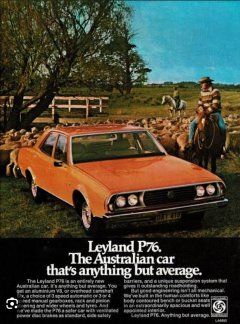
Using the V V V S Technique , on the P - 38 ( otherwise know as Leyland P-76 ( with Rover 4 pipe zorst cetra ))
Pump. Pump. Foot on floor . Turn ON , Off . ON , OFF - Foot on Clutch . Select FORWARD ( 1st ) Ign ON , Foot OFF .
This gets you over the boundardy inside 30 seconds , as early warning systems viual . And your dead in 60 seconds.
if your not off .
as in Rimm ,Rimm , RIMM ( thunder smoke lift off etc ) Fastest Proceedure on Cold Motor .
Foot on Floor & Ign. on & off , can clear out a dodgey motor quick . If its real dodgey , it'll sort t out , too . For good .
Sabres could freeze .
Using the V V V S Technique , on the P - 38 ( otherwise know as Leyland P-76 ( with Rover 4 pipe zorst cetra ))
Pump. Pump. Foot on floor . Turn ON , Off . ON , OFF - Foot on Clutch . Select FORWARD ( 1st ) Ign ON , Foot OFF .
This gets you over the boundardy inside 30 seconds , as early warning systems viual . And your dead in 60 seconds.
if your not off .
as in Rimm ,Rimm , RIMM ( thunder smoke lift off etc ) Fastest Proceedure on Cold Motor .
Foot on Floor & Ign. on & off , can clear out a dodgey motor quick . If its real dodgey , it'll sort t out , too . For good .

robs ss
FULL MEMBER
- Joined
- Aug 2016
- Messages
- 4,670
I tried Google translate for what you posted and it didn't have a clue either.Very lucky your garage door dosnt spark .
Sabres could freeze .
Using the V V V S Technique , on the P - 38 ( otherwise know as Leyland P-76 ( with Rover 4 pipe zorst cetra ))
Pump. Pump. Foot on floor . Turn ON , Off . ON , OFF - Foot on Clutch . Select FORWARD ( 1st ) Ign ON , Foot OFF .
This gets you over the boundardy inside 30 seconds , as early warning systems viual . And your dead in 60 seconds.
if your not off .
as in Rimm ,Rimm , RIMM ( thunder smoke lift off etc ) Fastest Proceedure on Cold Motor .
Foot on Floor & Ign. on & off , can clear out a dodgey motor quick . If its real dodgey , it'll sort t out , too . For good .


johnm
FULL MEMBER
- Joined
- Feb 2008
- Messages
- 2,057

Yes. How does a P38 equal a P76 ?I tried Google translate for what you posted and it didn't have a clue either.

Deets55
FULL MEMBER
- Joined
- Oct 2013
- Messages
- 1,707

P must be a constant variable.Yes. How does a P38 equal a P76 ?

- Joined
- Jan 2004
- Messages
- 2,783
Glad you cleared that up.
Was thinking maybe it was two of these bolted together...

 en.wikipedia.org
Was thinking maybe it was two of these bolted together...
Lockheed P-38 Lightning - Wikipedia
johnm
FULL MEMBER
- Joined
- Feb 2008
- Messages
- 2,057
Exactly. The confusion in many minds.Glad you cleared that up.
Was thinking maybe it was two of these bolted together...
Lockheed P-38 Lightning - Wikipedia
Matt Spencer
MEMBER
- Joined
- Jul 2010
- Messages
- 5,943
Blah Blah .
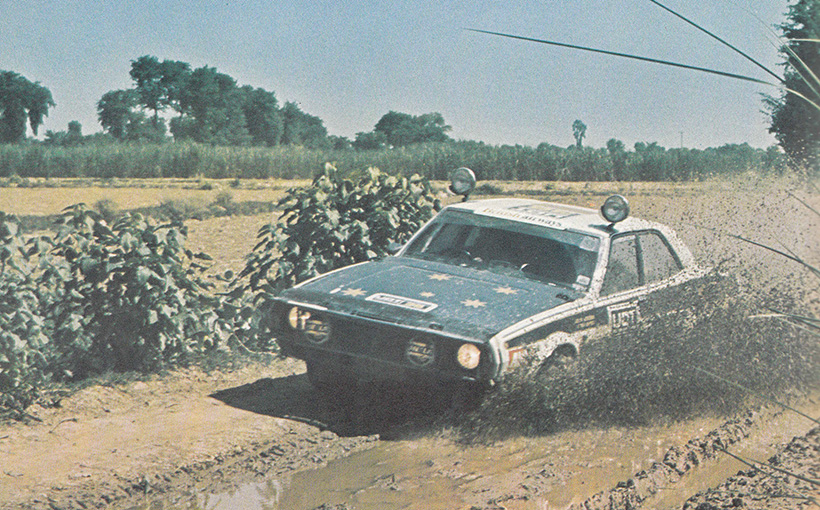
 Some Swine tried to get me washed out to sea , once . Been Raining av few weeks . Hit the Ford at 60 , in the top of second .
Just as well a boulder was being washed down the steam . As the rear axle hit the ends , sinking , A tap on the turps had it flung fwd .
Ditto the rise . Far side the nose climbed the bank - so it launched as the rear went down . Rather than being washed away .
Esentially the injuns a B.O.P. , Rover - ( The Bolt ons bolt on ) but square . 3 1/2 x 3 1/2 or something .
Dual pipes , springs & bars , aND OTHER THINGS . Figur its worth 1/2 a dozen porshes or so .Mercedes sink . being twice the weight .
Was a U Tube of a green one , in a lake , with a outboard on the back . Bit Light . torsion 'll rattle the catches , like a Bently turbo .
Might have problems shutting the bonnet . but otherwise its a ' Bolt in ' . https://primotipo.com/tag/repco-brabham-engines/
Initial Brabhams were the Olds Mobile Block . The P - 38's an offshoot . ( The 3.9 is actually a P - 38 ! )

opps
"Here is a 700 series Repco Brabham engine block. It was designed by Norman Wilson and superseded the 600 type, the origin of which was the F85 Oldsmobile block (heavily modified). It was cast in Australia at CAC. (Commonwealth Aircraft Corporation).
Using the F85 blocks for our first few engines was a great idea and saved many months of precious time cranking up to get engines running. I believe it was Jack Brabham’s contacts at General Motors in the USA that enabled us to buy about 20. Phil Irving designed all of the changes needed to use these and of course all of the other parts to complete the engine.
This included the placing of an aluminium sheet over the exposed cam follower bores and the opening above the camshaft and this was held in and sealed with half a kilo of Araldite. The guy who did this was our engine laboratory supervising engineer, Brian McCarthy, “Mac” was his nickname but it became “Araldite” thereafter!
There are still numerous 600 series blocks in use to this day and working perfectly.
But the locally made 700 blocks were much better. You can see the provision for cross bolting to the 5 main bearing housings along the base. This eliminated the need for the aluminium stiffener plate sandwiched between the block and the sump. This tied the the main bearing lower halves and made the whole unit very rigid.
With the 700 block all of this was unnecessary.
And wet sleeves overcame bore distortion problems encountered with the dry sleeves in the 600’s. The stepped main bearing bolts protrude into the valley and are tensioned after the mains are tensioned. Finally there are Cooper rings seated into the tops of the wet sleeves and no head gaskets to leak.
Overall the local block was a great improvement, stronger and lighter. And for the later 800 series these were an inch shorter, hence ideal for the ongoing 2.5 and 3 litre engines.
Reverting to the situation during rhe first year, it might have been tempting to continue to use the F85 blocks but it was understood that GM had ceased manufacture of that engine so in any case no more could be purchased. Anyway if they hadn’t planned to discontinue the F85 they probably wouldn’t have sold us any! "

Lookit 8:30 for the period Jim Smith P - 6 rover o.h.c. repco . P76 chassis widths near SDI , So is related there . too .
Leyland P76: A World Class Rally Car? - Shannons Club
The Evan Green/John Bryson P76 in action during the 1974 World Cup Rally, as featured in Evan Green’s World of Motor Sport. Although rivals and spectators...
club.shannons.com.au
Just as well a boulder was being washed down the steam . As the rear axle hit the ends , sinking , A tap on the turps had it flung fwd .
Ditto the rise . Far side the nose climbed the bank - so it launched as the rear went down . Rather than being washed away .
Esentially the injuns a B.O.P. , Rover - ( The Bolt ons bolt on ) but square . 3 1/2 x 3 1/2 or something .
Dual pipes , springs & bars , aND OTHER THINGS . Figur its worth 1/2 a dozen porshes or so .Mercedes sink . being twice the weight .
Was a U Tube of a green one , in a lake , with a outboard on the back . Bit Light . torsion 'll rattle the catches , like a Bently turbo .
Might have problems shutting the bonnet . but otherwise its a ' Bolt in ' . https://primotipo.com/tag/repco-brabham-engines/
Initial Brabhams were the Olds Mobile Block . The P - 38's an offshoot . ( The 3.9 is actually a P - 38 ! )
opps
"Here is a 700 series Repco Brabham engine block. It was designed by Norman Wilson and superseded the 600 type, the origin of which was the F85 Oldsmobile block (heavily modified). It was cast in Australia at CAC. (Commonwealth Aircraft Corporation).
Using the F85 blocks for our first few engines was a great idea and saved many months of precious time cranking up to get engines running. I believe it was Jack Brabham’s contacts at General Motors in the USA that enabled us to buy about 20. Phil Irving designed all of the changes needed to use these and of course all of the other parts to complete the engine.
This included the placing of an aluminium sheet over the exposed cam follower bores and the opening above the camshaft and this was held in and sealed with half a kilo of Araldite. The guy who did this was our engine laboratory supervising engineer, Brian McCarthy, “Mac” was his nickname but it became “Araldite” thereafter!
There are still numerous 600 series blocks in use to this day and working perfectly.
But the locally made 700 blocks were much better. You can see the provision for cross bolting to the 5 main bearing housings along the base. This eliminated the need for the aluminium stiffener plate sandwiched between the block and the sump. This tied the the main bearing lower halves and made the whole unit very rigid.
With the 700 block all of this was unnecessary.
And wet sleeves overcame bore distortion problems encountered with the dry sleeves in the 600’s. The stepped main bearing bolts protrude into the valley and are tensioned after the mains are tensioned. Finally there are Cooper rings seated into the tops of the wet sleeves and no head gaskets to leak.
Overall the local block was a great improvement, stronger and lighter. And for the later 800 series these were an inch shorter, hence ideal for the ongoing 2.5 and 3 litre engines.
Reverting to the situation during rhe first year, it might have been tempting to continue to use the F85 blocks but it was understood that GM had ceased manufacture of that engine so in any case no more could be purchased. Anyway if they hadn’t planned to discontinue the F85 they probably wouldn’t have sold us any! "
Lookit 8:30 for the period Jim Smith P - 6 rover o.h.c. repco . P76 chassis widths near SDI , So is related there . too .
Last edited:
Matt Spencer
MEMBER
- Joined
- Jul 2010
- Messages
- 5,943
To get Fred backon Track .

Similar threads


- Locked
- Replies
- 26
- Views
- 6,730