Hi there folks,
Thanks to a nice fellow forum member I was able to hop here and maybe am able to assist a little with some info:
1. I would refrain from closing a port with weld, because usually the thing that kills ya in the end are the wall thicknesses which remain the same even if filled up.
From what I remember that at least old blue and another Ducati had heavily welded (by rob north who to my knowledge lives by now in europe)and reshaped ports reshaped by Branch and Axtell.
2. I somehow got the info that also Ken canaga is on this forum, which did recalling one of my conversations with Michael Moore a heavily reangled port on his previous TT500 engine in a Roberts (frame?).
So I assume port welding knowledge should be here (not considering my ramblings

) in abundance.
3. I personally would not weld to close or put too much prolonged heat next to the seats as you might anneal that area and loose the crucial elongation strength needed for the seat inserts.
4. If I may: I personally would hog out the ports, with the gained room I would first weld/patch up the sides as one surely will penetrate during rough porting the sides (happens to me all the time on the ds1100 engines and on some Xt/TT/Sr's) than build up the port floors and raise em.
If one has to do it with Inserting a thick wall tube, I would consider a 60/30 preweld chamfer in order to reach all the needed areas quick and fast to not put too much heat in. For Inserting the tubes I would use 5356, while for welding/patching heavily inside I would use 4043 or even 4047 or if post heat treatment (T) I would go perhaps even with 4943.
5. As said most I would use an xxl length cup size 8-9 and a 3,2ish (for more heat resistance) grey or gold needle with about 15degr.
For patching I would go really low on frequency down to bout 40hz and good cleaning action and not too much amps I'm order to not penetrate too much, while for tube welding and fusing power I would go with very high frequency and medium cleaning action in order to basically intermittently weld/pulse or in my old school case pedal pumping the weld in stitch modus.
Of course one can still do it with an older square wave but on newer hi tech inverter machines the possibility of changing frequency and thus width and focused power of the arc is prize less, not even talking bout percentage of sinusoidal width or the advanced possibility of +/-amplitude strength like on the likes of big blue and big red inverters (Dynasty or aspect).
Preheating is a matter of welding style so I can not give info on that but I assume if not too much input during welding is used i would go up to 100-150 degr Celsius.
If one wants to cheat a little one can use a slightly bigger diameter cup, crank up the gas flow and prekink (with acet torch) the presharpened tungsten in order to reach hard to reach areas without going nutz.
(One of the tricks that the h&d always gladly like to forget to mention on their welding in port statements

ha ha ha.
And just because I read it, please no acetylen welding you make treatment wise talking marshmallows out of the crystal structure.
To my memory considering that unfortunately sandy Kosman (used to work there for a while in the early 90's) isn't in business anymore I think that there was in the south eastish San Jose area a very very capable tig-weldor that did a lot for flattrackers and dragster racers to my memory by the name "puccio"
In case there are more questions I'm very happy to help.
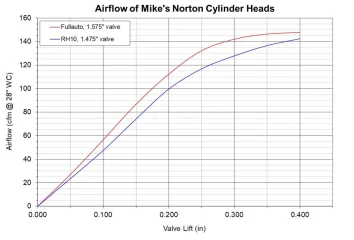
Btw I beg you clean the shit out of the ports maybe pregrinding and cleaning with weld prepping Al cleaner in order to get all the crap out of the pores becuz when I welded back then the Norton heads it was quite a messy job due to imho semi indecent foundry work ( oil binder sand?) While I never experienced anything comparable on A65 Heads (supposedly according to literature BSA had a state of the art foundry but what do I know.
Have a nice weekend and tanti saluti dall italia
Christian